
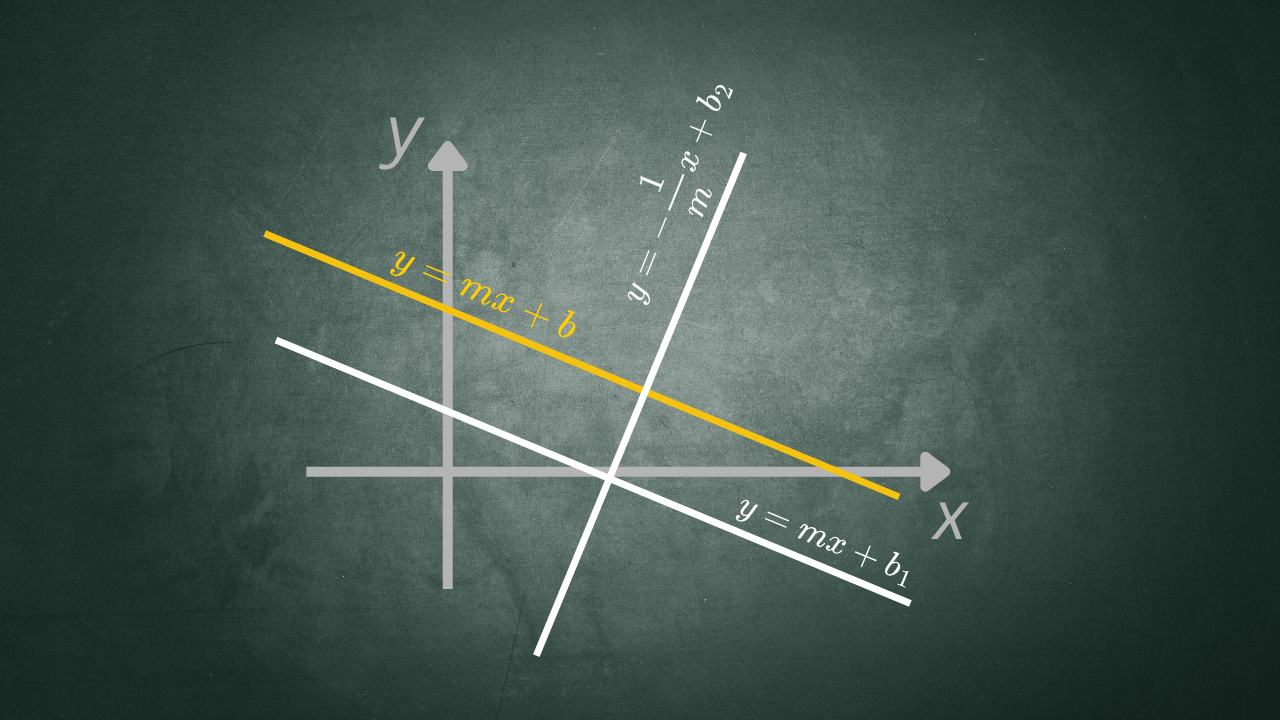
In the coordinate plane, the concept of parallel lines and perpendicular lines (or orthogonal lines) is closely tied to the slope. Understanding this relationship lets us quickly determine whether two lines meet at a right angle (perpendicular lines), never meet at all (parallel and distinct), or simply cross at some other angle (intersecting, but not perpendicular).
These properties aren’t just theoretical definitions: they’re a fundamental operational tool for solving analytic geometry problems. Many problems, in fact, come down to checking for parallelism, checking for perpendicularity, or finding the equation of a line with specific characteristics.
The study of parallel and perpendicular lines fits into the broader framework of the line in analytic geometry, of which it forms one of the most important conceptual cores.
Slope as a Criterion for Comparing Lines
Recall that a line, when it can be written in slope-intercept form, has equation:
The number \(m\) is the slope of the line, and it describes how steeply the line rises or falls relative to the \(x\)-axis. Geometrically, it tells us how much the line increases (or decreases) as \(x\) increases.
Two observations are fundamental here:
- lines with the same slope have the same inclination;
- lines with different slopes have different inclinations.
Comparing two lines in the coordinate plane therefore starts, first and foremost, with comparing their respective slopes.
Parallel Lines: Definition and Condition for Parallelism
Two lines in the coordinate plane are called parallel when they run in the same direction and share no common points. In other words, they never meet, while maintaining a constant distance from each other.
From an analytic standpoint, consider two lines written in slope-intercept form:
The two lines are parallel if and only if their slopes are equal:
The y-intercept \(b\) can differ between the two lines: it’s precisely this difference that keeps the two lines from coinciding. If \(b_1=b_2\) as well, then the lines are coincident — that is, they represent the same line.
Vertical Lines: A Special Case of Parallelism
Lines with equation:
are called vertical lines. They cannot be written in slope-intercept form \(y=mx+b\), and so they have no defined slope.
Geometrically, though, all vertical lines share the same direction. As a result:
- every vertical line is parallel to every other vertical line;
- a vertical line can never be parallel to a non-vertical line.
This special case is worth keeping in mind when working through exercises, since it falls outside the standard slope-based formulas.
Numerical Example: Checking Whether Two Lines Are Parallel
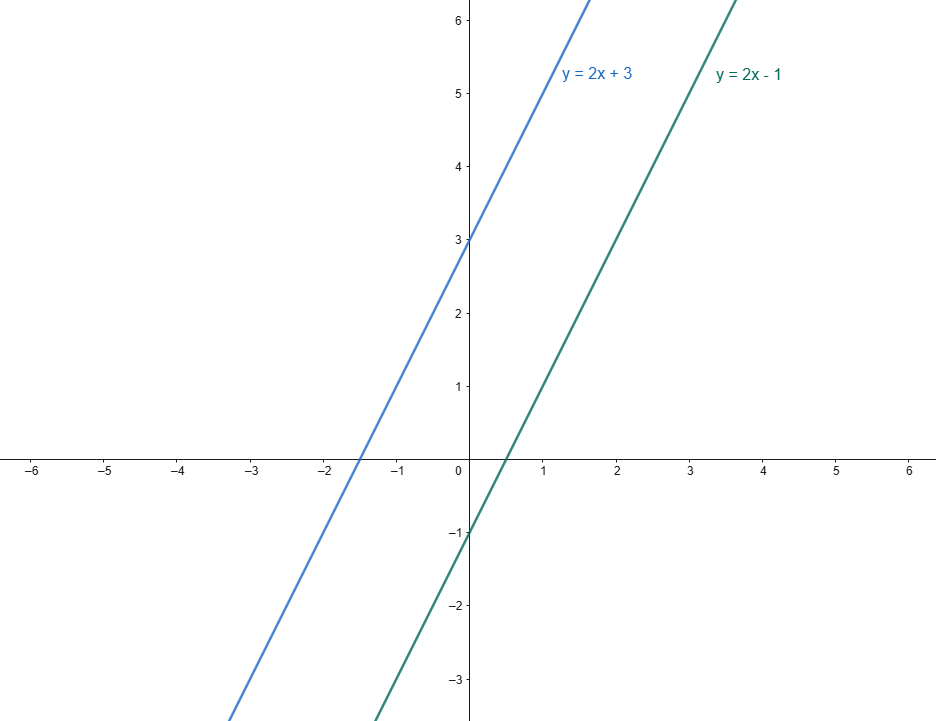
Consider the lines:
Their slopes are:
Since \(m_r=m_s\), the two lines share the same inclination. Their y-intercepts are different, so the lines don’t coincide (Fig. 1). We can conclude that lines \(r\) and \(s\) are parallel to each other.
This kind of check is typical of basic exercises: comparing the slopes is all it takes to get the answer.
Perpendicular Lines
The Geometric Meaning of Perpendicularity
Two lines are called perpendicular when they meet at a right angle — that is, an angle of 90°.
Geometrically, perpendicularity means one line is rotated a quarter turn relative to the other. In analytic geometry, this geometric idea translates into a very precise and remarkably simple relationship between the lines’ slopes, which we’ll work out in the next section.
Condition for Perpendicularity Between Two Lines
Two non-vertical lines are perpendicular if the product of their slopes equals −1:
In this case, the slopes are called negative reciprocals of each other. If a line has slope \(m\), the line perpendicular to it will have slope:
This rule lets us find the slope of the perpendicular line right away, with no need for a geometric construction.
Important Notes on Perpendicularity of Lines
A few special cases deserve close attention:
- If a line is horizontal, its slope is \(m=0\). The line perpendicular to it is vertical.
- If a line is vertical, it has no defined slope, but it is still perpendicular to every horizontal line.
In these cases the formula \(-1/m\) can’t be applied directly, so we have to reason geometrically instead.
Numerical Example: Perpendicular Lines in the Coordinate Plane
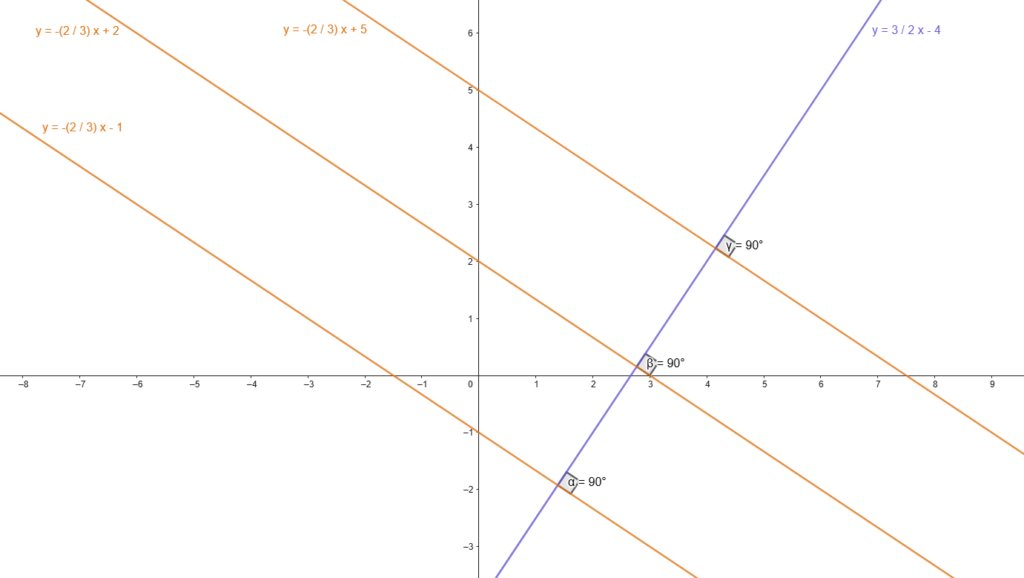
Let line \(r\) be given by:
Find the slope of the generic line \(s\) perpendicular to \(r\), and verify the perpendicularity condition between them.
The slope of line \(r\) is:
The slope of the perpendicular line will be its negative reciprocal:
Let’s check the perpendicularity condition:
The condition holds, so the two lines are perpendicular.
Lines Parallel or Perpendicular to a Given Line
If we know a line’s slope \(m\), we can immediately find the slope of a line that is:
- parallel to it, which will have the same slope \(m\);
- perpendicular to it, which will have slope \(-\frac{1}{m}\), provided the line isn’t vertical.
This observation is essential whenever we need to find the equation of a line through a given point that is parallel or perpendicular to another line. In many exercises, in fact, the first step is exactly this: identifying the correct slope.
Parallelism and perpendicularity are two of the core relationships explored in the complete guide on the line in analytic geometry.
Common Mistakes to Avoid with Parallel and Perpendicular Lines
One of the most frequent mistakes is confusing the negative reciprocal with the negative or with the reciprocal alone. The slope of the perpendicular line is not \(m\), nor \(-m\), nor \(\frac{1}{m}\). The correct expression is \(-\frac{1}{m}\).
So watch out — as we’ve seen, another typical mistake is forgetting the minus sign in the perpendicularity condition: the product of the slopes must equal exactly −1.
It’s also wrong to apply the formula \(m_1 \cdot m_2=-1\) to vertical lines, which have no defined slope.
Finally, having the same slope doesn’t automatically mean two lines coincide: we also need to compare their y-intercepts.
Conclusion
The slope is the key tool for quickly recognizing whether two lines are parallel or perpendicular in the coordinate plane. By simply comparing the values of \(m\), we can solve a wide range of analytic geometry exercises and problems both effectively and rigorously.
A solid grasp of these conditions is an essential foundation for tackling more advanced topics, such as studying the relative positions of lines and finding their equations in more complex situations.
Final Test
Test yourself: ten quick questions to check what you’ve taken away from this article. Some ask you to recall the rules directly, others ask you to apply them to a new pair of lines. Take your time and reason through each one before answering.
Cite this resource
"No shortcuts went into this one — just careful writing and checking. If it helped you, consider sharing it or citing it as a source."
Citation
HTML link to copy