
Finding the tangent line to a parabola at a given point is one of the core topics of analytic geometry, and it is an essential step toward understanding the conic sections.
In particular, this article shows how to determine the equation of a line that is tangent to a given parabola and that also satisfies certain conditions, such as passing through a point outside the parabola, passing through a point on the parabola, or having a prescribed slope (or other constraints).
Tangent Lines to a Parabola from an External Point: Calculation Method
Setting Up the Line-Parabola System
The tangency condition between a line and a parabola with a vertical axis can be reduced to solving the following system, formed by a quadratic and a linear equation:
\[\begin{cases} y=ax^2+bx+c \\ y-y_0=m(x-x_0) \end{cases} \tag{1}\]
where
\[y=ax^2+bx+c \quad (a\neq0)\]
is the equation of a general parabola with a vertical axis, while
\[y-y_0=m(x-x_0)\]
represents a general non-vertical line passing through the point with coordinates \(P_0(x_0,y_0)\).
Tangency Condition and Zero Discriminant
The tangency between a parabola and a line is described by the analytic condition of a zero discriminant (\(\Delta=0\)) applied to system (1). In particular, eliminating \(y\) from the system, for instance, gives:
\[ax^2+bx+c=m(x-x_0)+y_0\]
and collecting terms in \(x\):
\[ax^2+(b-m)x+c+mx_0-y_0=0 \tag{2}\]
Applying the tangency condition (\(\Delta=0\)) to equation (2) gives:
\[\Delta=(b-m)^2-4a(c+mx_0-y_0)=0 \tag{3}\]
which, solved for \(m\), gives the slopes of the tangent lines, when they exist.
Determining the Tangent Lines
The values of \(m\) obtained by solving equation (3) immediately give the equations of the tangent lines in the form:
\[y-y_0=m_1(x-x_0)\]
\[y-y_0=m_2(x-x_0)\]
Example
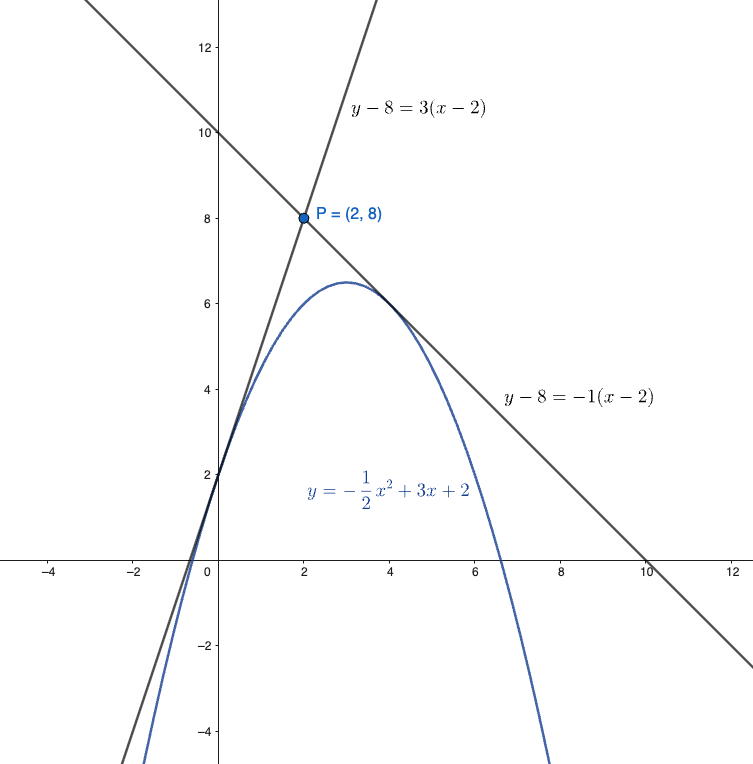
Find the equations of the tangent lines to the parabola \(y=-\frac{1}{2}x^2+3x+2\) that pass through the point \(P(2,8)\).
SOLUTION
Starting from system (1) gives:
\[\begin{cases} y=-\frac{1}{2}x^2+3x+2 \\ y-8=m(x-2) \end{cases}\]
Eliminating \(y\) between the equations gives:
\[-\frac{1}{2}x^2+3x+2=m(x-2)+8\]
Next, both sides are multiplied by \(-2\) and the terms are rearranged:
\[x^2-6x-4=-2m(x-2)-16\]
\[x^2-6x-4+2m(x-2)+16=0\]
\[x^2+(2m-6)x-4m+12=0\]
The discriminant of the last equation is then computed and set equal to zero (tangency condition):
\[\Delta=0 \Rightarrow (2m-6)^2-4(-4m+12)=0\]
which simplifies to:
\[4m^2+36-24m+16m-48=0\]
\[4m^2-8m-12=0\]
Dividing by 4:
\[m^2-2m-3=0\]
which, solved, gives:
\[m_{1,2}=\frac{2\pm\sqrt{16}}{2}\]
and therefore
\[m_1=3\]
\[m_2=-1\]
Substituting the values of \(m\) found gives, finally, the equations of the lines tangent to the parabola:
\[y-8=3(x-2)\]
\[y-8=-1(x-2)\]
Fig.1 shows the tangency between the lines thus obtained and the parabola.
Note: it is not necessary to compute the points of tangency between the lines and the parabola in order to solve the exercise; however, they could be found by solving the system formed by the parabola and each of the lines found, separately.
Tangent Line to a Parabola at a Point on the Parabola
Tangent Line Formula
When the given point lies on the parabola, there is exactly one tangent line passing through that point, and its equation can be determined directly by means of the tangent line formula:
\[y=(2ax_0+b)x-ax_0^2+c \tag{4}\]
where \(a\), \(b\), and \(c\) are the coefficients of the parabola \(y=ax^2+bx+c\), and \(x_0\) is the x-coordinate of the point of tangency.
Applying the Tangent Line Formula
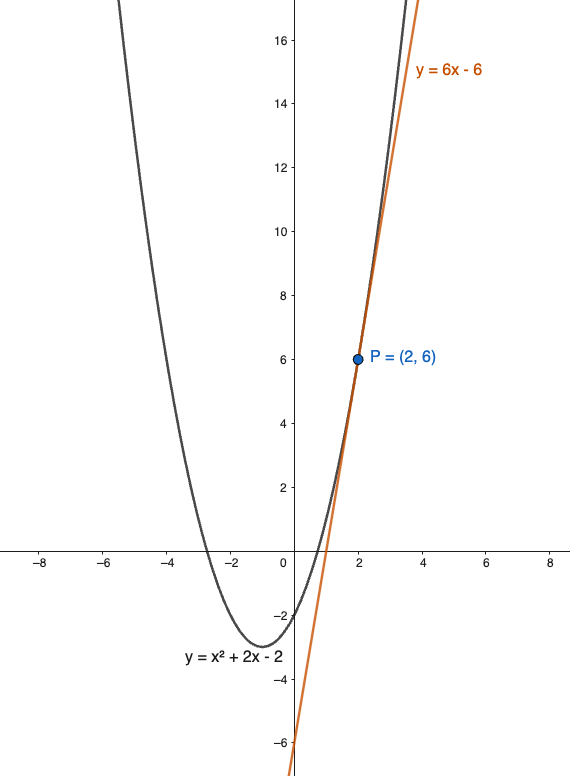
Find the equation of the line tangent to the parabola \(y=x^2+2x-2\) at its point with x-coordinate \(x_0=2\).
SOLUTION
Since the point lies on the parabola, formula (4) can be applied directly, noting that:
\[a=1, \; b=2, \; c=-2\]
\[x_0=2\]
Substituting these values into (4) and simplifying gives:
\[y=6x-6\]
which is the equation of the required line.
To find the y-coordinate of the point of tangency as well, it is enough to write:
\[y(x_0)=6x_0-6=6(2)-6=6\]
The graph in Fig.2 shows the line tangent to the parabola at its point with x-coordinate \(x_0=2\).
IMPORTANT NOTE: The tangent line formula should not be memorized without understanding where it comes from. It is obtained by applying the general method based on the system formed by the parabola and the line, and imposing the tangency condition \(\Delta=0\).
The same result obtained with the tangent line formula (4) can in fact be obtained from the system:
\[\begin{cases} y=ax^2+bx+c \\ y-y_0=m(x-x_0) \end{cases}\]
with
\[y_0=ax_0^2+bx_0+c\]
by imposing the condition \(\Delta=0\) on the resulting equation and thus solving for the slope \(m\). Finally, to obtain the equation of the tangent line, it is enough to substitute the value of \(m\) found into the equation of the line \(y-y_0=m(x-x_0)\).
APPLICATION AND COMPARISON WITH THE PREVIOUSLY WORKED EXAMPLE
Consider the system formed by the parabola and the general line passing through \(P(x_0,y_0)\), with \(x_0=2\):
\[\begin{cases} y=x^2+2x-2 \\ y-y_0=m(x-x_0) \end{cases}\]
Since the point also lies on the parabola, it follows that
\[y_0=y(2)=2^2+2(2)-2=6\]
and the system can therefore be rewritten as:
\[\begin{cases} y=x^2+2x-2 \\ y-6=m(x-2) \end{cases}\]
Eliminating \(y\) and arranging the resulting equation in terms of \(x\) gives:
\[x^2+2x-2=m(x-2)+6\]
\[x^2+(2-m)x+2m-8=0\]
Imposing the tangency condition (\(\Delta=0\)) on the last equation gives:
\[(2-m)^2-4(2m-8)=0\]
from which, after simplifying:
\[m^2-12m+36=0 \Rightarrow (m-6)^2=0 \Rightarrow m=6\]
Once the slope of the tangent line has been found, its value can be substituted into the point-slope equation to obtain the equation of the line:
\[y-6=6(x-2)\]
from which, after rearranging:
\[y=6x-6\]
which coincides with the result of the previously worked example, where the tangent line formula was applied directly.
Remark. The tangent line formula is a computational shortcut, but it derives from the general method based on the intersection of the line and the parabola and on the tangency condition \(\Delta=0\).
Parametric Problems
Problem 1
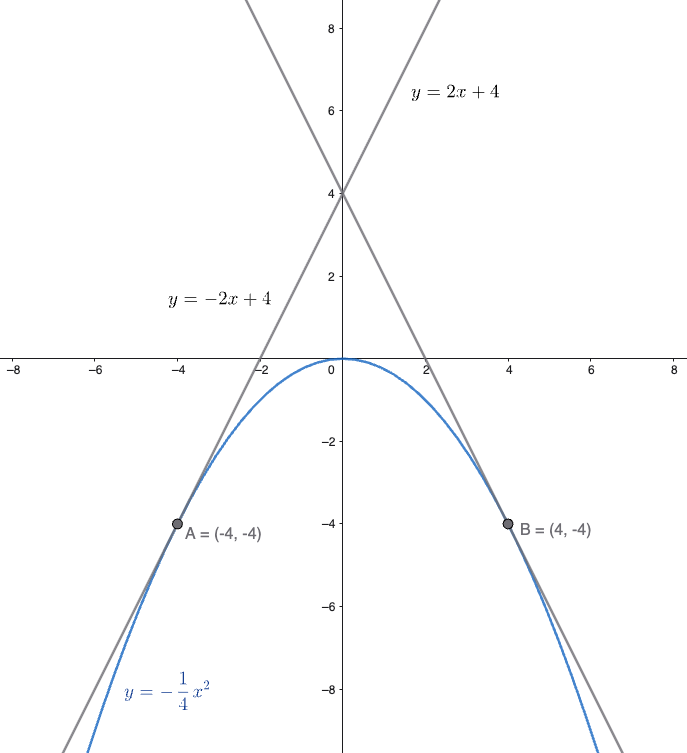
Find all values of the parameter \(k\) for which the line \(y=kx+4\) is tangent to the parabola \(y=-\frac{1}{4}x^2\).
SOLUTION
Setting up the system formed by the two equations gives:
\[\begin{cases} y=-\frac{1}{4}x^2 \\ y=kx+4 \end{cases}\]
from which, eliminating \(y\):
\[-\frac{1}{4}x^2=kx+4\]
\[\frac{1}{4}x^2+kx+4=0\]
\[x^2+4kx+16=0\]
Imposing the tangency condition \(\Delta=0\) on the last equation gives:
\[16k^2-4(16)=0\]
from which
\[k_{1,2}=\pm2\]
The equations of the tangent lines are therefore:
\[y=2x+4\]
and
\[y=-2x+4\]
Problem 2 (with Interactive Graph)
Find all values of the parameter \(k\) for which the parabola \(y=x^2+kx+1\) is tangent to the line \(y=2x\).
SOLUTION
Unlike the previous example, here the parameter \(k\) does not appear in the line but directly in the equation of the parabola. The procedure remains the same (a system formed by the two curves and the tangency condition \(\Delta=0\)), but the parameter now appears in a different place within the discriminant.
Setting up the system formed by the parabola and the line gives:
\[\begin{cases} y=x^2+kx+1 \\ y=2x \end{cases}\]
Eliminating \(y\) between the two equations gives:
\[x^2+kx+1=2x\]
and arranging the terms in \(x\):
\[x^2+(k-2)x+1=0\]
Next, the tangency condition (\(\Delta=0\)) is imposed on the last equation obtained:
\[(k-2)^2-4=0\]
from which
\[k_1=4 \qquad k_2=0\]
There are therefore two distinct values of the parameter \(k\) for which the parabola is tangent to the given line.
Verification of the points of tangency. Substituting the two values of \(k\) separately into the resulting equation shows that a zero discriminant does indeed correspond to a single real solution (which, in each case, coincides with the x-coordinate of the point of tangency).
For \(k_1=4\):
\[x^2+2x+1=0 \Rightarrow (x+1)^2=0 \Rightarrow x=-1\]
For \(k_2=0\):
\[x^2-2x+1=0 \Rightarrow (x-1)^2=0 \Rightarrow x=1\]
The interactive graph below illustrates the relative position of the line and the parabola as the parameter \(k\) varies, using the slider and the buttons.
Common Errors
When determining the tangent line to a parabola, it is easy to make certain errors in setting up the problem or in the calculations. The most frequent ones are listed below.
Confusing a secant line with a tangent line. A non-vertical line is tangent to the parabola if the system formed by the two equations has exactly one real solution of multiplicity two. Analytically, this is equivalent to imposing the condition of a zero discriminant (\(\Delta=0\)).
Using an unsuitable form of the equation of the line. When the line must pass through a given point, it is advisable to use the equation in point-slope form
\[y-y_0=m(x-x_0),\]
since it allows the slope of the tangent line to be determined directly.
Errors in expanding the discriminant. Most errors arise from the signs when expanding
\[\Delta=(b-m)^2-4a(c+mx_0-y_0).\]
It is advisable to expand the square and the product separately, avoiding steps that are too quick.
Applying the tangent line formula when the point does not lie on the parabola. The tangent line formula is valid only when the point of tangency already lies on the parabola. If the point is external, the general method based on the system and on the condition \(\Delta=0\) must be used.
Forgetting to check the data of the problem. Before starting the calculations, it is always advisable to check whether or not the given point lies on the parabola, since the solution method depends on this check.
Conclusions
Determining the tangent line to a parabola is one of the most important applications of analytic geometry. This article has shown how to approach the problem in two fundamental situations.
When the tangent line must pass through a point outside the parabola, the general method consists of setting up the system formed by the equation of the parabola and that of the line, and imposing the tangency condition \(\Delta=0\), which gives the slopes of the required lines.
When the point already lies on the parabola, the tangent line formula can be used, which gives the equation of the tangent line immediately. As shown in the article, this formula is not independent of the general method, but is a practical simplification of it.
Mastery of these procedures is also the foundation for tackling more advanced problems on the conic sections, such as the study of the relative position of a line and a parabola, parametric problems, and the various applications of analytic geometry.
Final Test
The following short quiz of 10 questions checks comprehension of the topic of tangent lines to a parabola.
Cite this resource
"No shortcuts went into this one — just careful writing and checking. If it helped you, consider sharing it or citing it as a source."
Citation
HTML link to copy