
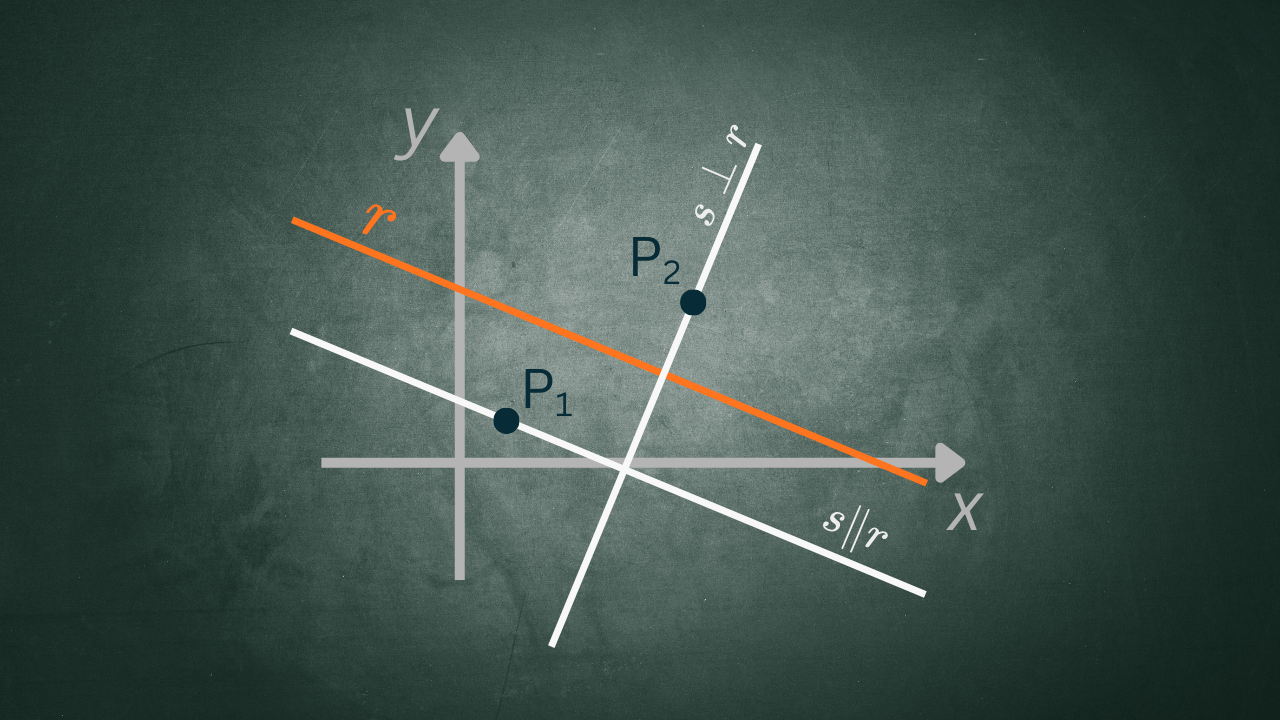
In analytic geometry, one of the most common tasks is finding the equation of a line that satisfies two conditions at once: it must pass through a given point, and it must be either parallel or perpendicular to a given line.
This type of problem sits at the center of the study of lines in the coordinate plane, and it draws a direct connection between the geometric properties of lines and how those properties show up in their equations.
In this article, we will work through the procedure for finding the equation of a line through a known point that is also parallel or perpendicular to a given line. We will cover the full process from start to finish, laying out the logical steps, the formulas involved, and the most common mistakes to avoid.
The Role of Slope in the Study of Lines
Every non-vertical line in the coordinate plane can be written in slope-intercept form as:
where:
- \(m\) is the slope, which tells us how steeply the line rises or falls relative to the \(x\)-axis;
- \(b\) is the y-intercept, the point where the line crosses the \(y\)-axis.
The slope is the key tool that lets us compare two lines and determine whether they are parallel, perpendicular, or simply intersecting at some other angle.
Parallelism and perpendicularity, as it turns out, both translate into precise conditions on the slopes of the two lines involved.
Line Through a Point, Parallel to a Given Line
The Geometric Meaning of Parallelism
Two lines are called parallel if they point in the same direction and never meet. Analytically, this means they share the same slope, while having different y-intercepts.
If a line has equation:
then every line parallel to it will have the same slope \(m\).
Setting Up the Problem
Suppose we know:
- a line \(r\);
- a point \(P(x_0,y_0)\).
We want to find the equation of the line \(s\) that:
- passes through the point \(P\);
- is parallel to the line \(r\).
Step 1: Find the Slope
If the given line is written in slope-intercept form, the slope \(m\) can be read directly from (1).
If, instead, the line is given in the general form:
the slope is obtained as:
This value will be exactly the same for the parallel line we’re looking for.
Step 2: Use the Point-Slope Form
The most convenient way to write the equation of a line through a given point is the point-slope form:
This equation describes all and only the lines that:
- have slope \(m\);
- pass through the point \(P(x_0,y_0)\).
Worked Example: A Line Parallel to a Given Line
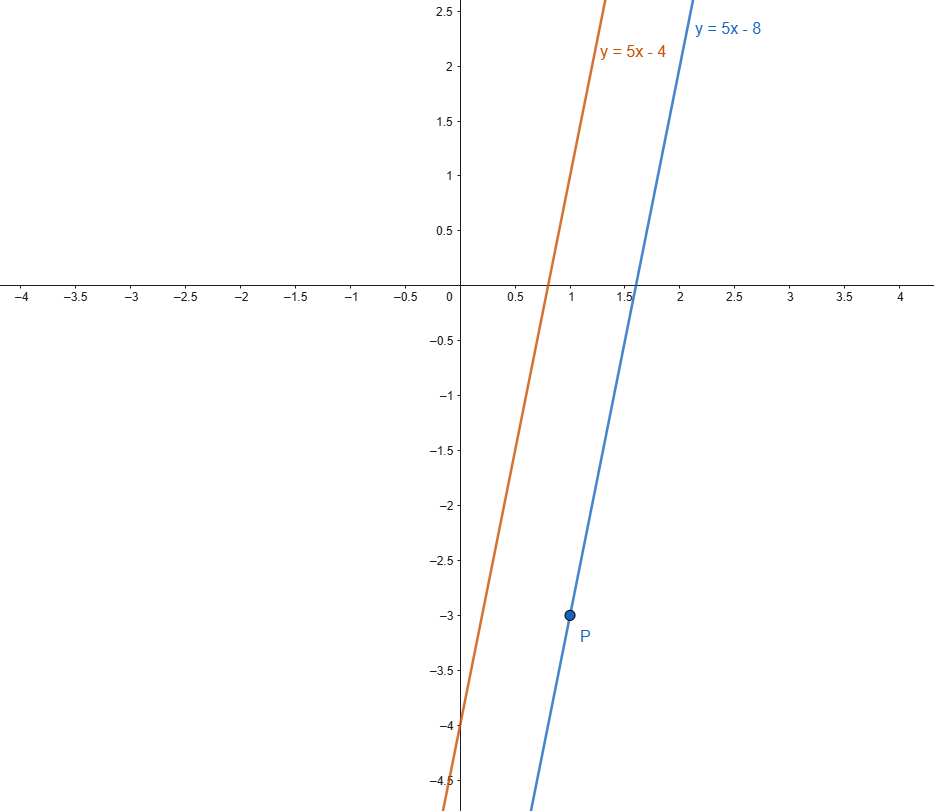
Let the line be:
and the point:
Find the equation of the line parallel to \(r\) that passes through \(P\).
SOLUTION
The slope of line \(r\) is \(m=5\).
We also know the coordinates of point \(P\):
At this point, let’s write the point-slope form in its general shape:
and substitute the known values in, which gives us:
Working through the algebra, we finally get:
This last equation is the line we were looking for.
Line Through a Point, Perpendicular to a Given Line
The Geometric Meaning of Perpendicularity
Two lines are perpendicular to each other if they meet and form four right angles (90° each).
In analytic geometry, as we’ll see next, this condition (perpendicularity) translates into a relationship between the slopes of two lines that is both very precise and, at the same time, remarkably simple.
The Algebraic Condition for Perpendicularity
Two non-vertical lines \(r_1\) and \(r_2\) are perpendicular to each other if the following relationship holds:
In other words, the slope of a line perpendicular to a given line (with slope \(m\)) is the opposite reciprocal of \(m\).
So, if a line has slope \(m\), the line perpendicular to it will have slope:
Special Cases: Vertical and Horizontal Lines
- If a line is horizontal (\(m=0\)), the line perpendicular to it is vertical.
- If a line is vertical, it has no defined slope, and it is perpendicular to every horizontal line.
Procedure for Finding the Equation of a Line Perpendicular to a Given Line and Passing Through a Point P
Given:
- a line \(r\);
- a point \(P(x_0,y_0)\).
The procedure for finding the equation of the line perpendicular to \(r\) and passing through \(P\) can be summed up in the following steps:
- find the slope \(m\) of the given line;
- calculate the perpendicular slope \(m_ \perp\);
- write the point-slope equation of the line we’re looking for.
Worked Example: A Line Perpendicular to a Given Line and Through a Point P
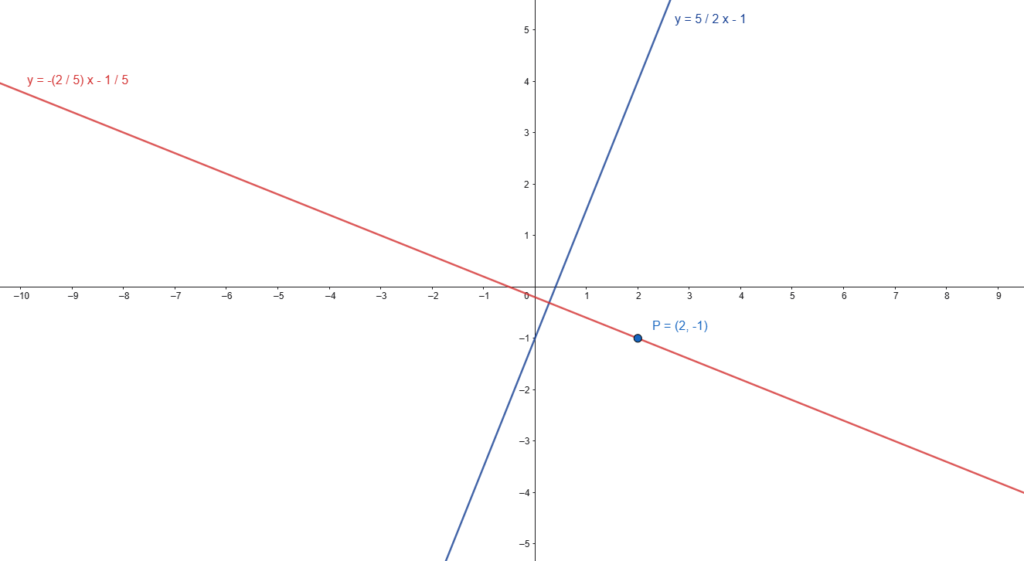
Let the line be:
and the point:
Find the equation of the line \(s\) perpendicular to \(r\) and passing through the point \(P\).
SOLUTION
The slope of the given line is:
The slope of the perpendicular line is:
Let’s write the point-slope equation in its general form:
At this point, we can substitute into this equation the value of the generic slope with that of the line orthogonal to \(r\):
while at the same time requiring that the line pass through the point \(P\) with coordinates:
Making these substitutions, we get:
and then, continuing with the algebra:
This last equation represents the line we were looking for.
Parallel Lines vs. Perpendicular Lines
To sum up, given a line with slope \(m\):
- a line parallel to the given line has the same slope \(m\);
- a line perpendicular to the given line has a slope that is the opposite reciprocal of the other, namely \(-\frac{1}{m}\).
In both cases, the condition that the line pass through the known point \(P\) is what lets us pin down the y-intercept, through the point-slope equation.
Connections to Other Problems on Lines
This type of exercise is closely connected to:
- the equation of a line through two points;
- families of lines;
- conditions for parallelism and perpendicularity between lines.
This problem draws together several concepts covered in more depth in the complete guide on the line in analytic geometry.
Common Mistakes to Avoid
When working through exercises on parallelism or perpendicularity between lines through a point with known coordinates, it’s easy to trip up on a few recurring mistakes. Let’s go through the most common ones:
- Confusing the reciprocal with the opposite
The slope of a perpendicular line is not \(-m\), but rather:
- Applying the perpendicularity condition to vertical lines
Vertical lines have no defined slope, so the formulas above simply don’t apply to them.
- Forgetting the negative sign
This is one of the most frequent slip-ups, and it immediately produces a line that isn’t actually perpendicular.
- Concluding that two lines coincide just because they share the same slope
Two lines with the same slope are parallel, but they only coincide if they also share the same y-intercept.
Conclusion
Finding the equation of a line through a point, parallel (or perpendicular) to a given line, is a fundamental step in the study of analytic geometry.
In this context, the slope is the true link between the geometric picture of a line and its algebraic representation. Once its role is understood, these exercises become mechanical and easy to work through.
This skill is essential for tackling more advanced problems with confidence, and for building real mastery of the study of lines in the coordinate plane.
Final Test
Before moving on, this short test checks how well the parallel and perpendicular conditions have been absorbed. The ten questions mix direct calculations with a few that require applying the reasoning in a slightly different way than the worked examples above.
Cite this resource
"No shortcuts went into this one — just careful writing and checking. If it helped you, consider sharing it or citing it as a source."
Citation
HTML link to copy