
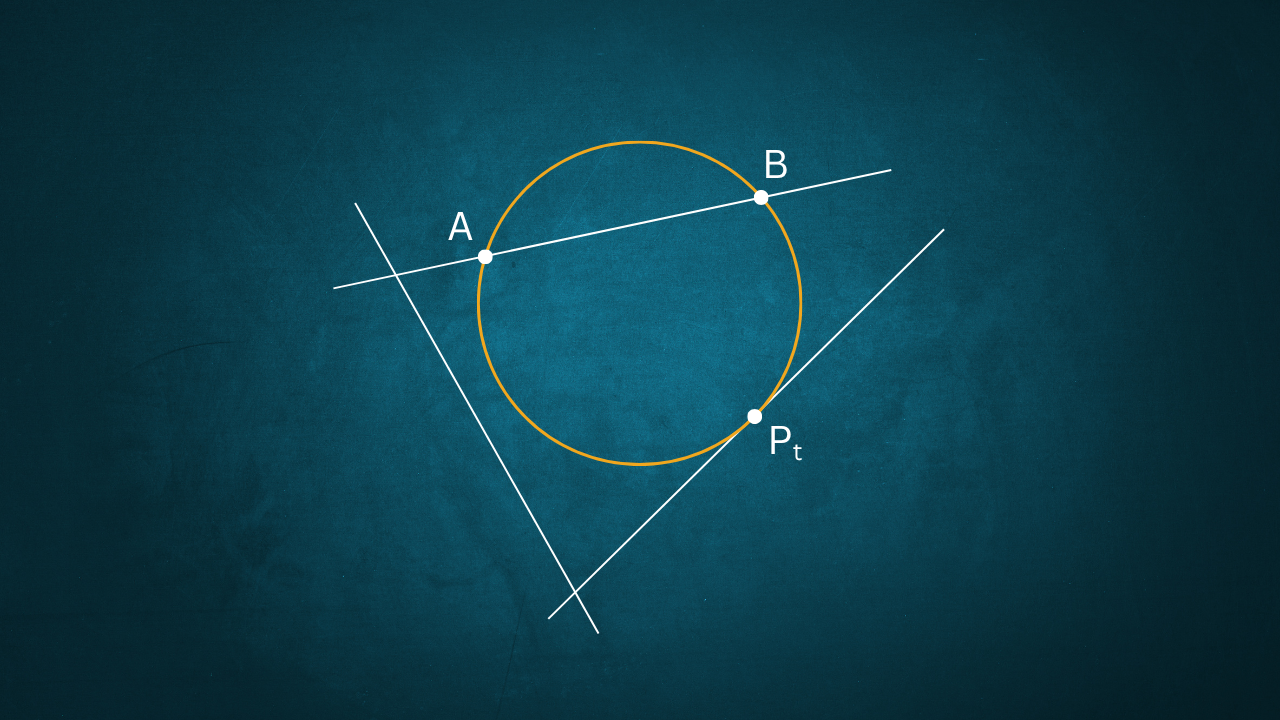
Determining the relative position of a line and a circle is an important problem in analytic geometry.
It is fairly intuitive that the relative position of a line and a circle depends essentially on the number of points they have in common in the Cartesian plane.
In particular, three fundamental cases arise:
- Secant lines: intersect the circle at two distinct points.
- Tangent lines: the intersection points coincide at a single point (there are, in effect, two coinciding points).
- External lines: share no points with the circle.
For the full picture of how circles behave in the coordinate plane — center, radius, tangents, pencils, and more — see the complete guide on the circle.
Algebraic Method for Determining the Relative Position of a Line and a Circle: The Three Cases
To determine the relative position of a line and a circle, and therefore find their intersection points, it is enough to solve the system formed by their two equations.
In particular, consider the system formed by the equations
where
\[x^2+y^2+D x+E y+F=0\tag{2}\]
represents the equation of the circle, and
\[ax+by+c=0\tag{3}\]
represents the equation of the line, three distinct cases can be identified, as anticipated: the line can be secant, tangent, or external to the given circle.
Each of these cases corresponds to a precise algebraic condition that makes it possible to determine whether the line is secant, tangent, or external to the circle.
SECANT LINE TO THE CIRCLE
For the case of a secant line, there must exist two distinct points \(A(x_1,y_1)\) and \(B(x_2,y_2)\) representing the intersection points between the circle and the line. Consequently, in this case the problem reduces to solving system (1), and the algebraic condition that results is a positive discriminant. In formulas:
\[\Delta>0\]
⚠️ An important clarification to avoid mistakes: \(\Delta\) refers to the resulting equation obtained from system (1) after eliminating one unknown. A frequent error is to take the coefficients \(a\), \(b\), and \(c\) of the line and compute \(\Delta=b^2-4ac\) directly from them. This leads to a conceptual mistake, since it amounts to applying the concept of a discriminant to a first-degree equation. A common error!
TANGENT LINE TO THE CIRCLE
In the case of a tangent line, points \(A(x_1,y_1)\) and \(B(x_2,y_2)\) coincide, so that
\[x_1=x_2\]
\[y_1=y_2\]
Here the discriminant is instead zero, giving
\[\Delta=0\]
in the equation resulting from system (1). This resulting equation can be obtained simply by substituting the equation of the line (3) into the equation of the circle (2) in system (1), after solving one of the two variables explicitly.
LINE EXTERNAL TO THE CIRCLE
When the line and the circle share no common intersection point, system (1) has no solution. In this case, it must necessarily follow that
\[\Delta<0\]
In this last case, we say the line is external to the circle.
Below, we work through a series of numerical examples to clarify each of these three cases in more detail.
Example of a Secant Line (Δ > 0)
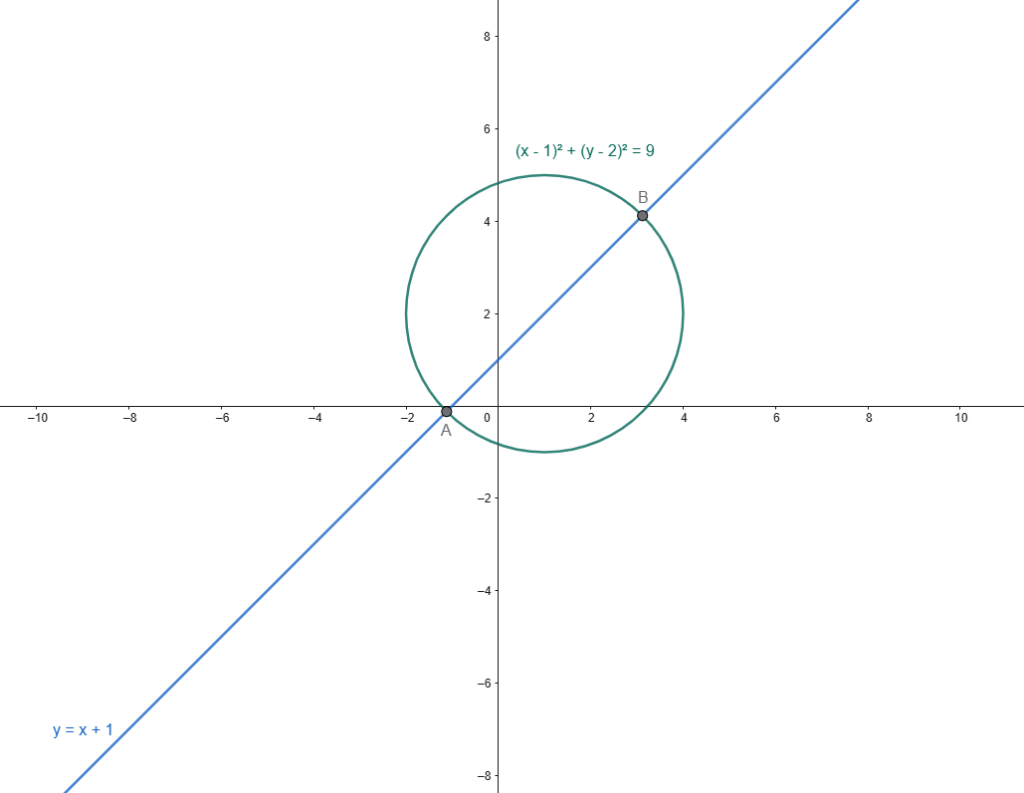
If the discriminant is positive, system (1) has two distinct real solutions: the line intersects the circle at two distinct points and is therefore secant to it.
Given the circle:
\[(x-1)^2 + (y-2)^2 = 9\]
and the line:
\[y=x+1\]
determine the relative position of the line and the circle.
SOLUTION
From the two equations, we obtain the following system:
To solve it, we substitute the second equation into the first, obtaining:
\[(x-1)^2+(x+1-2)^2=9\]
Simplifying and expanding the squares gives:
\[(x-1)^2+(x-1)^2=9\]
\[2(x-1)^2=9\]
\[2x^2-4x+2=9\]
\[2x^2-4x-7=0\]
At this point, we compute the discriminant of the resulting equation; we get:
\[\Delta=(-4)^2-4(2)(-7)=72\]
from which we immediately obtain the x-coordinates of the intersection points:
\[x_{1,2}=\frac{-(-4)\pm\sqrt{72}}{2\cdot2}=\frac{2\pm3\sqrt{2}}{2}\]
We obtain two distinct real solutions, so the line is secant to the circle (Fig. 1).
To find the y-coordinates of the points, we can use either equation (for example, the line) and substitute the values of \(x_{1,2}\):
\[y_1=x_1+1=\frac{2+3\sqrt{2}}{2}+1\]
\[y_2=x_2+1=\frac{2-3\sqrt{2}}{2}+1\]
Example of a Tangent Line (Δ = 0)
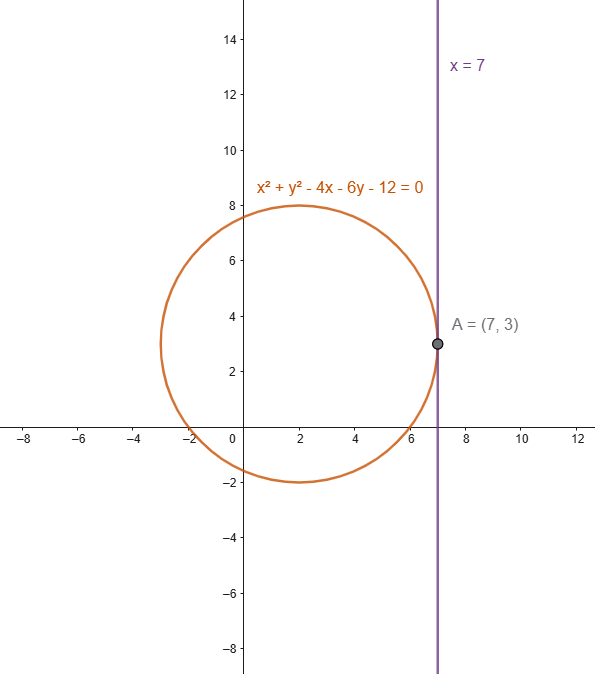
If the discriminant of the equation resulting from system (1) is zero, we obtain two coinciding real solutions: in this case, the line has exactly one point in common with the circle and is tangent to it at that point.
Given the circle:
\[x^2+y^2-4x-6y-12=0\]
and the vertical line with equation:
\[x=7\]
determine the relative position of the line and the circle.
SOLUTION
Setting up the system from the given equations, we get:
which can be solved simply by substituting the second equation into the first, giving:
\[7^2+y^2-4(7)-6y-12=0\]
Simplifying, we get
\[y^2-6y+9=0\]
which can also be written as
\[(y-3)^2=0\]
whose solution is the pair of coinciding roots
\[y_{1,2}=3\]
Having obtained two coinciding solutions, we conclude that the line \(x=7\) is tangent to the circle at the single point \(A(7,3)\) (Fig. 2).
Example of an External Line (Δ < 0)
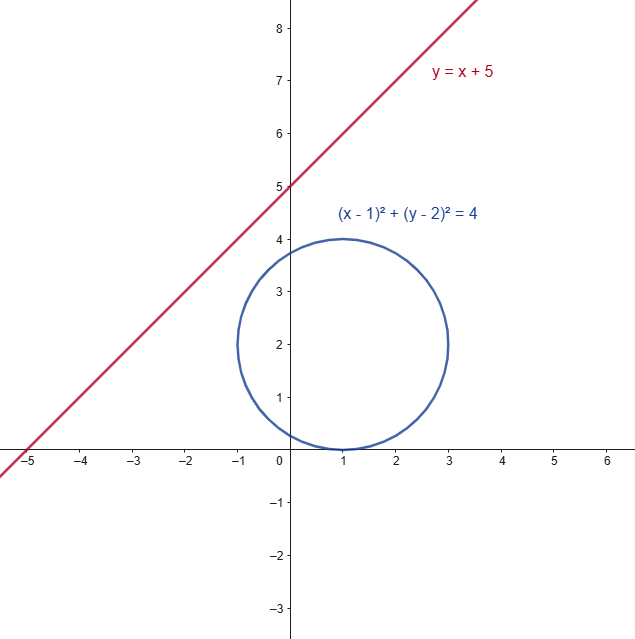
If the discriminant is negative, system (1) has no real solutions: the line shares no points with the circle and is external to it.
Given the circle with equation
\[(x-1)^2 + (y-2)^2 = 4\]
and the line
\[y=x+5\]
determine the relative position of the line and the given circle.
SOLUTION
Setting up the system from the given equations, we get:
Substituting the second equation into the first, as before, we obtain:
\[(x-1)^2+(x+5-2)^2=4\]
so, expanding the squares and simplifying,
\[x^2+1-2x+x^2+9+6x=4\]
\[2x^2+4x+6=0\]
Now we divide both sides by 2 to simplify further,
\[x^2+2x+3=0\]
The discriminant of this last equation is:
\[\Delta=2^2-4(1)(3)=-8<0\]
Since the discriminant is negative, we conclude that no real roots exist for system (1), and consequently no intersection point exists between the line and the circle. For this reason, the line must necessarily be external to the circle (Fig. 3).
Example with Parameter \(k\)
Given the circle with equation
\[x^2+y^2-10y+16=0\]
and the line with equation
\[y=kx+1\]
determine the values of the parameter \(k\) for which the line is secant, tangent, or external to the circle.
SOLUTION
Proceeding as in the previous cases, we substitute the equation of the line into the equation of the circle, obtaining:
\[x^2+(kx+1)^2-10(kx+1)+16=0\]
Substituting:
\[x^2 + k^2x^2 + 2kx + 1-10kx-10 + 16 = 0\]
\[(1 + k^2)x^2 + (2k-10k)x + (1-10 + 16) = 0\]
\[(1 + k^2)x^2-8kx + 7 = 0\]
Now we compute the discriminant:
\[\Delta = (-8k)^2-4(1 + k^2)\cdot 7\]
\[\Delta = 64k^2-28(1 + k^2)\]
\[\Delta = 64k^2-28-28k^2\]
\[\Delta = 36k^2-28\]
We have thus arrived at the discriminant of the equation resulting from system (1), expressed as a function of the parameter \(k\). It is therefore necessary to study the sign of the discriminant and determine the values of \(k\) for which \(\Delta\) is positive (secant line), negative (external line), or zero (tangent line).
Recalling the procedure for solving second-degree inequalities, we find that:
\[\Delta=36k^2-28=4(9k^2-7)\]
which is positive when
\[9k^2-7>0\]
that is, for
\[k<-\frac{\sqrt{7}}{3}\quad \text{or}\quad k>\frac{\sqrt{7}}{3}\]
For these values of \(k\), the line is secant to the circle.
Finally, for
\[k=\pm\frac{\sqrt{7}}{3}\]
the line is tangent to the circle, since for these values of \(k\) the discriminant vanishes,
while for
\[-\frac{\sqrt{7}}{3}<k<\frac{\sqrt{7}}{3}\]
the discriminant is negative. In this last case, there are no intersections between the circle and the line, and the line is external to the circle.
Line-Circle Position with Variable Parameter k (Interactive Graph)
Fixed circle x² + y² − 10y + 16 = 0. Drag the slider to vary k in the line y = kx + 1 and watch the relative position change.
An Alternative Method: Point-to-Line Distance
The algebraic method based on the discriminant is not the only way to determine the relative position of a line and a circle. A very effective alternative relies on the distance from the center of the circle to the line.
The idea is as follows:
- consider the center of the circle \(C(x_0,y_0)\)
- compute the distance from point C to the line
- compare this distance with the radius \(r\)
Three cases arise:
- distance > \(r\) → external line
- distance = \(r\) → tangent line
- distance < \(r\) → secant line
This alternative method is often faster and more intuitive, since it relies on the concept of distance, allowing for a more immediate check of the result.
Conclusions
The relative position of a line and a circle is a central concept in analytic geometry, resting on a simple yet powerful criterion: the number of shared points.
Through the algebraic method, the classification reduces to studying the discriminant of a second-degree equation:
- Δ > 0 → the line is secant
- Δ = 0 → the line is tangent
- Δ < 0 → the line is external
Note: This approach makes it possible to determine the relative position rigorously, without relying on a graph, and is especially useful in exercises.
At the same time, it is worth knowing the alternative point-to-line distance method as well, since it offers a geometric and immediate reading of the problem.
In conclusion, mastering both methods makes it possible not only to solve exercises correctly, but also to develop a deeper understanding of the connection between algebra and geometry.
FINAL TEST
Test yourself on the discriminant method for classifying secant, tangent, and external lines, including cases with a parameter. Ten questions cover the worked examples above and a few new configurations.
Cite this resource
"If this explanation saved you some confusion, passing it along costs you nothing and might save someone else the same struggle."
Citation
HTML link to copy