
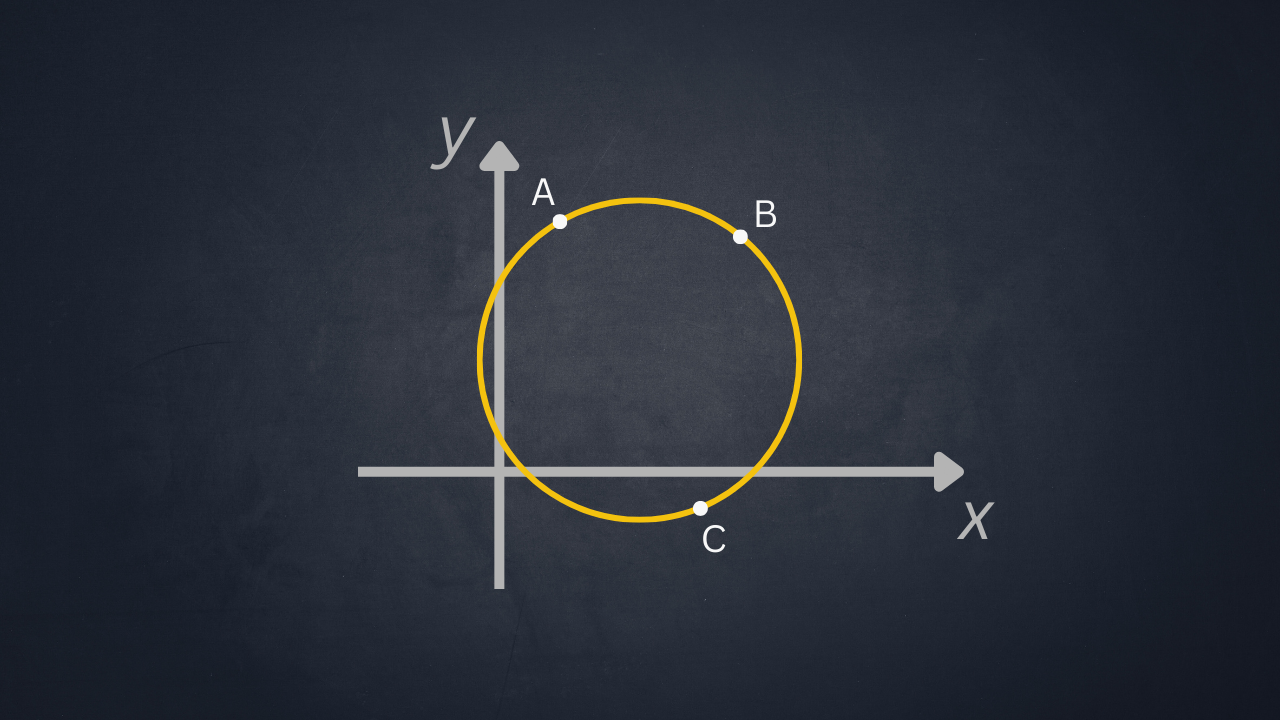
Finding the equation of a circle through three points is one of the classic problems in analytic geometry.
In particular, given three distinct points in the Cartesian plane that are not collinear, it is possible to determine the equation of the circle that contains all three (that is, the circle passing through all of them) using a straightforward algebraic procedure.
This problem appears very frequently in precalculus and analytic geometry exercises, since it brings together several concepts at once, including:
- the general form of the equation of a circle
- substituting the coordinates of the points
- solving a system of equations
In this article we will cover:
- when a circle through three points exists
- the step-by-step analytical method
- a quick procedure to use in exercises
- several fully worked examples
When Does a Circle Through Three Points Exist
Three distinct points in the plane determine exactly one circle, provided they are not collinear.
If the three points lie on the same line, it would not be possible to find a circle containing all three of them.
In other words:
- three distinct, non-collinear points → exactly one circle exists
- three collinear points → no circle exists
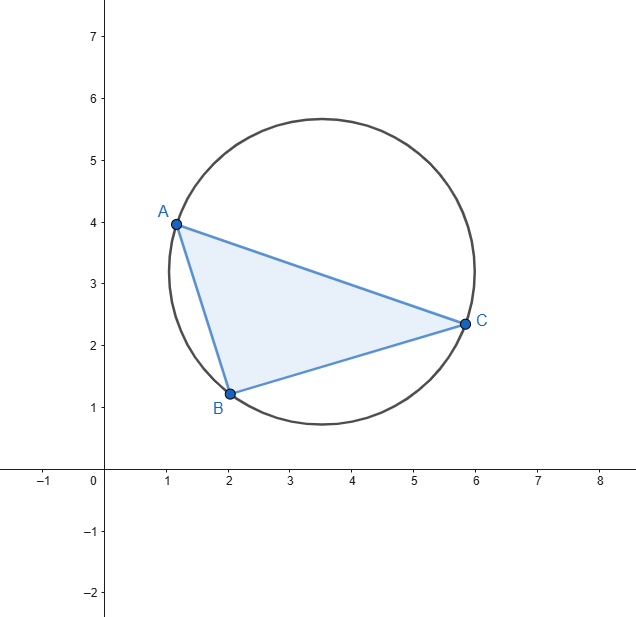
Geometrically, this happens because three non-collinear points form the vertices of a triangle, and every triangle has a circumscribed circle (Fig. 1).
Review of the General Form of the Equation of a Circle
The analytical method for finding the circle through three points always starts from the general form of the equation of a circle:
\[x^2 + y^2 + Dx + Ey + F = 0\tag{1}\]
where \(D\), \(E\), and \(F\) are real parameters to be determined.
Notice that there are three unknown parameters, \(D\), \(E\), and \(F\): finding them will therefore require three independent equations.
Brief Review: Finding the Center and Radius of a Circle
Once the equation of the circle has been found, it can be useful to determine its center and radius.
If the equation is
\[x^2+y^2+Dx+Ey+F=0\]
then:
The center \(C\) has coordinates:
\[C=\left(-\frac{D}{2},-\frac{E}{2}\right)\tag{2}\]
while the radius \(r\) can be computed as:
\[r=\sqrt{\frac{D^2+E^2}{4}-F}\tag{3}\]
Analytical Method for Finding the Circle Through Three Points
Suppose we are given three points:
\[A(x_1,y_1),\quad B(x_2,y_2),\quad C(x_3,y_3)\]
Let’s walk through the step-by-step procedure that leads to the equation of the circle in general form.
PROCEDURE
1. Write the general equation of the circle
\[x^2+y^2+Dx+Ey+F=0\]
2. Substitute the coordinates of the first point
Since point \(A\) lies on the circle, its coordinates must satisfy the equation:
\[x_1^2+y_1^2+Dx_1+Ey_1+F=0\]
3. Substitute the coordinates of the second point (point \(B\))
\[x_2^2+y_2^2+Dx_2+Ey_2+F=0\]
4. Substitute the coordinates of the third point (point \(C\))
\[x_3^2+y_3^2+Dx_3+Ey_3+F=0\]
5. Solve the system
This produces a linear system of three equations in the three unknowns \(D,E,F\):
\[x_1^2+y_1^2+Dx_1+Ey_1+F=0\]
\[x_2^2+y_2^2+Dx_2+Ey_2+F=0\]
\[x_3^2+y_3^2+Dx_3+Ey_3+F=0\]
Solving this system determines the coefficients \(D\), \(E\), and \(F\).
6. Write the final equation
Substituting the values found into the general equation (1) gives the equation of the circle we were looking for.
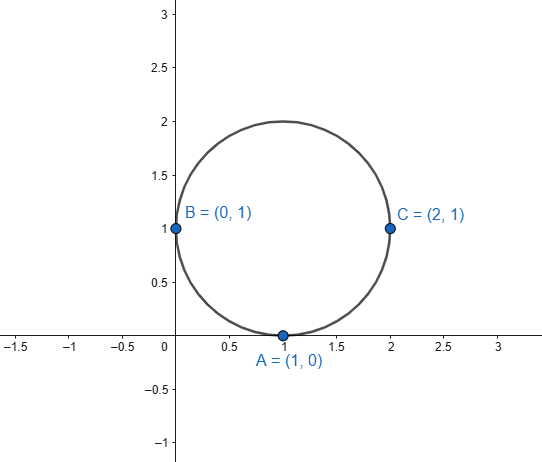
Example 1
Find the circle through the points:
\[A(1,0),\quad B(0,1),\quad C(2,1)\]
SOLUTION
We write the general equation
\[x^2+y^2+Dx+Ey+F=0\]
Substituting the coordinates of point A into the equation
\[1^2+0^2+D(1)+E(0)+F=0\]
\[1+D+F=0\]
Substituting the coordinates of point B
\[0^2+1^2+D(0)+E(1)+F=0\]
\[1+E+F=0\]
Similarly, substituting the coordinates of point C
\[2^2+1^2+2D+E+F=0\]
\[5+2D+E+F=0\]
This gives the following linear system of three equations in three unknowns:
\[1+D+F=0\]
\[1+E+F=0\]
\[5+2D+E+F=0\]
Let’s now solve the system.
From the first two equations we get:
\[D=-1-F\]
\[E=-1-F\]
Substituting into the third:
\[5+2(-1-F)+(-1-F)+F=0\]
\[5-2-2F-1-F+F=0\]
\[2-2F=0\]
\[F=1\]
Therefore
\[D=E=-2\]
Substituting the values of \(D\), \(E\), and \(F\) into the general equation gives the equation of the circle:
\[x^2+y^2-2x-2y+1=0\]
which is the answer to the problem.
Example 2
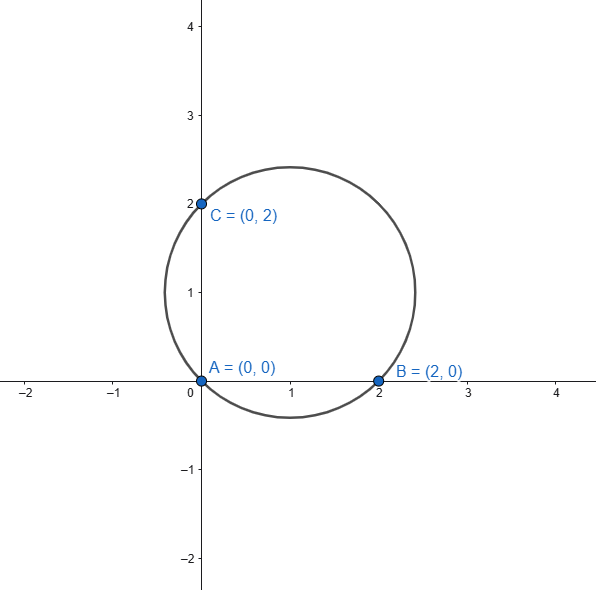
Find the circle through:
\[A(0,0),\quad B(2,0),\quad C(0,2)\]
SOLUTION
Proceeding with the substitutions as in Example 1, we get:
for \(A(0,0)\)
\[F=0\]
for \(B(2,0)\)
\[4+2D=0\]
\[D=-2\]
for \(C(0,2)\)
\[4+2E=0\]
\[E=-2\]
The equation of the circle is therefore:
\[x^2+y^2-2x-2y=0\]
Example 3
Find the circle through the points:
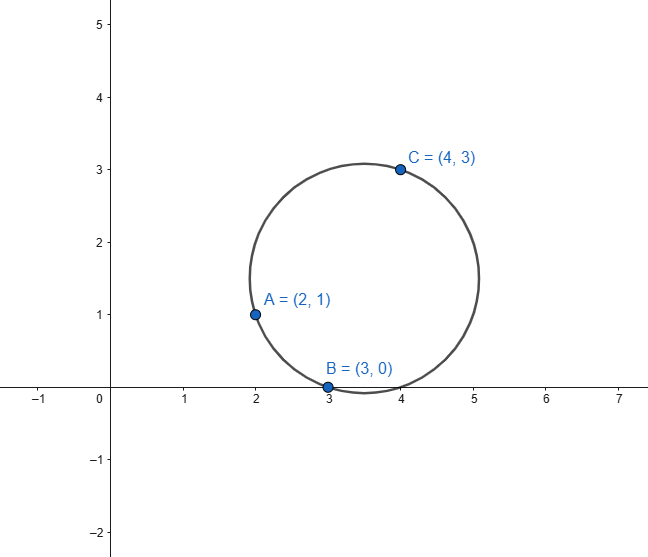
\[A(2,1),\quad B(3,0),\quad C(4,3)\]
SOLUTION
General equation
\[x^2+y^2+Dx+Ey+F=0\]
Let’s carry out the usual substitutions.
Point A
\[2^2+1^2+2D+E+F=0\]
\[5+2D+E+F=0\]
Point B
\[3^2+3D+F=0\]
\[9+3D+F=0\]
Point C
\[4^2+3^2+4D+3E+F=0\]
\[25+4D+3E+F=0\]
The resulting system:
\[5+2D+E+F=0\]
\[9+3D+F=0\]
\[25+4D+3E+F=0\]
Let’s now solve the system.
From the second equation:
\[F=-9-3D\]
Substituting into the first:
\[5+2D+E-9-3D=0\]
\[-4-D+E=0\]
\[E=D+4\]
Substituting into the third:
\[25+4D+3(D+4)-9-3D=0\]
\[25+4D+3D+12-9-3D=0\]
\[28+4D=0\]
\[D=-7\]
Therefore
\[E=-7+4=-3\]
\[F=-9-3(-7)=12\]
Final equation
\[x^2+y^2-7x-3y+12=0\]
The coordinates of the center, from (2), are:
\[\left(-\frac{D}{2},-\frac{E}{2}\right)=\left(\frac{7}{2},\frac{3}{2}\right)\]
while the radius \(r\) can be found from (3) as:
\[r=\sqrt{\frac{D^2+E^2}{4}-F}=\]
\[=\sqrt{\frac{(-7)^2+(-3)^2}{4}-12}=\frac{\sqrt{10}}{2}\]
Quick Reference Scheme for Exercises
To solve exercises quickly, it helps to remember this scheme:
Steps
- Write: \(x^2+y^2+Dx+Ey+F=0\)
- Substitute the three points one at a time
- Obtain a system of three equations
- Solve the system for \(D\), \(E\), and \(F\)
- Write the equation of the circle by substituting the values of \(D\), \(E\), and \(F\) obtained from solving the system
Practice Exercises (with Final Solution)
EXERCISE 1
Find the circle through the points \(A(-1,1)\), \(B(2,2)\), \(C(3,0)\)
Solution [\(x^2+y^2-\frac{13}{7}x-\frac{3}{7}y-\frac{24}{7}=0\)]
EXERCISE 2
Find the circle through the points \(A(0,1/2)\), \(B(1,1)\), \(C(3/2,0)\)
Solution [\(x^2+y^2-\frac{3}{2}x-\frac{1}{2}y=0\)]
EXERCISE 3
Find the circle through the points \(A(-1/2,1)\), \(B(1/2,-1)\), \(C(1,3/2)\)
Solution [\(x^2+y^2-\frac{8}{7}x-\frac{4}{7}y-\frac{5}{4}=0\)]
Geometric Method
There is also a geometric method for finding the circle through three points, based on the perpendicular bisectors of the sides of the inscribed triangle.
If we construct the perpendicular bisectors of the sides of the triangle formed by the three points, their point of intersection is the center of the circle circumscribed about the triangle.
Once the center has been found, the radius can be determined, and the equation of the circle can be written in the form:
\[(x-x_0)^2+(y-y_0)^2=r^2\]
However, algebra exercises almost always call for the analytical method using a system of equations, since it is more systematic.
Common Mistakes in Exercises
⚠️ The most frequent mistakes when finding a circle through three points are:
- forgetting the term \(x^2+y^2\)
- arithmetic errors in the substitutions
- solving the system incorrectly
- not checking the result
It is always good practice to verify the equation of the circle obtained by substituting the coordinates of each of the three points (one at a time) and checking that it reduces to an identity.
If the result is correct, the equation must vanish for each point.
Conclusion
Finding the circle through three points is a classic exercise in analytic geometry.
The procedure is based on a very simple idea:
- start from the general equation of the circle
- substitute the coordinates of the three points
- solve the resulting system
This method makes it possible to systematically determine the equation of the circle and, from there, to also find its center and radius.
With a bit of practice, the procedure becomes very fast and makes it possible to solve most of the exercises assigned in homework and exams with ease.
This is just one piece of the puzzle: the full guide to circles in coordinate geometry ties it together with tangent lines, pencils of circles, and more.
FINAL TEST
The following test checks understanding of the analytical method for finding the circle through three points. It covers the general form of the equation, the role of the system of equations, and how to find the center and radius once the coefficients are known.
Cite this resource
"If this explanation saved you some confusion, passing it along costs you nothing and might save someone else the same struggle."
Citation
HTML link to copy