
Finding the equation of a parabola that passes through three given points is one of the classic, fundamental problems of analytic geometry.
In this article, in particular, we will see how to find the equation of a parabola with a vertical axis passing through three points, using the standard algebraic method: solving a linear system of three equations in three unknowns, obtained by requiring that each of the points satisfy the equation of the parabola.
Beyond the general procedure, we will also examine some special cases and a series of worked examples that show how the theory is applied in practice.
Setting Up the Problem: A Parabola Through Three Points
To find the equation of a parabola with axis parallel to the y-axis from three known points in the plane that are not collinear and such that no two of them share the same x-coordinate, three independent conditions (equations) must be imposed. This is the case because the general equation of a parabola with a vertical axis contains three unknown parameters (\(a, b, c\)). Consequently, finding these values reduces directly to solving a system in which the number of unknowns (\(a,b,c\)) equals the number of equations (one for each condition of passing through a known point).
Suppose, then, that the points \(A(x_1,y_1)\), \(B(x_2,y_2)\), and \(C(x_3,y_3)\) are given in the plane, and that we want to find the equation of the parabola with a vertical axis:
\[y = ax^2 + bx + c \qquad (a \neq 0) \tag{1}\]
that passes through all three of them.
Equation (1) must clearly be satisfied by each of the known points, and therefore the following equations must hold:
\[y_1 = ax_1^2 + bx_1 + c\]
\[y_2 = ax_2^2 + bx_2 + c\]
\[y_3 = ax_3^2 + bx_3 + c\]
The coefficients in (1) can then be found by solving the linear system formed by these three equations in the unknowns \(a\), \(b\), and \(c\), namely:
\[\begin{cases} y_1 = ax_1^2 + bx_1 + c \\ y_2 = ax_2^2 + bx_2 + c \\ y_3 = ax_3^2 + bx_3 + c \end{cases} \tag{2}\]
which gives the solution to the problem.
Note: The equation \(y = ax^2\) of a parabola with vertex at the origin, which is useful when the vertex coincides with the origin, cannot be used in this case: it has only one free parameter, so it can satisfy at most one arbitrarily chosen condition of passing through a given point, not three.
Solution Procedure
- Substitute the coordinates of each point into the general equation \(y = ax^2+bx+c\), obtaining three equations.
- Solve the system in the unknowns \(a\), \(b\), \(c\), by substitution or elimination.
- Write the equation of the parabola using the coefficients found.
- Optionally, check the result by substituting the three points into the final equation.
Example 1 – General Case
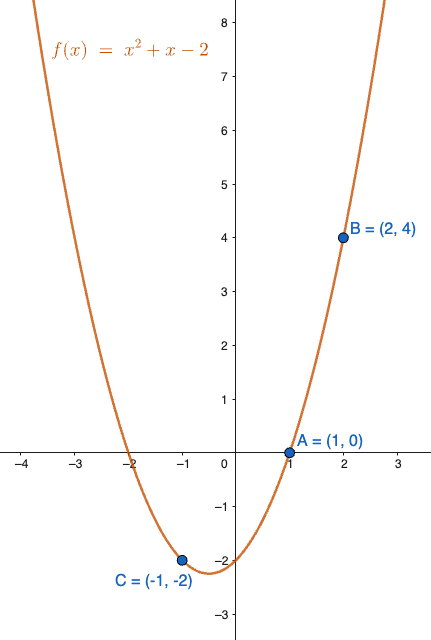
Find the equation of the parabola passing through \(A(1,0)\), \(B(2,4)\), and \(C(-1,-2)\).
SOLUTION
The three given points must each satisfy the equation of the parabola, since they all belong to it. Therefore, substituting the coordinates of the three points one at a time into the general equation of a parabola with a vertical axis, \(y=ax^2+bx+c\), we obtain:
- passing through \(A(1,0)\):
\[0=a(1)^2+b\cdot 1+c\]
- passing through \(B(2,4)\):
\[4=a(2)^2+b\cdot 2+c\]
- passing through \(C(-1,-2)\):
\[-2=a(-1)^2+b(-1)+c\]
Each of the three equations represents an analytical condition to be satisfied, and since all three must hold simultaneously, the solution can be found by solving the system of the three equations in the unknowns \(a\), \(b\), and \(c\), that is:
\[\begin{cases} a+b+c=0 \\ 4a+2b+c=4 \\ a-b+c=-2 \end{cases}\]
To solve the system, we can, for example, solve the first equation for \(c\) and substitute into the second and third equations, obtaining:
\[\begin{cases} c=-a-b \\ 4a+2b-a-b=4 \\ a-b-a-b=-2 \end{cases}\]
and then find the value of \(b\) from the third equation as follows:
\[-2b=-2 \rightarrow b=1\]
and then, from the second equation:
\[a=\frac{4-b}{3}=\frac{4-1}{3}=1\]
Finally, from the first equation:
\[c=-a-b=-1-1=-2\]
Substituting the values of the coefficients \(a\), \(b\), and \(c\) into the general equation of a parabola with a vertical axis, we finally obtain:
\[y=x^2+x-2\]
which is the equation of the parabola passing through the given points (Fig. 1).
Example 2 – General Case
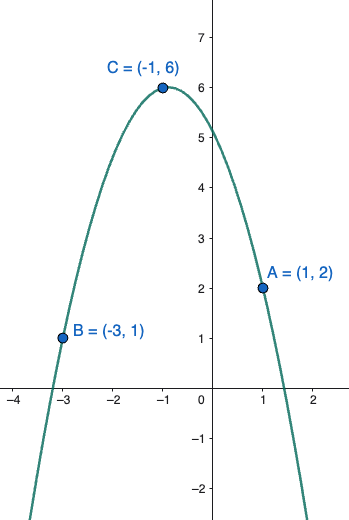
Find the equation of the parabola passing through \(A(1,2)\), \(B(-3,1)\), and \(C(-1,6)\).
SOLUTION
As in the first example, the three points must once again each satisfy the equation of the parabola. Substituting the coordinates of the three points one at a time into the equation of a parabola with a vertical axis, \(y=ax^2+bx+c\), we obtain:
- passing through \(A(1,2)\):
\[2=a(1)^2+b\cdot 1+c\]
- passing through \(B(-3,1)\):
\[1=a(-3)^2+b\cdot(-3)+c\]
- passing through \(C(-1,6)\):
\[6=a(-1)^2+b(-1)+c\]
Each of the three equations represents an analytical condition, and since all three must hold simultaneously, the solution can be found by solving the system of the three equations in the unknowns \(a\), \(b\), and \(c\), that is:
\[\begin{cases} a+b+c=2 \\ 9a-3b+c=1 \\ a-b+c=6 \end{cases}\]
To solve the system, we can once again solve the first equation for \(c\) and substitute into the second and third equations, obtaining:
\[\begin{cases} c=2-a-b \\ 9a-3b+2-a-b=1 \\ a-b+2-a-b=6 \end{cases}\]
and then find the value of \(b\) from the third equation as follows:
\[-2b=4 \rightarrow b=-2\]
and then, from the second equation:
\[a=\frac{-1+4b}{8}=\frac{-1+4(-2)}{8}=-\frac{9}{8}\]
Finally, from the first equation:
\[c=2-a-b=2+\frac{9}{8}+2=\frac{41}{8}\]
Substituting the values of the coefficients \(a\), \(b\), and \(c\) into the general equation of a parabola with a vertical axis, we finally obtain:
\[y=-\frac{9}{8}x^2-2x+\frac{41}{8}\]
which is the equation of the parabola passing through the given points (Fig. 2).
Example 3 – A Point with Zero x-Coordinate
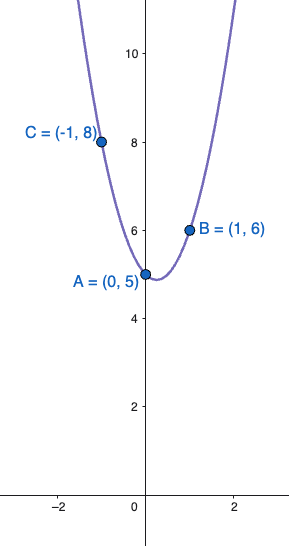
Find the equation of the parabola passing through \(A(0,5)\), \(B(1,6)\), and \(C(-1,8)\).
SOLUTION
Requiring the parabola with a vertical axis \(y=ax^2+bx+c\) to pass through the three given points, we obtain:
- passing through \(A(0,5)\):
\[5=a(0)^2+b\cdot 0+c\]
- passing through \(B(1,6)\):
\[6=a(1)^2+b\cdot(1)+c\]
- passing through \(C(-1,8)\):
\[8=a(-1)^2+b(-1)+c\]
from which we get the system of three equations in the unknowns \(a\), \(b\), and \(c\), that is:
\[\begin{cases} c=5 \\ a+b+c=6 \\ a-b+c=8 \end{cases}\]
Notice that the equations obtained are not all coupled to one another, since the first of them directly gives the value of \(c\), which represents the y-coordinate of the parabola at the point where its x-coordinate is zero, that is, its y-intercept.
After substituting \(c=5\) into the second and third equations, the system therefore reduces to:
\[\begin{cases} a+b=1 \\ a-b=3 \end{cases}\]
from which:
\[\begin{cases} a=1-b \\ 1-b-b=3 \end{cases}\]
\[-2b=2 \rightarrow b=-1\]
and then, from the first equation:
\[a=1-b=1+1=2\]
Substituting the values of the coefficients \(a\), \(b\), and \(c\) into the general equation of a parabola with a vertical axis, we finally obtain:
\[y=2x^2-x+5\]
which is the equation of the parabola passing through the given points (Fig. 3).
Example 4 – A Point at the Origin
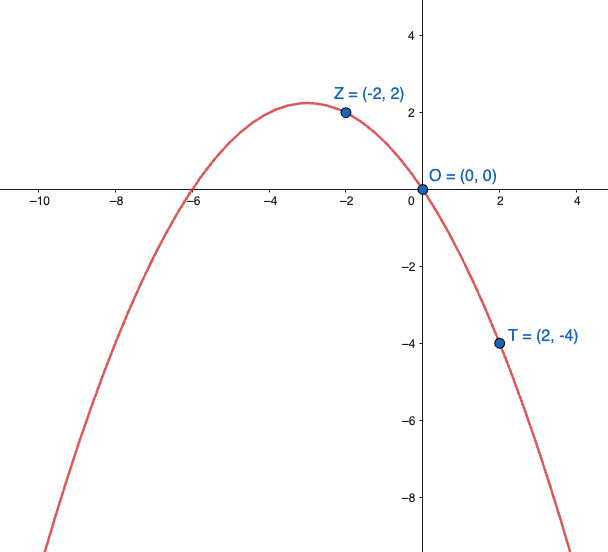
Find the equation of the parabola passing through \(O(0,0)\), \(Z(-2,2)\), and \(T(2,-4)\).
SOLUTION
Requiring the parabola with a vertical axis \(y=ax^2+bx+c\) to pass through the three given points, we obtain:
- passing through \(O(0,0)\):
\[0=a(0)^2+b\cdot 0+c\]
- passing through \(Z(-2,2)\):
\[2=a(-2)^2+b\cdot(-2)+c\]
- passing through \(T(2,-4)\):
\[-4=a(2)^2+b(2)+c\]
from which we get the system of three equations in the unknowns \(a\), \(b\), and \(c\), that is:
\[\begin{cases} c=0 \\ 4a-2b=2 \\ 4a+2b=-4 \end{cases}\]
from which we obtain:
\[a=-\frac{1}{4}\]
\[b=-\frac{3}{2}\]
Substituting the values of \(a\), \(b\), and \(c\) into the equation of a parabola with a vertical axis, we obtain:
\[y=-\frac{1}{4}x^2-\frac{3}{2}x\]
Special Case – Two Points with the Same x-Coordinate
Find the equation of the parabola passing through \(P(2,3)\), \(Q(2,7)\), and \(R(0,1)\).
SOLUTION
In this case, we observe that the points \(P\) and \(Q\) have the same x-coordinate. If we now try to require the parabola with a vertical axis \(y=ax^2+bx+c\) to pass through these two points, we obtain:
- passing through \(P(2,3)\):
\[3=a(2)^2+b\cdot 2+c\]
- passing through \(Q(2,7)\):
\[7=a(2)^2+b\cdot(2)+c\]
If we now subtract the second equation from the first, we arrive at a contradiction:
\[-4=0\]
Consequently, the system obtained from the conditions for the known points is inconsistent in this particular case. It is therefore impossible to find any equation of the form \(y=ax^2+bx+c\) that satisfies the given conditions.
Special Case – Three Collinear Points
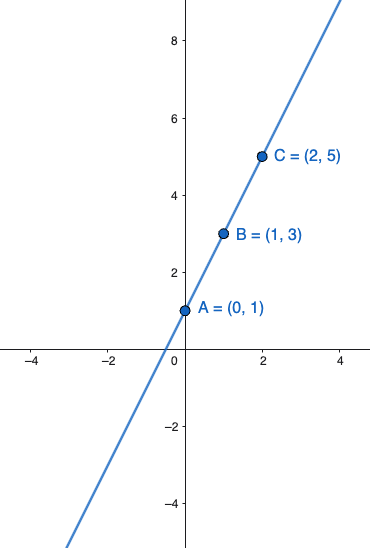
Find the equation of the parabola passing through \(A(0,1)\), \(B(1,3)\), and \(C(2,5)\).
SOLUTION
Requiring the parabola with a vertical axis \(y=ax^2+bx+c\) to pass through the three given points, we obtain:
- passing through \(A(0,1)\):
\[1=a(0)^2+b\cdot 0+c\]
- passing through \(B(1,3)\):
\[3=a(1)^2+b\cdot(1)+c\]
- passing through \(C(2,5)\):
\[5=a(2)^2+b(2)+c\]
from which we get the system of three equations in the unknowns \(a\), \(b\), and \(c\), that is:
\[\begin{cases} c=1 \\ a+b+c=3 \\ 4a+2b+c=5 \end{cases}\]
from which, by simplifying and thus eliminating \(c\) from the last two equations:
\[\begin{cases} a+b=2 \\ 2a+b=2 \end{cases}\]
which, when solved, gives:
\[\begin{cases} a=0 \\ b=2 \end{cases}\]
Substituting the values of \(a\), \(b\), and \(c\) into the equation of a parabola with a vertical axis, we obtain:
\[y=2x+1\]
which is the equation of a line.
In this case, no parabola passes through the three points, because they are collinear (Fig. 5). Note, however, that the method does not produce an absurd result: it simply returns the case in which the parabola reduces to a line (\(a=0\)).
Common Mistakes
Here is a brief overview of some of the most common mistakes that arise when working on exercises and problems involving the parabola with a vertical axis through three known points.
- Starting from the equation of a parabola with vertex at the origin. Setting up the system with \(y=ax^2\) instead of \(y=ax^2+bx+c\) leaves only one free parameter: the system is overdetermined, or requires ignoring two of the three conditions.
- Sign errors during elimination. Subtracting equations that involve negative coordinates (x-coordinates or y-coordinates) is where a sign is most often lost; it is advisable to rewrite each equation with all signs written out explicitly before subtracting.
- Skipping the final check. A good practice for keeping the possibility of error to a minimum is to verify the solution, that is, to make sure that substituting the parameters \(a\), \(b\), and \(c\) satisfies all the equations of the system.
- Failing to recognize an inconsistent system or other special cases. Interpreting \(-4=0\) as a calculation error to be “corrected” rather than as information about the given points (same x-coordinate, different y-coordinates); likewise, failing to identify \(a=0\) as a reduction to a line and treating it instead as an anomalous result to be discarded.
Conclusion
The method for finding the equation of the parabola through three points is essentially always the same: a linear system solved with the same sequence of steps. Its application, however, requires attention to the cases in which the system does not yield a parabola: points with the same x-coordinate, which make the system inconsistent, and collinear points, which nevertheless allow us to find the equation of the line containing them. Recognizing these two outcomes is as much a part of mastering the method as knowing how to apply it to the general case.
With this tool, it is also possible to tackle problems in which the parabola is defined by mixed conditions, for example a given point on the parabola together with a prescribed vertex or axis, which require combining this system with the geometric properties covered in the other articles on the study of the parabola.
FINAL TEST
This test checks understanding of the topics covered in this article. It consists of 10 multiple-choice questions on the parabola through three points.
Cite this resource
"Behind this article: hours of writing, checking, and rewriting to get it right. If it was useful, a share or citation helps it find the next person who needs it."
Citation
HTML link to copy