
In a previous article, we examined the parabola with vertex at the origin, whose axis coincides with the y-axis.
This article represents the natural extension — and generalization — of that discussion. We will remove the assumption that the vertex \(V\) coincides with the origin \(O\) of the coordinate plane, and turn our attention to a generic parabola with axis parallel to the y-axis, deriving its equation and the fundamental features that identify it (e.g., axis of symmetry, vertex, focus, and directrix).
Deriving the Equation of a Vertical Parabola (via Translation of the Reference System)
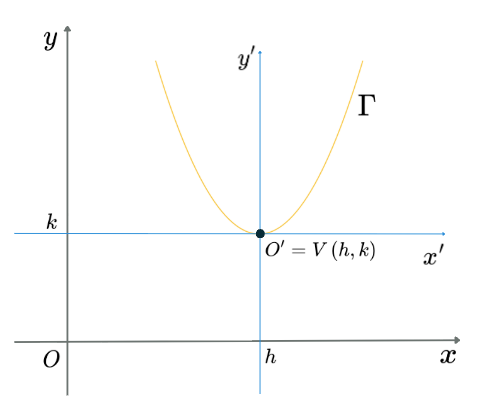
Referring to Fig. 1, consider a vertical parabola \(\Gamma\) with vertex \(V(h,k)\) in the reference system \(Oxy\). If we now refer this same parabola \(\Gamma\) to the translated reference system \(O’x’y’\), we know from the theory of the parabola with vertex at the origin that, in this new system, the parabola is described by the equation
\[y’=ax’^2 \tag{1}\]
Again from Fig. 1, we can see graphically that the equations defining the translation between the two reference systems \(Oxy\) and \(O’x’y’\) take the form:
\[\begin{cases} x=x’+h \\ y=y’+k \end{cases} \tag{2}\]
from which we immediately obtain:
\[\begin{cases} x’=x-h \\ y’=y-k \end{cases} \tag{3}\]
Substituting (3) into (1) gives:
\[y-k=a(x-h)^2 \tag{4}\]
Equation (4) is the equation of a parabola with axis of symmetry parallel to the y-axis and vertex at the generic point \(V(h,k)\).
Note: If we let the parameter \(a\) vary, equation (4) represents a family of parabolas — all those with vertex \(V(h,k)\) and axis parallel to the y-axis.
Expanding the square in (4) and rearranging, we obtain:
\[y-k=a(x^2+h^2-2xh)\] \[y=ax^2-2ahx+ah^2+k\]
At this point, if in the previous equation we set:
\[-2ah=b\] \[ah^2+k=c\]
it can be rewritten as:
\[y=ax^2+bx+c \quad (a\neq0) \tag{5}\]
which is the standard form of a generic parabola with vertical axis (parallel to the y-axis).
Algebraic and Geometric Connection Between Quadratic Functions of the Form \(y=ax^2+bx+c\)
This section lays the groundwork for the analytic determination of the focus, directrix, axis, and vertex of the generic parabola with equation \(y=ax^2+bx+c\). Here we want to show that every equation of type (5) represents a parabola with vertical axis.
To show this, starting from (5), note that after setting \(\Delta=b^2-4ac\), it can be written as:
\[y=a\left(x^2+\frac{b}{a}x+\frac{c}{a}\right)=a\left(x^2+\frac{b}{a}x+\frac{b^2}{4a^2}-\frac{b^2}{4a^2}+\frac{c}{a}\right)=\] \[=a\left[\left(x+\frac{b}{2a}\right)^2-\frac{\Delta}{4a^2}\right]\]
from which we obtain
\[y=a\left(x+\frac{b}{2a}\right)^2-\frac{\Delta}{4a}\]
and hence
\[y+\frac{\Delta}{4a}=a\left(x+\frac{b}{2a}\right)^2 \tag{6}\]
Now setting:
\[x+\frac{b}{2a}=x’ \tag{7}\] \[y+\frac{\Delta}{4a}=y’ \tag{8}\]
equation (6) becomes:
\[y’=ax’^2 \tag{9}\]
which is essentially the same as (1).
Note also that relations (7) and (8) can also be written as:
\[x=x’-\frac{b}{2a} \tag{10}\] \[y=y’-\frac{\Delta}{4a} \tag{11}\]
which are nothing more than a translation of the reference system \(Oxy\) into \(O’x’y’\).
Comparing equations (10) and (11) with (2) gives:
\[h=-\frac{b}{2a}\] \[k=-\frac{\Delta}{4a}\]
which are the coordinates of the origin \(O’\) as seen in the reference system \(Oxy\); we can therefore write:
\[O’ \left(-\frac{b}{2a},-\frac{\Delta}{4a}\right)\]
Finally, note that the graph of function (9) is a parabola with vertical axis, whose vertex coincides with the origin of the system \(O’x’y’\) and whose axis of symmetry is the \(y’\)-axis. It follows that equation (5), which we rewrite here for convenience:
\[y=ax^2+bx+c \quad (a\neq0)\]
also represents a parabola with axis of symmetry parallel to the y-axis.
Vertex and Axis of Symmetry of a Parabola with Axis Parallel to the Y-Axis
To determine the coordinates of the vertex of the parabola \(\Gamma\) with equation
\[y=ax^2+bx+c\]
note that the point with coordinates
\[x’=y’=0\]
is the vertex of parabola (9) in the reference system \(O’x’y’\); therefore, from (10) and (11) we obtain:
\[h=-\frac{b}{2a} \tag{12}\] \[k=-\frac{\Delta}{4a} \tag{13}\]
which are the coordinates of the vertex of the parabola \(\Gamma\) in the reference system \(Oxy\).
To derive the equation of the axis of symmetry of the parabola in the reference system \(Oxy\), note that this same axis has equation \(x’=0\) in the system \(O’x’y’\); taking (10) into account, we obtain:
\[x=-\frac{b}{2a} \tag{14}\]
Focus and Directrix of a Parabola with Axis Parallel to the Y-Axis
The coordinates of the focus and the equation of the directrix of the parabola \(\Gamma\) can be obtained starting from the results already known for the vertical parabola with vertex at the origin.
In the situation described in this article, our parabola, viewed in the system \(O’x’y’\), is a parabola with vertex at the origin, so the coordinates of its focus are \(x’=0\) and \(y’=\frac{1}{4a}\). To obtain the coordinates of the focus of the parabola in the reference system \(Oxy\), it is enough to apply the transformation equations (10) and (11), which for \(x’=0\) and \(y’=\frac{1}{4a}\) become:
\[x_F=-\frac{b}{2a} \tag{15}\] \[y_F=\frac{1}{4a}-\frac{\Delta}{4a}=\frac{1-\Delta}{4a} \tag{16}\]
As for the equation of the directrix, we know from the theory of the parabola with vertex at the origin that it is given by:
\[y’=-\frac{1}{4a}\]
and so, again applying the coordinate transformations (10) and (11), we obtain:
\[y=-\frac{1}{4a}-\frac{\Delta}{4a}=-\frac{1+\Delta}{4a} \tag{17}\]
Equation (17) is the equation of the directrix of a generic parabola with vertical axis.
Note that the distance from the vertex to the focus — and, equally, from the vertex to the directrix — is \(\frac{1}{4|a|}\), often denoted \(p\). This distance depends only on \(a\), not on \(b\) or \(c\): once the vertex \(V(h,k)\) is known, the focus and directrix are simply located \(p\) units above and below it along the axis of symmetry.
Note: The sign of \(a\) in (5), just as in the case of the parabola with vertex at the origin, determines its direction of opening. Specifically:
- if \(a>0\), the parabola opens upward and the vertex is the point of minimum ordinate;
- if \(a<0\), the parabola opens downward and the vertex is the point of maximum ordinate;
- if \(a=0\), the parabola degenerates into a line.
Summary of Formulas for the Vertical Parabola
| Description | Formula |
|---|---|
| vertex | \(V\left(-\frac{b}{2a},-\frac{\Delta}{4a}\right)\) |
| axis of symmetry | \(x=-\frac{b}{2a}\) |
| focus | \(F\left(-\frac{b}{2a},\frac{1-\Delta}{4a}\right)\) |
| directrix | \(y=-\frac{1+\Delta}{4a}\) |
| opens upward | \(a>0\) |
| opens downward | \(a<0\) |
Worked Exercises on the Vertical Parabola
EXERCISE 1
Find the vertex and the focus of the parabola with equation \(y=x^2+2x-1\). Determine its direction of opening.
SOLUTION
The coefficients of the given parabola’s equation are:
\[a=1\] \[b=2\] \[c=-1\]
from which we can immediately compute:
\[\Delta=b^2-4ac=4+4=8\]
From the theory of the vertical parabola, we know the vertex has coordinates:
\[h=-\frac{b}{2a}=-\frac{2}{2}=-1\] \[k=-\frac{\Delta}{4a}=-\frac{8}{4}=-2\]
while the focus can be computed as:
\[x_F=-\frac{b}{2a}=-\frac{2}{2}=-1\] \[y_F=\frac{1-\Delta}{4a}=\frac{1-8}{4}=-\frac{7}{4}\]
Fig. 2 below shows the graph of this parabola, highlighting the vertex \(V\) and the focus \(F\).
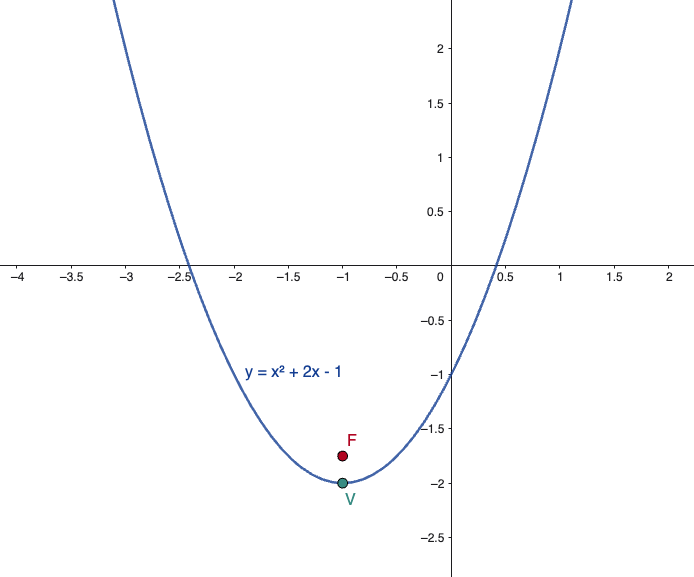
The parabola opens upward, since the coefficient of the quadratic term is positive (\(a=1>0\)).
EXERCISE 2
Given the parabola with equation \(y=-x^2+2x+3\), find the coordinates of the focus. Also find the equations of the directrix and the axis of symmetry, and finally determine the parabola’s direction of opening.
SOLUTION
The solution is immediate. As in the previous exercise, the coordinates of the focus are found from the coefficients \(a,b\) and \(c\), which here are:
\[a=-1\] \[b=2\] \[c=3\]
from which
\[\Delta=b^2-4ac=4+4=16\]
and so
\[x_F=-\frac{b}{2a}=-\frac{2}{2(-1)}=1\] \[y_F=\frac{1-\Delta}{4a}=\frac{1-16}{4(-1)}=\frac{15}{4}\]
The equation of the directrix can be written immediately by applying (17):
\[y=-\frac{1+\Delta}{4a}=-\frac{1+16}{4(-1)}=\frac{17}{4}\]
while the equation of the axis of symmetry follows from (14):
\[x=-\frac{b}{2a}=-\frac{2}{2(-1)}=1\]
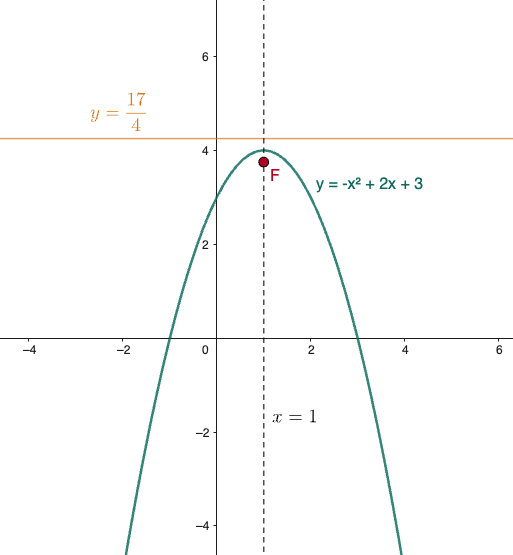
Finally, the parabola opens downward, since the coefficient of the quadratic term is negative (\(a=-1<0\)).
EXERCISE 3
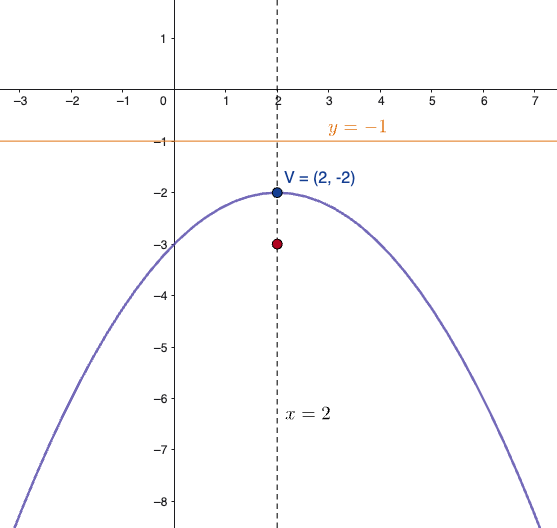
Find the equation of the parabola with vertex \(V(2,-2)\) and directrix \(y=-1\).
SOLUTION
Using the formulas for the vertex coordinates (12), (13) and for the directrix (17), we arrive at the following system of equations:
\[\begin{cases} -\frac{1+\Delta}{4a}=-1 \\ -\frac{b}{2a}=2 \\ -\frac{\Delta}{4a}=-2 \end{cases}\]
We now solve the system:
\[\begin{cases} \frac{1+\Delta}{4a}=1 \\ b=-4a \\ \Delta=8a \end{cases}\]
substituting the third equation into the first, the latter becomes:
\[\frac{1+8a}{4a}=1\]
\[1+8a=4a\]
\[4a=-1\]
\[a=-\frac{1}{4}\]
Now that we know \(a\), we can immediately find \(b\) from the second equation:
\[b=-4(-\frac{1}{4})=1\]
At this point, we can find the value of \(\Delta\) from the third equation:
\[\Delta=8(-\frac{1}{4})=-2\]
and, recalling that \(\Delta=b^2-4ac\), solving for \(c\) gives:
\[4ac=b^2-\Delta\]
from which
\[c=\frac{b^2-\Delta}{4a}=\frac{1+2}{4(-\frac{1}{4})}=-3\]
To find the equation of the parabola, it is now enough to substitute the values of \(a,b\) and \(c\) found into equation (5), which gives:
\[y=-\frac{1}{4}x^2+x-3\]
shown in Fig. 4 below.
EXERCISE 4
Find the intersections of the following parabolas with the coordinate axes.
a) \(y=x^2-6x+5\)
b) \(y=-x^2+9\)
c) \(y=x^2+4\)
SOLUTION
a)
Recalling that the x-axis has equation \(y=0\), the intersections with this axis are found by solving the system:
\[\begin{cases} y=x^2-6x+5 \\ y=0 \end{cases}\]
from which
\[x^2-6x+5=0\]
solving gives:
\[\Delta=b^2-4ac=(-6)^2-4(1)(5)=16\]
\[x_{1,2}=\frac{-b\pm\sqrt{\Delta}}{2a}=\frac{6\pm4}{2}\]
The intersection points with the x-axis therefore have coordinates
\[(5,0)\] \[(1,0)\]
To find the intersections with the y-axis (\(x=0\)), we simply solve the system:
\[\begin{cases} y=x^2-6x+5 \\ x=0 \end{cases}\]
from which, substituting the first equation into the second, we immediately obtain:
\[y=5\]
and so the point in question is
\[(0,5)\]
b)
Proceeding as in part a), we obtain:
\[\begin{cases} y=-x^2+9 \\ y=0 \end{cases}\]
from which
\[-x^2+9=0\]
solving gives
\[x_{1,2}=\pm3\]
The intersection with the y-axis is found by setting \(x=0\) in the parabola’s equation, which immediately gives \(y=9\).
c)
Note that the system
\[\begin{cases} y=x^2+4 \\ y=0 \end{cases}\]
gives
\[x^2+4=0\]
which has no solution in the real numbers, so there are no intersections with the x-axis.
As before, the intersection with the y-axis is found by setting \(x=0\) in the parabola’s equation, giving the solution \(y=4\).
EXERCISE 5
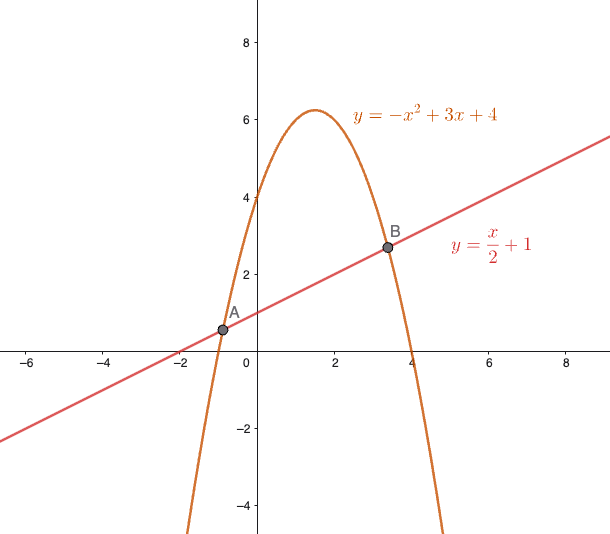
Find the points of intersection between the line with equation \(y=\frac{x}{2}+1\) and the parabola with equation \(y=-x^2+3x+4\).
SOLUTION
The exercise can be solved by setting up the system between the two equations:
\[\begin{cases} y=\frac{x}{2}+1\ \\ y=-x^2+3x+4 \end{cases}\]
Eliminating \(y\) from the system gives:
\[\frac{x}{2}+1=-x^2+3x+4\]
then simplifying and solving for \(x\):
\[x^2-\frac{5}{2}x-3=0\] \[2x^2-5x-6=0\] \[\Delta=25-4(2)(-6)=25+48=73\] \[x_{1,2}=\frac{5\pm \sqrt{73}}{4}\]
We now compute the ordinates of the intersection points as follows:
\[y_1=\frac{x_1}{2}+1=\frac{5+\sqrt{73}}{8}+1\] \[y_2=\frac{x_2}{2}+1=\frac{5-\sqrt{73}}{8}+1\]
EXERCISE 6
Discuss the direction of opening of the parabola with equation \(y=t^2x^2-3x^2+tx\) as the parameter \(t\) varies.
SOLUTION
From the theory, we know that the direction of opening of a parabola depends solely on the coefficient of the second-degree term, \(a\). In light of this, it is convenient to factor out the quadratic term, rewriting the equation as:
\[y=(t^2-3)x^2+tx\]
We can now study the sign of the coefficient of the quadratic term, for instance by imposing that it be greater than zero. This gives:
\[t^2-3>0\]
whose solution is:
\[t<-\sqrt{3} \vee t>\sqrt{3}\]
which is the interval of values of \(t\) for which the parabola opens upward.
The parabola will instead open downward for \(t^2-3<0\), that is, for:
\[-\sqrt{3}<t<\sqrt{3}\]
Finally, note that for \(t=\pm\sqrt{3}\) we have \(t^2-3=0\), so the parabola degenerates into the lines with equation \(y=\pm \sqrt{3}x\).
The following interactive figure shows the behavior of the parabola \(y=(t^2-3)x^2+tx\) as \(t\) varies dynamically, highlighting the direction of opening.
Common Errors with the Vertical Parabola
In studying the vertical parabola, certain typical errors tend to recur, mostly due to inattentive application of the formulas or confusion with the case of the parabola with vertex at the origin. The most frequent ones are listed below.
Confusing the standard form with the case of vertex at the origin. The equation \(y=ax^2\) (parabola with vertex at the origin) is a special case of the standard form \(y=ax^2+bx+c\), valid only when \(b=c=0\), i.e., when the vertex coincides with the origin. Applying the formulas for the parabola with vertex at the origin (vertex at the origin, focus at \(\left(0,\frac{1}{4a}\right)\), directrix \(y=-\frac{1}{4a}\)) to a parabola with \(b\neq0\) or \(c\neq0\) leads to incorrect results.
Sign error when computing the vertex’s x-coordinate. The formula \(h=-\frac{b}{2a}\) requires particular care when \(b\) is negative: the minus sign in the formula, combined with the sign of \(b\), can lead to calculation errors. For example, for \(b=-4\) and \(a=2\), \(h=-\frac{-4}{4}=1\), not \(h=-1\).
Sign error when computing the discriminant. When computing \(\Delta=b^2-4ac\), if \(a\) or \(c\) is negative, the product \(4ac\) changes sign, and the term \(-4ac\) can end up positive rather than negative. It is good practice to compute \(b^2\) and \(4ac\) separately before subtracting, avoiding mental shortcuts that can introduce sign errors.
Mixing up the formulas for the focus and the directrix. The ordinates of the focus and directrix, \(y_F=\frac{1-\Delta}{4a}\) and \(y=-\frac{1+\Delta}{4a}\), differ only in the sign of the numerator’s term and are easily confused. A useful check is to verify that the focus and directrix are equidistant from the vertex, at distance \(\frac{1}{4|a|}\), and lie on opposite sides of it along the axis of symmetry.
Forgetting the condition \(a\neq0\). If the coefficient of the quadratic term vanishes — a situation that can arise when \(a\) depends on a parameter, as in Exercise 6 — the equation \(y=ax^2+bx+c\) degenerates into a line and no longer represents a parabola. In such cases, the formulas for the vertex, focus, and directrix become meaningless and must be discarded.
Error in the equation of the axis of symmetry. The axis of symmetry of a vertical parabola is the vertical line \(x=-\frac{b}{2a}\), not a horizontal line. Writing the equation in the form \(y=\dots\) instead of \(x=\dots\) is a conceptual error, not a computational one, since the axis of symmetry is — by definition — parallel to the y-axis.
Conclusions
In this article, we extended the study of the parabola with vertex at the origin to the general case of a parabola with axis of symmetry parallel to the y-axis, removing the assumption that the vertex coincides with the origin of the reference system.
Through a translation of the coordinate axes, we showed that every equation of the form \(y=ax^2+bx+c\), with \(a\neq0\), represents a parabola with vertical axis, and we derived the formulas characterizing its main elements:
- vertex \(V\left(-\frac{b}{2a},-\frac{\Delta}{4a}\right)\);
- axis of symmetry \(x=-\frac{b}{2a}\);
- focus \(F\left(-\frac{b}{2a},\frac{1-\Delta}{4a}\right)\);
- directrix \(y=-\frac{1+\Delta}{4a}\).
We also observed how the sign of the coefficient \(a\) determines the parabola’s direction of opening, and how the limiting case \(a=0\) corresponds to the curve degenerating into a line.
The worked exercises applied these formulas to computing the vertex, focus, directrix, and direction of opening; to finding the equation of a parabola from known elements; to computing intersections with the coordinate axes and with a line; and to discussing the direction of opening as a parameter varies.
The formulas derived here form the basis for studying further topics related to the parabola, such as the relative position of a line and a parabola, the tangent line, and finding the equation from given geometric conditions.
FINAL TEST
Test your understanding of the topics covered in this article. The test consists of 10 multiple-choice questions on the parabola with axis parallel to the y-axis: standard form, vertex, axis of symmetry, focus, and directrix.
Cite this resource
"Behind this article: hours of writing, checking, and rewriting to get it right. If it was useful, a share or citation helps it find the next person who needs it."
Citation
HTML link to copy