
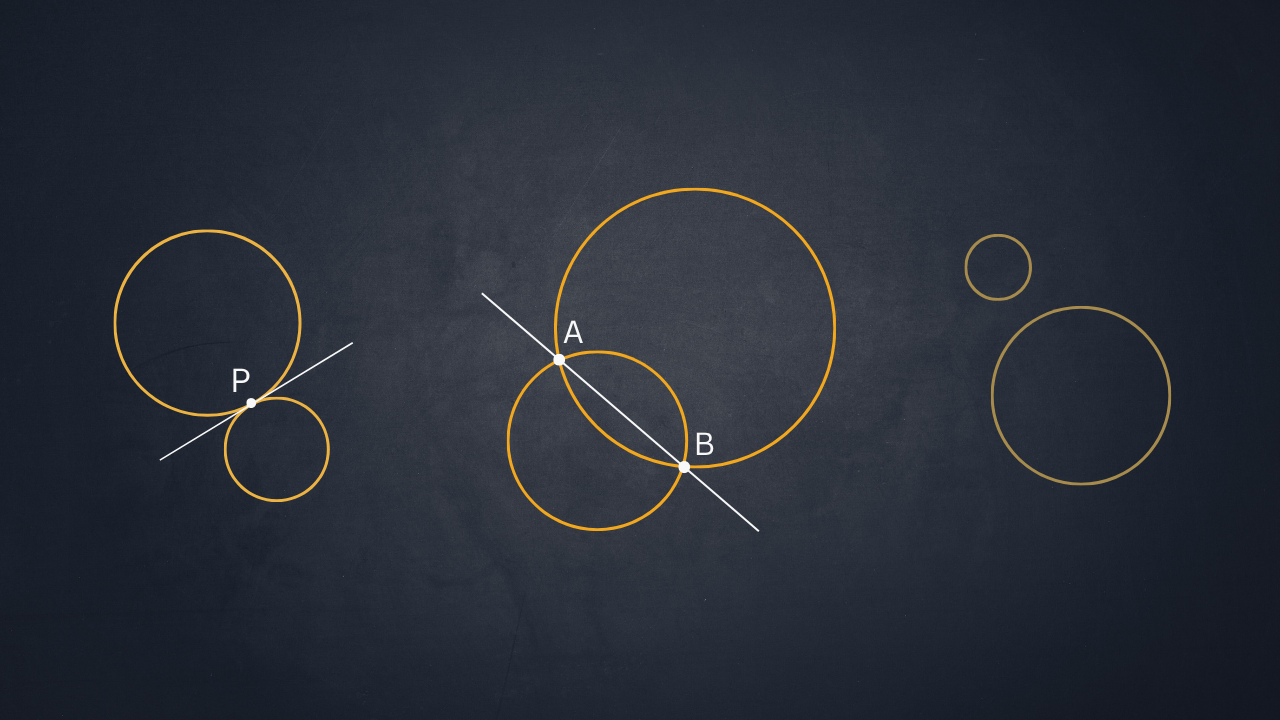
Studying the relative position of two circles means determining how they are arranged in the Cartesian plane, in particular whether they intersect at two points, are tangent at one point, or are completely separate (with no points of intersection).
This problem plays a central role in analytic geometry and can be approached from two complementary perspectives:
- a geometric approach, based on comparing the distance between the centers with the radii;
- an analytic approach, based on solving a system of equations and studying the discriminant Δ.
Although these methods start from different perspectives, they lead to the same results and provide a complete description of all possible configurations.
In the following sections, both approaches will be presented, together with several step-by-step examples, to make clear not only how to carry out the procedure, but also the geometric meaning of the results obtained.
Relative Position of Two Circles: The Possible Cases
Consider two generic circles in the Cartesian plane. Depending on their arrangement, they can be:
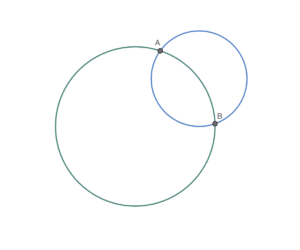
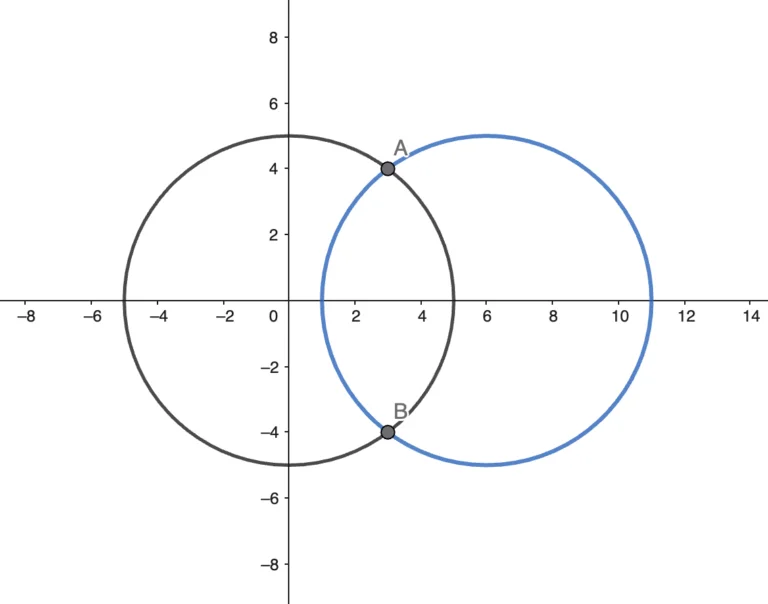
- intersecting — the circles share 2 common points of intersection (Fig.1);
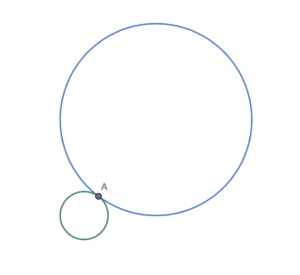
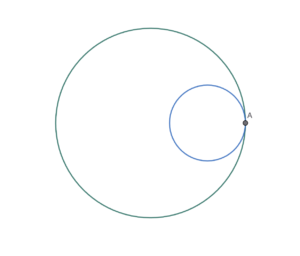
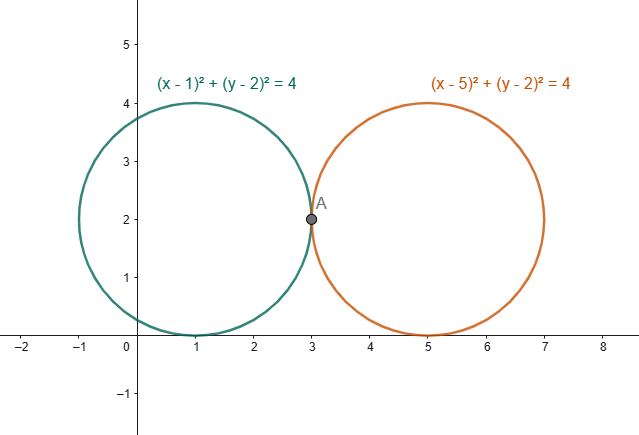
- tangent — the circles share exactly one common point. Tangent circles can further be externally tangent (Fig.2) or internally tangent (Fig.3), depending on their relative position;
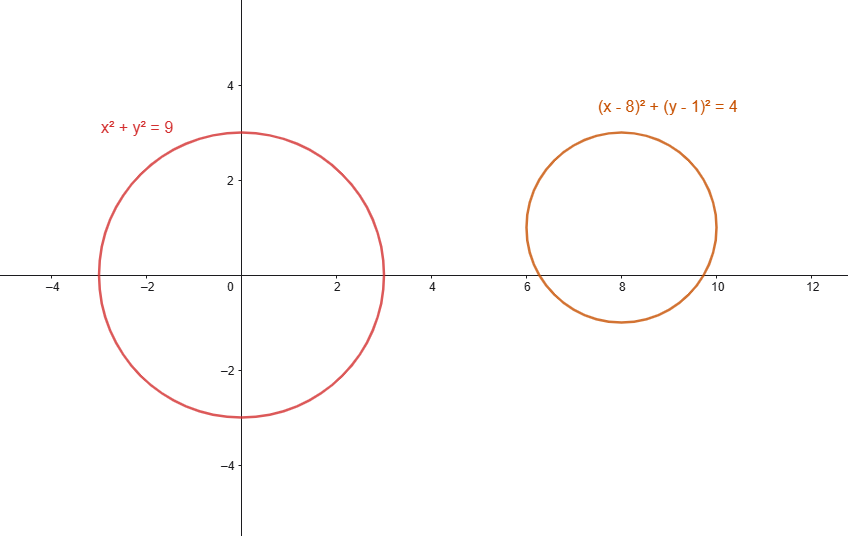
- external (separate) — if there are no common points between them (Fig.4);
- internal — if, again, there are no common points, but one circle lies entirely inside the other (Fig.5);
- coincident — if the two circles coincide (Fig.6).



Geometric Method: Analyzing the Relative Position
Consider two generic circles with equations:
\[\Gamma_1: (x-x_1)^2 + (y-y_1)^2 = r_1^2\] \[\Gamma_2: (x-x_2)^2 + (y-y_2)^2 = r_2^2\]
From the theory of the circle, the centers and the respective radii are:
- centers: \(C_1(x_1, y_1)\) and \(C_2(x_2, y_2)\)
- radii: \(r_1\) and \(r_2\)
The distance between the centers of the two circles is given by:
\[d = \sqrt{(x_2-x_1)^2 + (y_2-y_1)^2} \tag{1}\]
The problem of determining the relative position of the two circles then reduces essentially to comparing:
- the distance \(d\) between the centers \(C_1\) and \(C_2\) and the respective radii
- the sum \(r_1+r_2\)
- the difference \(|r_1-r_2|\)
Referring back to the cases already outlined above, each configuration corresponds to a specific geometric condition:
For intersecting circles, the distance between the centers must be strictly between the absolute value of the difference of the radii and their sum:
\[|r_1-r_2| < d < r_1+r_2 \tag{2}\]
For circles externally tangent, the distance between the centers equals the sum of the radii:
\[d=r_1+r_2 \tag{3}\]
For circles internally tangent, the distance between the centers equals the absolute value of the difference of the radii:
\[d=|r_1-r_2|\tag{4}\]
If the circles share no common point, they can be external or internal to one another, and the following conditions apply, respectively:
\[d>r_1+r_2 \quad \text{(external)}\tag{5}\] \[d<|r_1-r_2| \quad \text{(internal)}\tag{6}\]
In other words, if the circles are external, the distance between their centers must exceed the sum of the radii, while for internal circles the distance between the centers must be smaller than the absolute value of the difference of the radii.
Concentric circles: a special case
A special case of internal circles is that of concentric circles, where the centers coincide (\(d=0\)) but the radii differ (\(r_1 \neq r_2\)): they share no common point.
In the special case of coincident circles, the centers coincide, as do the respective radii:
\[d=0 \;\; \text{and} \;\; r_1=r_2\]
SUMMARY:
- Intersecting → \(|r_1-r_2| < d < r_1+r_2\)
- Externally tangent → \(d = r_1+r_2\)
- Internally tangent → \(d = |r_1-r_2|\)
- External → \(d > r_1+r_2\)
- Internal → \(d < |r_1-r_2|\)
- Coincident → \(d=0\) and \(r_1 = r_2\)
Worked Examples with the Geometric Method
Example 1 – Intersecting Circles
Given the circles
\[\Gamma_1: x^2 + y^2 = 25\] \[\Gamma_2: (x-6)^2 + y^2 = 25\]
determine the relative position between them (state whether they are intersecting, tangent, or otherwise).
SOLUTION
The first step is to correctly identify the data. Here we first find the centers and radii of the two circles:
- \(C_1 = (0,0)\), \(r_1 = 5\)
- \(C_2 = (6,0)\), \(r_2 = 5\)
We then compute the distance between the centers \(C_1\) and \(C_2\) using (1):
\[d=\sqrt{(6-0)^2 + (0-0)^2}=6\]
Next we compute the quantities
\[|r_1-r_2| = 0, \quad r_1+r_2 = 10\]
Comparing the numbers, we find that
\[0<6<10\]
so condition (2) holds: the circles intersect at two distinct points.
Example 2 – Tangent Circles
Given the circles
\[\Gamma_1: (x-1)^2 + (y-2)^2 = 4\] \[\Gamma_2: (x-5)^2 + (y-2)^2 = 4\]
determine the relative position between them.
SOLUTION
As in the previous exercise, we compute
- centers: \(C_1(1,2)\) and \(C_2(5,2)\)
- radii: \(r_1 = r_2 = 2\)
We proceed to compute the distance between the centers \(C_1\) and \(C_2\), again applying (1):
\[d=\sqrt{(5-1)^2 + (2-2)^2}=4\]
We now compute the quantities
\[|r_1-r_2| = 0, \quad r_1+r_2 = 4\]
Comparing the numbers, condition (3) holds immediately: the circles are therefore externally tangent at one point.
Example 3 – External Circles
Given the following circles
\[\Gamma_1: x^2 + y^2 = 9\] \[\Gamma_2: (x-8)^2 + (y-1)^2 = 4\]
determine whether they are tangent, intersecting, internal, or external to one another.
SOLUTION
As always, we start by finding the centers and radii of the two circles. In particular:
- \(C_1 = (0,0), \quad r_1 = 3\)
- \(C_2 = (8,1), \quad r_2 = 2\)
The distance between the centers \(C_1\) and \(C_2\), applying (1), is:
\[d = \sqrt{8^2 + 1^2} = \sqrt{65}\]
Now we compute the quantities
\[|r_1-r_2| = 3-2=1, \quad r_1+r_2 = 5\]
Comparing the numbers, we find that
\[d>r_1+r_2\]
so condition (5) holds: the circles are external to one another, and therefore share no common point.
Analytic Method: System, Radical Axis, and Discriminant
Alongside the geometric method covered in the previous sections, there is, as already mentioned, a further method for determining the relative position of two circles — that is, for establishing whether they share any common points. This is an analytic method based on the concept of the discriminant (delta), which makes it possible to find any points of intersection between two circles or their point of tangency.
The analytic method consists essentially of studying the system formed by the two circles and determining its real solutions.
Setting Up the System
Consider the following equations of circles \(\Gamma_1\) and \(\Gamma_2\):
\[\Gamma_1: x^2 + y^2 + D_1x + E_1y + F_1 = 0\] \[\Gamma_2: x^2 + y^2 + D_2x + E_2y + F_2 = 0\]
The problem of finding the relative position of the two conics can be solved as the system formed by the two equations:
\[\left\{\begin{matrix}x^2 + y^2 + D_1x + E_1y + F_1 = 0\\x^2 + y^2 + D_2x + E_2y + F_2 = 0\end{matrix}\right. \tag{7}\]
Note. To solve system (7), it is convenient to use a technique described in the next section, which also introduces the concept of the radical axis.
Radical Axis and Reduction of the System
Subtracting the equations of system (7) term by term eliminates the quadratic terms, giving:
\[(D_1-D_2)x + (E_1-E_2)y + (F_1-F_2) = 0\tag{8}\]
which is the equation of a line.
This line (8) is called the radical axis of the two circles.
The radical axis has several properties:
- it is the locus of points that have equal power with respect to the two circles
- it contains any points of intersection
- it is perpendicular to the line joining the centers of the circles
Substituting the equation of the radical axis in place of one of the equations of system (7) — say, the second — yields a new system formed by one of the two circles (in this case \(\Gamma_1\)) and the line with equation (8).
This makes clear that the problem of finding the points of intersection between the circles has been reduced to finding the points of intersection between a circle and the radical axis (in a fully equivalent way).
We can therefore write system (7) as equivalent to:
\[\left\{\begin{matrix}x^2 + y^2 + D_1x + E_1y + F_1 = 0\\(D_1-D_2)x + (E_1-E_2)y + (F_1-F_2) = 0\end{matrix}\right. \tag{9}\]
Eliminating one of the two variables from system (9) yields a second-degree equation, which can admit at most 2 distinct solutions depending on the value of the discriminant \(\Delta\).
Studying the Discriminant Δ (Delta)
At this point we study the discriminant (or delta) of system (9).
As known from the theory of second-degree equations, we distinguish the following cases:
- Δ > 0 → two real solutions → intersecting circles at two distinct points
- Δ = 0 → two real and coincident solutions → tangent circles at one point (the circles may nonetheless be either externally tangent, as in Fig.2, or internally tangent, as in Fig.3, at that point)
- Δ < 0 → no real solution → non-intersecting circles (however, this method alone cannot tell whether they are external or internal to one another, as in Fig.4 or Fig.5).
⚠️ Note: to distinguish between external and internal circles (both for tangent circles and for non-intersecting ones), it is necessary to compare the distance between the centers \(d\) with the quantities \(|r_1-r_2|\) or \(r_1+r_2\) (see the geometric method in the first part of this article).
Worked Examples with the Analytic Method
Example 4 – Intersecting Circles (Δ > 0) with a Vertical Radical Axis
With reference to the following circles
\[x^2 + y^2 = 25\] \[(x-6)^2 + y^2 = 25\]
determine any points of intersection.
SOLUTION
Setting up the system of the two equations after writing them in general form gives:
\[\left\{\begin{matrix}x^2 + y^2-25 = 0\\x^2 + y^2-12x + 11 = 0\end{matrix}\right.\]
Subtracting term by term:
\[12x-36 = 0 \Rightarrow x = 3\]
The radical axis therefore has equation
\[x=3\]
which, recall, is the equation of a vertical line.
Note: to find the points of intersection in this case, we cannot use the equation of the radical axis, since substituting the root \(x=3\) into it would only give a trivially true identity. In such cases, finding any points of tangency or intersection requires using the equation of the circle instead.
Substituting the value found into the equation of the circle, we obtain:
\[3^2 + y^2 = 25 \Rightarrow y^2 = 16\] \[y = \pm 4\]
We therefore find two real and distinct solutions (since the discriminant of the system is greater than zero), yielding the following points of intersection:
\[A(3,4) \quad B(3,-4)\]
The two circles therefore intersect at points \(A\) and \(B\).
Note: The equations of the circles are the same as those in Example 1 (already worked with the geometric method), so the graph of the circles matches the one already given in Fig.7. Unlike the previous case, however, this time we arrive directly at the points of intersection in order to establish whether the circles intersect.
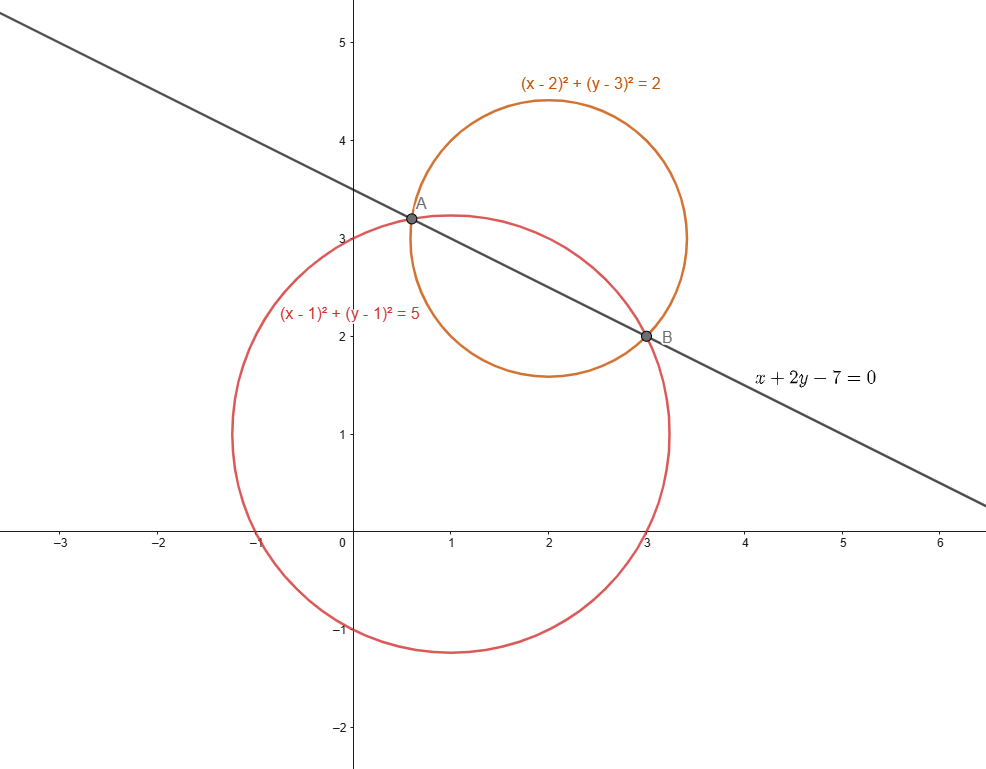
Example 5 – Intersecting Circles (Δ > 0) with a Slanted Radical Axis
Determine whether the following circles
\[(x-1)^2 + (y-1)^2 = 5\] \[(x-2)^2 + (y-3)^2 = 2\]
share any common points, and find them if they exist.
SOLUTION
First, we write both equations in general form as follows:
\[x^2 + y^2-2x-2y-3= 0\] \[x^2 + y^2-4x-6y+11= 0\]
Subtracting the equations term by term gives the equation of the radical axis:
\[x + 2y-7 = 0\]
We now solve the following system:
\[\left\{\begin{matrix}x^2 + y^2-2x-2y-3= 0\\x + 2y-7 = 0\end{matrix}\right.\]
We can solve for \(x\) from the second equation
\[x+2y-7=0 \Rightarrow x=7-2y\]
and substitute it into the first, obtaining:
\[(7-2y)^2 + y^2-2(7-2y)-2y-3= 0\] expanding the squares and rearranging in terms of \(y\), we get: \[49-28y+4y^2+y^2-14+4y-2y-3=0\] simplifying further: \[5y^2-26y+32=0\]
We compute \(\Delta\):
\[\Delta=(-26)^2-4(5)(32)=676-640=36>0\]
Since \(\Delta>0\), the circles are certainly intersecting at two distinct points.
We now find the solutions for \(y\):
\[y=\frac{26\pm \sqrt{36}}{2(5)}=\frac{26\pm6}{10}\]
from which
\[y_1=\frac{16}{5}, \quad y_2=2\]
and finally the values of \(x\):
\[x_1=7-2y_1=7-2\frac{16}{5}=\frac{3}{5}\] \[x_2=7-2y_2=7-2(2)=3\]
The points of intersection are:
\[A\left(\frac{3}{5},\frac{16}{5}\right)\] \[B(3,2)\]
Example 6 – Tangent Circles (Δ = 0)
Determine whether the following circles
\[\Gamma_1: x^2+y^2-10x+6y+22=0\] \[\Gamma_2:x^2+y^2-18x+14y+86+16\sqrt{6}=0\]
share any common points, and find them if they exist. Also determine the equation of the radical axis.
SOLUTION
The equations are already written in general form, so we can proceed directly to subtracting them term by term to obtain the equation of the radical axis:
\[x^2+y^2-10x+6y+22+\] \[-(x^2+y^2-18x+14y+86+16\sqrt{6})=0\]
Simplifying the squares and combining like terms, we obtain
\[x-y-8-2\sqrt{6}=0\]
which is the equation of the radical axis.
To find any points of intersection, we proceed as usual by intersecting one of the two equations with the radical axis. This means solving the system:
\[\left\{\begin{matrix}x^2+y^2-10x+6y+22=0\\x-y-8-2\sqrt{6}=0\end{matrix}\right.\]
From the second equation we solve for \(y\):
\[y=x-8-2\sqrt{6}\]
and substitute it into the first, obtaining:
\[x^2+(x-8-2\sqrt{6})^2-10x+6(x-8-2\sqrt{6})+22=0\]
Carrying out the calculations (left to the reader as an exercise) and rearranging in terms of \(x\), we arrive at:
\[x^2-(10+2\sqrt{6})x+31+10\sqrt{6}=0\]
which, solved for \(x\), gives
\[\Delta=b^2-4ac=(-(10+2\sqrt{6}))^2-4(31+10\sqrt{6})\]
simplifying
\[\Delta=(124+40\sqrt{6})-(124+40\sqrt{6})=0\]
from which the solution
\[x_1=\frac{-b}{2a}=\frac{10+2\sqrt{6}}{2}=5+\sqrt{6}\]
\[y_1=5+\sqrt{6}-8-2\sqrt{6}=-3-\sqrt{6}\]
which are the coordinates of the point of tangency \(A(x_1,y_1)\) of the two circles (Fig.11).
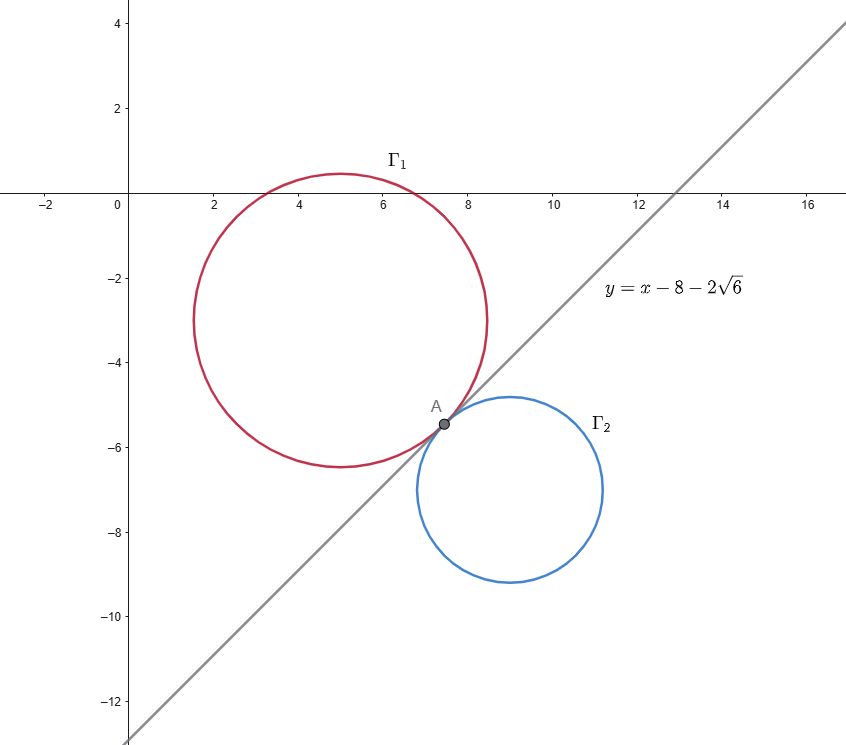
Note: studying the relative position of two circles based on the sign of the discriminant makes it possible, in the case of tangent circles, to find the point of tangency, as shown in the worked example. It does not, however, make it possible to determine whether the circles are externally or internally tangent. To answer that question, we leave it to the reader to verify the condition for external tangency using the geometric method covered in the first part of the article.
Example 7 – External Circles (Δ < 0)
Given the circles with equations
\[\Gamma_1: x^2 + y^2 = 1\] \[\Gamma_2: (x-5)^2 + y^2 = 4\]
determine any points of intersection and the radical axis.
SOLUTION
As always, we start by rewriting the equations of the circles in general form, which gives
\[x^2 + y^2 -1= 0\] \[x^2+y^2-10x+21=0\]
Subtracting the equations term by term to obtain the equation of the radical axis:
\[10x-22 = 0 \Rightarrow x = \frac{11}{5}\]
To find any points of intersection, it is enough, as usual, to substitute the equation of the radical axis into one of the two equations (we always recommend using the simpler one, in this case \(\Gamma_1\)) and solve it for one of the two variables (in this particular case, for \(y\)).
Substituting, we get:
\[\left(\frac{11}{5}\right)^2 + y^2 = 1 \Rightarrow y^2 = 1-\frac{121}{25}\] \[y^2 = -\frac{96}{25}\]
which is impossible, since a square cannot equal a negative number.
We conclude that, since there is no real intersection between the radical axis and \(\Gamma_1\), there is likewise no intersection between the two circles \(\Gamma_1\) and \(\Gamma_2\).
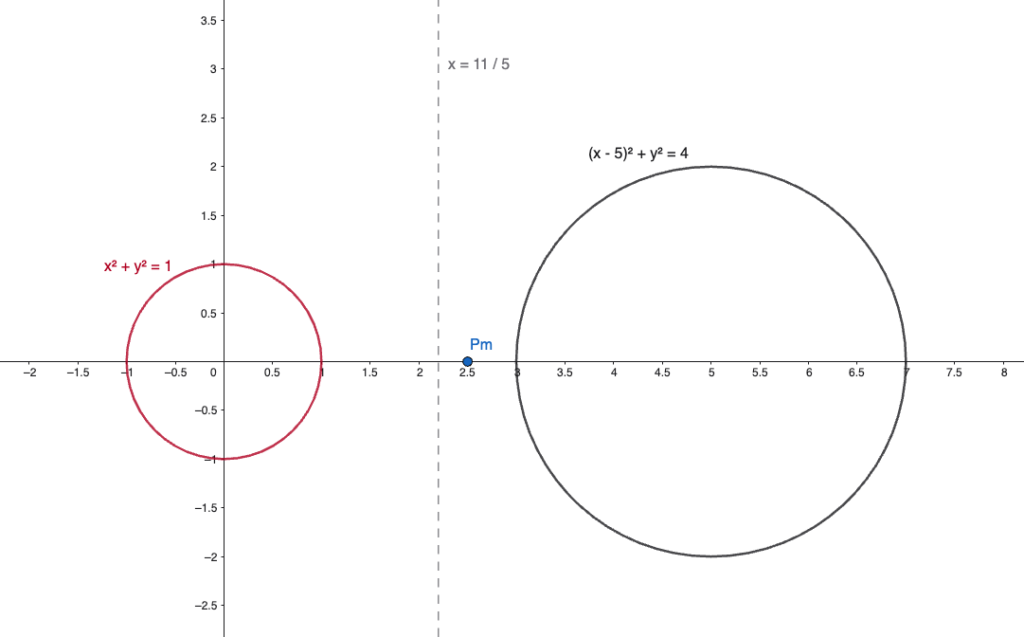
Note: here too, as already seen for tangent circles, this method alone cannot establish whether the circles are external or internal to one another. The answer can instead be found by comparing the distance between the centers with the respective radii (as shown above with the geometric method).
Finally, note that even though the two circles share no common point, the radical axis still exists. It lies closer to the circle with the larger radius, and to the left of the midpoint \(P_m\) of the segment joining the two centers \(C_1(0,0)\) and \(C_2(5,0)\), which has coordinates \(\left(\frac{5}{2},0\right)\).
Common Mistakes
Below is a list of the most common mistakes students make when applying the methods described above.
Forgetting the absolute value \(|r_1-r_2|\)
One of the most frequent mistakes is writing simply \(r_1-r_2\) instead of \(|r_1-r_2|\).
This leads to incorrect conclusions, especially when \(r_2 > r_1\).
Rule to remember:
the difference of the radii must always be taken in absolute value.
Errors in computing the distance between the centers
The distance \(d\) is at the heart of the geometric method. Errors here compromise the entire result.
Typical mistakes:
- forgetting the squares
- sign errors
- not simplifying radicals correctly
Tip:
always write out the intermediate steps, avoiding mental shortcuts in the early stages.
Confusing the tangency cases
Many students remember that “tangent = one point” but fail to distinguish between:
- external tangency → \(d = r_1+r_2\)
- internal tangency → \(d = |r_1-r_2|\)
This matters because it completely changes the relative position of the circles.
Practical tip to avoid mistakes:
- sum of the radii → circles “far apart” that just touch
- difference of the radii → one inside the other
Errors when converting to general form (analytic method)
When converting to general form, students often make errors expanding squares, such as:
\[(x-a)^2 \neq x^2-a^2 \quad \text{incorrect}\]
instead of:
\[(x-a)^2 = x^2-2ax+a^2 \quad \text{correct}\]
An error here compromises:
- the radical axis
- the final equation
- the discriminant
- the solutions
Tip:
always expand each square carefully, paying close attention to signs.
Misreading the discriminant Δ
In the analytic method, the discriminant indicates the number of solutions, but it must be interpreted correctly:
- Δ > 0 → two distinct points
- Δ = 0 → one point (tangency)
- Δ < 0 → no real point
Typical mistake:
- stopping at the calculation without connecting it to its geometric meaning
Fundamental rule:
Δ is not just a number — it is geometric information.
Conclusions
Studying the relative position of two circles is a fundamental step in analytic geometry, because it directly connects:
- geometric properties (distances and radii)
- algebraic tools (equations and systems)
The two methods examined offer different but fully consistent perspectives:
- the geometric method allows an immediate classification of the cases, making the arrangement of the circles in the plane clear
- the analytic method allows a more general and rigorous treatment, valid even in less immediate situations
From a practical standpoint, it is advisable to:
- use the geometric method for a first analysis
- confirm the result, where needed, with the analytic method, or use it to find any common points.
Finally, it is worth stressing that behind every calculation there is not just a technical procedure, but a precise geometric interpretation: each result obtained concretely describes how the two circles meet — or fail to meet — in the plane.
Learning to read this connection between algebra and geometry is the main goal of studying this topic, and it is an essential skill for tackling more advanced exercises with confidence.
See the complete guide to the circle in coordinate geometry for how this connects to tangent lines, pencils of circles, and the rest of the topic.
FINAL TEST
Test your understanding of the material covered above with a short quiz on the relative position of two circles. Each question includes an explanation, whether the answer given is correct or not.
Cite this resource
"If this explanation saved you some confusion, passing it along costs you nothing and might save someone else the same struggle."
Citation
HTML link to copy