
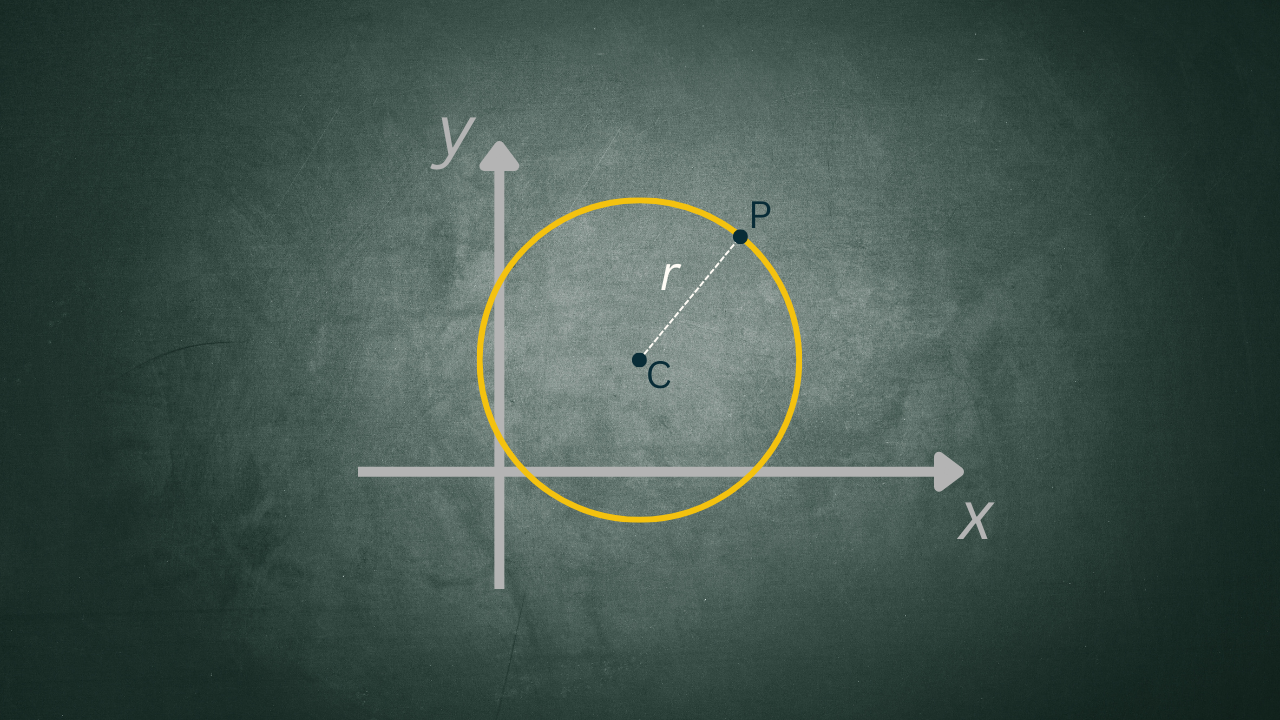
The circle is one of the most widely studied figures in analytic geometry, both for its theoretical importance and for its role in countless exercises. This guide covers how to derive the equation of a circle, how to find its center and radius, and how to determine whether a given equation actually represents a circle.
The following topics are covered in this guide:
- recognizing a circle from its equation
- connecting the circle to the broader family of conic sections
- finding the center and radius of a circle
- distinguishing the three existence cases for a circle
- solving fully worked examples step by step
This guide is written both for students meeting the circle for the first time and for those looking to strengthen their understanding before tackling more advanced problems.
The Definition of a Circle as a Locus
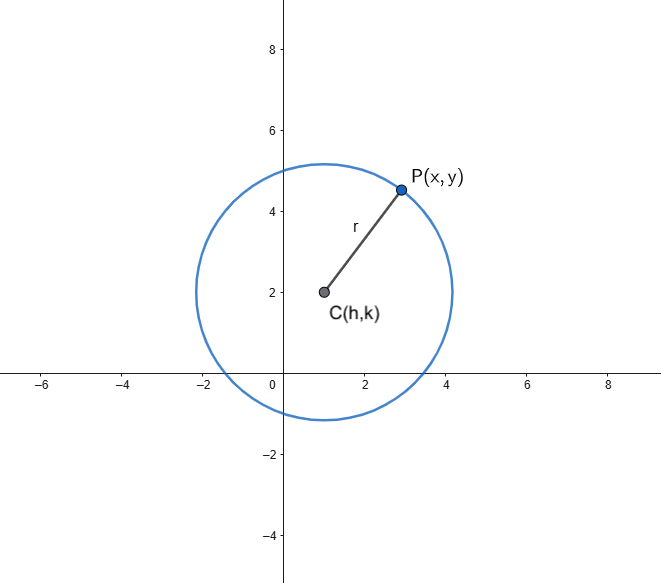
A circle is defined as the locus of points in the plane equidistant from a fixed point, called the center. The constant distance from every point on the locus to the center is called the radius \(r\).
Denoting:
- \(C(h,k)\) the center
- \(r\) the radius
- \(P(x,y)\) a generic point on the circle
the distance between \(P\) and \(C\) is always \(r\). In formulas:
\[PC=r\]
Equation of a Circle Given Center and Radius
By the Pythagorean theorem, the distance between two generic points \(P(x,y)\) and \(C(h,k)\) is given by:
\[PC = \sqrt{(x-h)^2 + (y-k)^2}\]
Since \(PC=r\) must hold, squaring both sides yields the equation of a circle in standard form, with its center and radius made explicit:
\[(x-h)^2 + (y-k)^2 = r^2\tag{1}\]
\[C(h,k):\;\text{center}\]
\[r:\;\text{radius}\]
Equation (1) is one of the most intuitive forms of the circle equation and is especially useful for sketching graphs and working through introductory exercises. Notice that knowing only the coordinates of the center and the radius is enough to represent a circle or write down its equation.
Equation of a Circle Centered at the Origin (A Special Case)
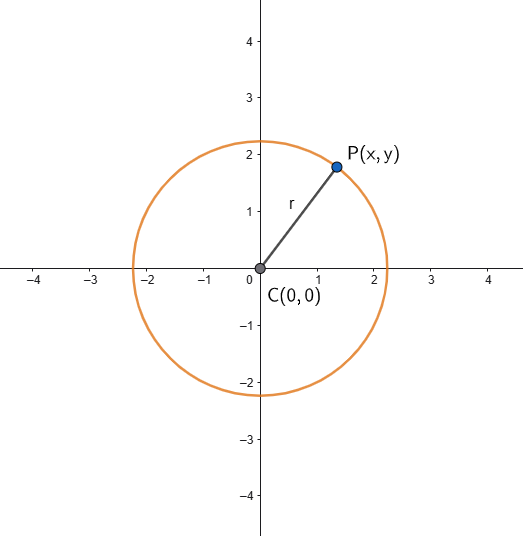
If the center \(C\) of the circle coincides with the origin of the axes, then:
\[C(0,0)\]
Equation (1) then simplifies to:
\[x^2 + y^2 = r^2\tag{2}\]
This equation represents a circle centered at the origin (Fig. 2).
General Form of the Equation of a Circle
Expanding the squares in (1) gives:
\[x^2 +y^2-2hx-2ky+h^2+k^2 = r^2\]
Setting
\[-2h=D\]
\[-2k=E\]
\[h^2+k^2-r^2=F\]
equation (1), after expanding the squares and rearranging, can be written as:
\[x^2 + y^2 + Dx + Ey + F = 0\tag{3}\]
which is called the general form of the equation of a circle.
From these substitutions, the center is given by:
\[C(h,k) = C\left(-\frac{D}{2}, -\frac{E}{2}\right)\tag{4}\]
The radius \(r\) can instead be written as:
\[r = \sqrt{h^2+k^2-F}\]
and therefore, substituting back:
\[r = \sqrt{\frac{D^2}{4} + \frac{E^2}{4}-F}\tag{5}\]
Existence Conditions for a Circle
For the circle to exist, the radius \(r\) defined by (5) must be real and non-negative. Three fundamental cases can be distinguished:
Case 1: Positive Radius (A Real Circle)
If
\[\frac{D^2}{4} + \frac{E^2}{4}-F>0\]
(the left-hand side being the radicand in (5)), it follows that the radius of the circle is positive, so equation (3) represents a real circle.
Example:
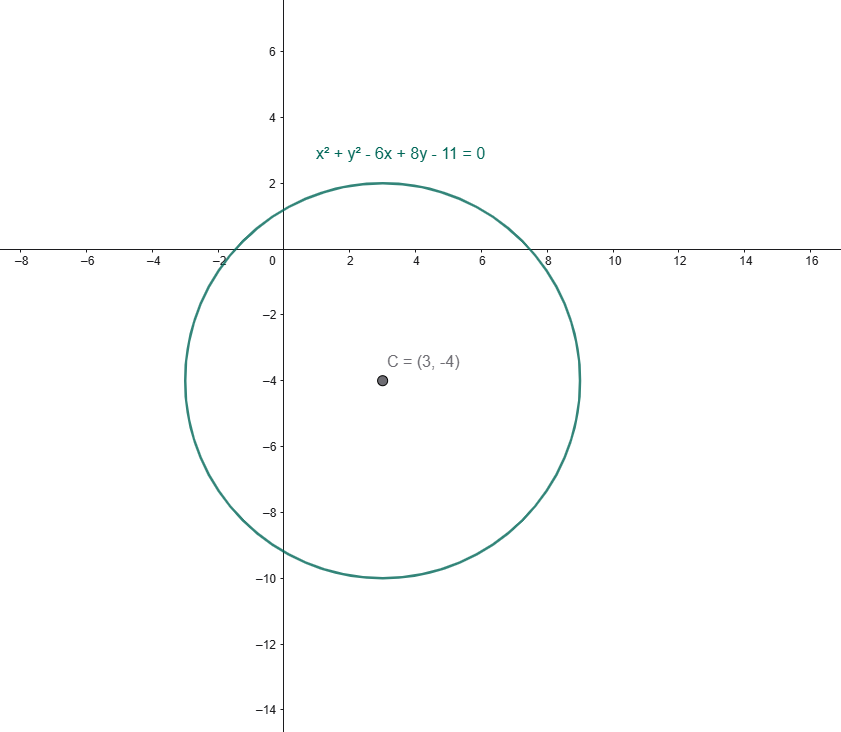
\[x^2 + y^2-6x + 8y-11 = 0\]
In this case:
\[D=-6 \quad E=+8 \quad F=-11\]
Squaring (5) to compute \(r^2\) gives:
\[r^2=\frac{(-6)^2}{4}+\frac{8^2}{4}-(-11)=36\]
This is a real circle with:
- Center at
\[h=-\frac{D}{2}=-\frac{-6}{2}=3\]
\[k=-\frac{E}{2}=-\frac{8}{2}=-4\]
- Radius
\[r=\sqrt{36}=6\]
Case 2: Zero Radius (A Degenerate Circle)
If
\[\frac{D^2}{4} + \frac{E^2}{4}-F = 0\]
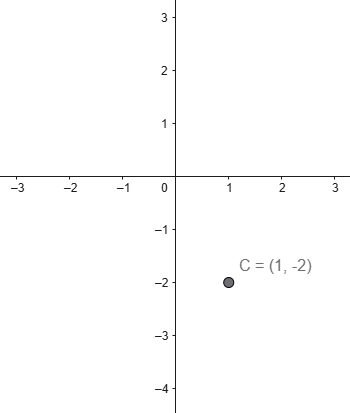
then (5) gives a radius of zero: \(r=0\). In this case the circle collapses to a single point coinciding with its center, and is called a degenerate circle.
Example:
\[x^2 + y^2-2x + 4y + 5 = 0\]
We ask whether this equation represents a circle.
At first glance it might appear to, but squaring equation (5) gives:
\[r^2=\frac{(-2)^2}{4}+\frac{4^2}{4}-(5)=0\]
using the substitutions:
\[D=-2 \quad E=4 \quad F=5\]
Here the radius \(r\) turns out to be zero, so this is a degenerate circle with zero radius.
Case 3: No Real Circle Exists
If instead
\[\frac{D^2}{4} + \frac{E^2}{4}-F<0\]
then (5) becomes meaningless over the reals, since the square of a real number cannot be negative.
⚠️ In this case, equation (3) does not represent any real circle!
Example:
\[x^2 + y^2 + 2x + 4y + 10 = 0\]
Using equation (5), we obtain:
\[r^2=\frac{(2)^2}{4}+\frac{4^2}{4}-(10)=-5\]
which is impossible, since a square cannot equal a negative number.
We conclude that, in this case, the given equation does not represent any real circle.
Connection to Conic Sections
The circle belongs to the family of conic sections. A general conic is represented by an equation of the form:
\[Ax^2 + Bxy + Cy^2 + Dx + Ey + F = 0\tag{6}\]
Equation (6) can define a parabola, a circle, an ellipse, or a hyperbola, depending on the values of the coefficients. (Note that the \(D\), \(E\), \(F\) here are the coefficients of the general conic, not necessarily the same as the \(D\), \(E\), \(F\) of the circle’s general form (3) — the connection between the two is made explicit below.)
Defining the quantity:
\[\Delta=B^2-4AC\]
equation (6) represents different curves depending on the sign of \(\Delta\).
In particular:
- if \(\Delta<0\), the conic is of ellipse type, including the circle as a special case;
- if \(\Delta=0\), the conic is of parabola type;
- if \(\Delta>0\), the conic is of hyperbola type.
A circle arises when:
- \(B=0\) (no mixed \(xy\) term)
- \(A=C\neq0\) (the quadratic coefficients are equal and nonzero)
In that case, dividing equation (6) through by \(A\) reduces it exactly to the general form (3) seen above, with \(D/A\), \(E/A\), \(F/A\) playing the role of the circle’s \(D\), \(E\), \(F\).
For the bigger picture — how this fits together with tangent lines, pencils of circles, and the relative position between circles and lines — see the complete guide to the circle in coordinate geometry.
Worked Examples on the Circle
Example 1
Write the equation of the circle with center \(C(-4,1)\) and radius 3.
SOLUTION
Since the center and radius are known, (1) can be applied directly. This gives:
\[(x +4)^2 + (y-1)^2 = 3^2\]
Expanding the squares and simplifying:
\[x^2+8x+16+y^2-2y+1=9\]
\[x^2+y^2+8x-2y+8=0\]
Example 2
Write the equation of the circle centered at the origin and passing through the point \(A(3,6)\).
SOLUTION
The solution here follows directly from equation (2); however, the radius must first be found as the distance from the origin to point \(A\):
\[r=OA=\sqrt{3^2+6^2}=\sqrt{45}\]
By (2), this gives:
\[x^2 + y^2 = 45\]
Example 3
Determine whether the equation
\[3x^2+3y^2-2x+7y=9\]
represents a circle, and if so, find its center and radius.
SOLUTION
The first step is to rewrite the given equation in general form by dividing through by 3 and rearranging:
\[x^2+y^2-\frac{2}{3}x+\frac{7}{3}y-3=0\]
The coefficients \(D, E,\) and \(F\) are then:
\[D=-\frac{2}{3}\]
\[E= \frac{7}{3}\]
\[F=-3\]
and, using (5), the radius:
\[r = \sqrt{\frac{D^2}{4} + \frac{E^2}{4}-F}=\]
\[= \sqrt{\frac{(-2/3)^2}{4}+\frac{(7/3)^2}{4} +3}=\frac{\sqrt{161}}{6}\]
Since the radius is positive, this is a real circle centered at:
\[C(h,k) = C\left(-\frac{D}{2}, -\frac{E}{2}\right)=C\left(\frac{1}{3}, -\frac{7}{6}\right)\]
Example 4
Determine whether the equation
\[x^2+y^2+2x+3y+16=0\]
represents a circle, and if so, find its center and radius.
SOLUTION
Notice first that the equation is already written in general form, so the coefficients \(D, E,\) and \(F\) can be read off directly:
\[D=2\]
\[E= 3\]
\[F=16\]
Using (5), compute \(r^2\):
\[r^2 = \frac{D^2}{4} + \frac{E^2}{4}-F=\]
\[= \frac{2^2}{4} + \frac{3^2}{4}-16=-\frac{51}{4}\]
Since \(r^2<0\), no such circle exists.
Example 5
Find the values of the real parameter \(m\) for which the equation
\[x^2+y^2-mx+6y-m+1=0\]
represents a circle.
SOLUTION
For the given equation to represent a circle, the radius must be positive. Using (5):
\[r = \sqrt{\frac{D^2}{4} + \frac{E^2}{4}-F}>0\]
which holds if and only if the radicand is positive, that is:
\[\frac{D^2}{4} + \frac{E^2}{4}-F>0\]
Here the coefficients of the equation are:
\[D=-m\]
\[E= 6\]
\[F=1-m\]
Substituting:
\[\frac{(-m)^2}{4} + \frac{6^2}{4}+m-1>0\]
This reduces to solving a quadratic inequality in \(m\). Multiplying both sides by 4:
\[m^2+4m+32>0\]
Computing the discriminant \(\Delta\):
\[\Delta=4^2-4(32)=-112<0\]
From the theory of quadratic inequalities, since \(\Delta<0\) and the leading coefficient is positive, the inequality holds for every real value of \(m\). The given equation therefore always represents a real circle, regardless of the value of the parameter \(m\).
Conclusion
The equation of a circle is one of the fundamental tools of analytic geometry.
Knowing how to use it makes it possible to recognize when an equation truly represents a circle and to easily determine its main features.
In particular, starting from the equation, it is possible to:
- find the center of the circle;
- compute the radius;
- determine whether the equation represents a real circle, a degenerate circle, or whether no real circle exists.
The techniques covered in this guide form the basis for many analytic geometry exercises on the circle.
Upcoming articles will explore some classic problems in more depth, such as the relative position of a line and a circle, finding tangent lines, and determining the circle through three given points.
FINAL TEST
Test what you’ve learned with this short quiz on the equation of a circle — ten questions covering standard form, general form, center and radius, existence conditions, and the connection to conic sections.
Circle Equation Quiz
Test your understanding — 10 questions
Cite this resource
"No shortcuts went into this one — just careful writing and checking. If it helped you, consider sharing it or citing it as a source."
Citation
HTML link to copy