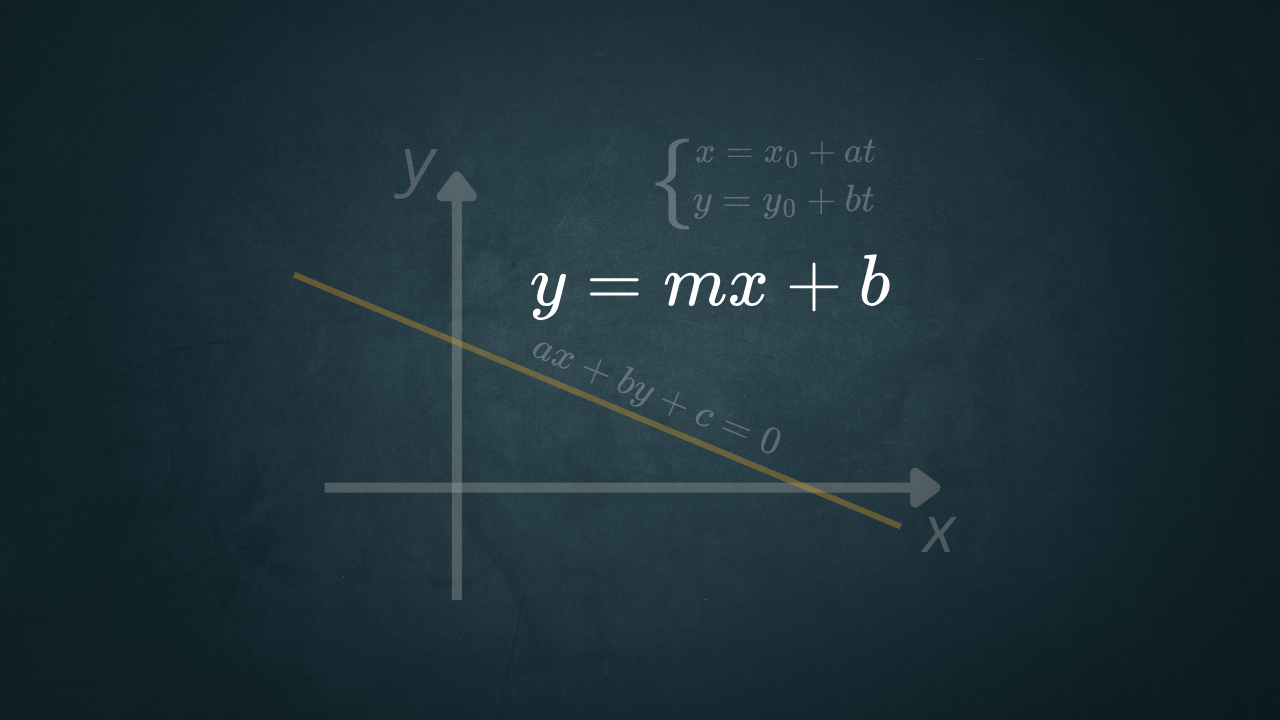
When studying lines in the coordinate plane, the first real difficulty is rarely understanding what a line is. It is writing its equation correctly for the situation at hand. The same line often shows up in several different-looking equations, and although the algebra changes shape, the underlying geometric object stays exactly the same.
There is no such thing as a “mysterious” equation here: there are only different forms of the same equation, each one built to be convenient in a specific situation. Once the meaning and the use of each form are clear, working with lines becomes far more reliable, unnecessary mistakes disappear, and choosing the most efficient approach to a given problem becomes second nature.
This article works through, in order:
- the Slope-Intercept Form
- the General Form
- the Parametric Form
of a line, showing how they connect to one another and when each one is the right tool.
Slope-Intercept Form of a Line
The Slope-Intercept Form is probably the most familiar form, and usually the first encountered in the study of analytic geometry.
A line is written in Slope-Intercept Form when its equation has the type:
\[y=mx+b\]
where:
- \(m\) is the slope
- \(b\) is the \(y\)-intercept
Geometric Meaning of the Parameters
The slope \(m\) describes how steeply the line is tilted with respect to the \(x\)-axis:
- if \(m>0\), the line is increasing
- if \(m<0\), the line is decreasing
- if \(m=0\), the line is horizontal
The term \(b\) marks the point where the line crosses the \(y\)-axis, namely the point with coordinates \((0,b)\).
When Slope-Intercept Form Is the Right Choice
Slope-Intercept Form is particularly useful when:
- the goal is to graph a line
- the steepness of two lines needs to be compared
- the problem concerns parallel or perpendicular lines
It is not, however, always the most convenient form — especially when the equation cannot easily be solved for \(y\).
General Form of a Line
The General Form of the equation of a line is written as:
\[Ax+By+C=0\]
where \(A\), \(B\), and \(C\) are real numbers, with \(A\) and \(B\) not both zero.
In this form:
- the variable \(y\) is not isolated
- the equation treats the variables \(x\) and \(y\) symmetrically
- vertical lines can also be represented
For instance, the line
\[x=3\]
cannot be written in Slope-Intercept Form, but in General Form it becomes:
\[x-3=0\]
Converting Slope-Intercept Form to General Form
Starting from Slope-Intercept Form, it is sometimes necessary to rewrite a line in General Form.
Example
Line in Slope-Intercept Form:
\[y=\frac{2}{3}x-1\]
We multiply by 3 to clear the denominator:
\[3y=2x-3\]
\[2x-3y-3=0\]
Converting General Form to Slope-Intercept Form
In the same way, it is often necessary to go the other way: from General Form back to Slope-Intercept Form. Two examples follow.
Example 1
Consider the following line written in General Form:
\[2x-3y+6=0\]
We isolate \(y\):
\[-3y=-2x-6\]
Dividing by \(-3\):
\[y=\frac{-2x-6}{-3}\]
so, distributing the denominator term by term, we obtain:
\[y=\frac{-2}{-3}x+\frac{-6}{-3}\]
\[y=\frac{2}{3}x+2\]
This last equation represents the line in Slope-Intercept Form, with slope \(m=\frac{2}{3}\) and \(y\)-intercept \(b=2\).
Example 2
Consider the line:
\[5x+2y-4=0\]
We isolate \(y\):
\[2y=-5x+4\]
so we divide both sides by 2 and simplify:
\[y=-\frac{5}{2}x+2\]
The slope is therefore \(m=-\frac{5}{2}\), while the \(y\)-intercept is \(b=2\).
Parametric Form of a Line
The Parametric Form describes a line as the set of points generated as a real parameter \(t\) varies. It can be written as:
\[x=x_0+at\]
\[y=y_0+bt,\quad t\in\mathbb{R}\]
where:
- \((x_0,y_0)\) is a point on the line
- \((a,b)\) is a direction vector
Meaning of the Parameter \(t\)
The parameter \(t\) makes it possible to “slide” along the line:
- different values of \(t\) generate different points
- as \(t\) varies, the entire line is traced out
Example: From Parametric Form to Cartesian Form
Given the parametric line:
\[x=1+2t\]
\[y=3-t\]
find its equation in Cartesian form.
SOLUTION
To find the Cartesian form of the line, we need to eliminate the parameter \(t\) from the system.
For instance, we can first solve for \(t\) in the second equation:
\[t=3-y\]
and substitute it into the first equation, so as to eliminate \(t\); in formulas:
\[x=1+2(3-y)\]
\[x=1+6-2y\]
\[x+2y-7=0\]
This last equation represents the line in General Form.
Parametric line explorer
Line in parametric form: \( x = 1 + 2t \), \( y = 3 – t \)
Example: From Cartesian Form to Parametric Form
Given the line \(r\) in Slope-Intercept Form:
\[r:\;y=2x-1\]
find a representation of it in Parametric Form.
SOLUTION
In this case, the first step is to choose a point \(P_0\) that lies on the line: for convenience, we can pick the value \(x_0=0\) and find \(y_0\) from the Cartesian equation.
This gives:
\[y_0=2\cdot(0)-1\]
\[y_0=-1\]
The point \(P_0\) therefore has coordinates \((0,-1)\).
At this point, setting \(x=t\) and substituting into the original equation gives the system:
\[x=t\]
\[y=-1+2t\]
From this system, we can immediately read off the coefficients \(a\), \(b\) of the direction vector:
\[a=1 \quad b=2\]
Connecting the Different Forms of a Line
The three forms of the equation of a line do not describe different lines. They describe the same geometric object seen from different points of view. Each form brings out certain properties of the line and turns out to be more convenient in specific contexts, but all of them are equivalent to one another.
In particular:
- Slope-Intercept Form ↔ General Form
the conversion happens through simple algebraic manipulations, with the exception of vertical lines; - Parametric Form ↔ Cartesian Form
the connection is made by introducing or eliminating the parameter \(t\), depending on the starting form.
Which Form to Choose in Problems
No form is "the best one" in an absolute sense. The choice depends on the type of problem:
- Slope-Intercept Form → graphing, parallelism, perpendicularity
- General Form → intersections, vertical lines, algebraic computations
- Parametric Form → problems involving points and directions, vector geometry
These three forms are part of the broader toolkit covered in the complete guide on the line in analytic geometry.
Common Mistakes to Avoid
- Thinking that different forms represent different lines
- Forgetting that vertical lines have no Slope-Intercept Form
- Confusing the slope with the coefficients of the General Form
- Using Parametric Form without correctly specifying the parameter
Conclusion
The different forms of the equation of a line are not competing alternatives. They are complementary tools.
Moving from General Form to Slope-Intercept Form, from Parametric to Cartesian and back again, is simpler than it looks. With a few logical steps and a careful choice of points and direction vectors, any line can be represented in all of its forms. Knowing how to recognize, transform, and use each one in the right context makes it possible to tackle both basic exercises and the more structured problems of analytic geometry with confidence.
Final Test
Ten questions test recognition of the three forms of a line and the algebraic conversions between them. Each question includes immediate feedback with a full explanation.
Cite this resource
"This page didn't write itself — every word here was written and checked by hand. If it helped you, sharing it or citing it as a source helps it reach the next student who needs it."
Citation
HTML link to copy