
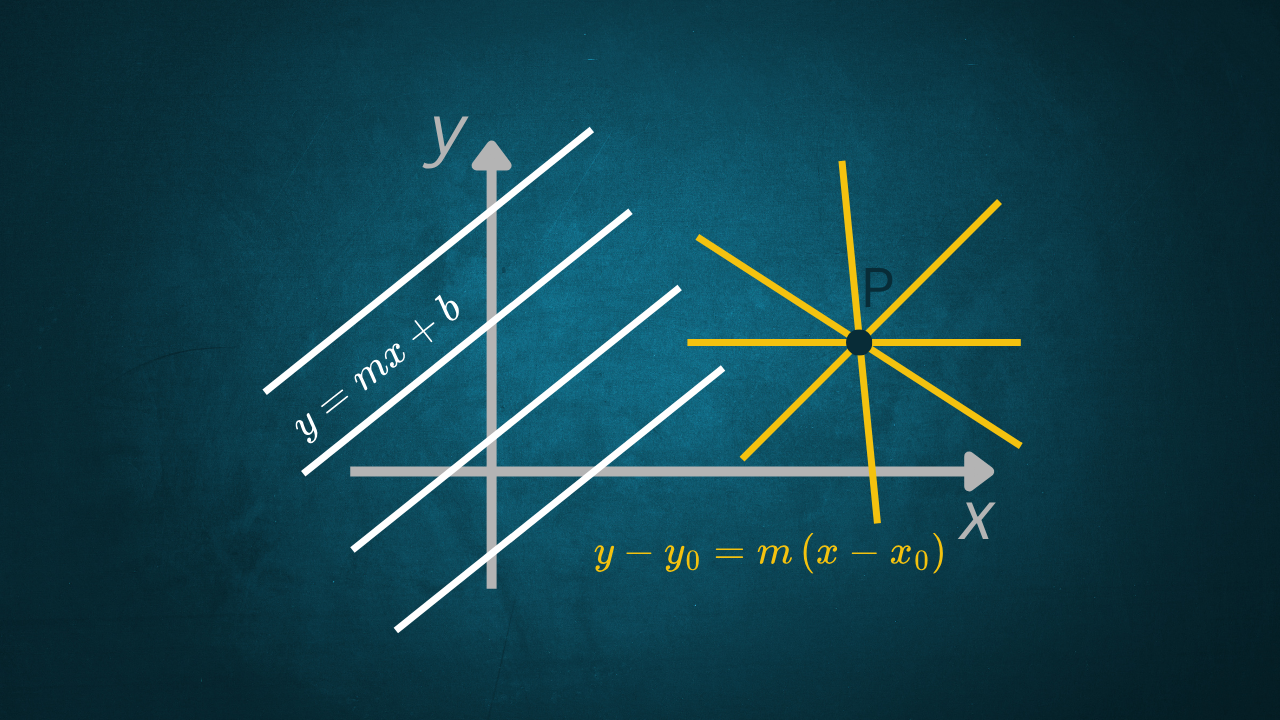
A family of concurrent lines and a family of parallel lines are two closely related but distinct concepts in analytic geometry, describing sets of lines that share a common feature: either passing through the same point or being mutually parallel.
Understanding the difference between these two types of families makes it possible to approach problems involving intersections, parallelism, perpendicularity, and the distance between a point and a line with greater confidence. This guide provides clear definitions, general formulas, and fully worked examples. In particular, the following topics are covered:
- What a family of lines is
- The difference between a family of concurrent lines and a family of parallel lines
- How to write the equation of each type of family
- Fully worked examples
- Connections with other concepts in analytic geometry
What Is a Family of Lines
A family of lines is a set of lines that share a common feature. There are two main types of families:
- Family of concurrent lines – all the lines pass through the same point;
- Family of parallel lines – all the lines are parallel to one another, and therefore never meet.
Family of Concurrent Lines
A family of concurrent lines is a set of lines that all pass through the same point \(P(x_0, y_0)\). This point is called the point of concurrency of the family.
General Equation of the Family of Concurrent Lines
Consider two distinct lines \(r_1\) and \(r_2\) that pass through a point \(P(x_0,y_0)\) common to both.
Then any line belonging to the family can be written as a linear combination of the two given lines \(r_1\) and \(r_2\); in particular, in general form, this gives:
\[(\text{equation of}\;r_1)+\]
\[+\lambda(\text{equation of}\;r_2)=0, \;\; \lambda \in \mathbb{R}\tag{1}\]
This last equation is the general form of a family of concurrent lines.
Equivalently, when solving exercises it is often more convenient to use a more immediate form than (1), relying on the slope \(m\):
\[y – y_0 = m(x – x_0), \quad m \in \mathbb{R}\tag{2}\]
This equation allows every line belonging to the family of concurrent lines to be interpreted as the generic line \(r\) passing through the point \(P(x_0,y_0)\), as the slope \(m\) varies.
Note. In general, the equation of a family of lines can be written in combined form, that is, as a linear combination of two given lines (1). Introducing a real parameter \(\lambda\), this makes it possible to obtain every line of the family simply by varying the value of that parameter.
Example
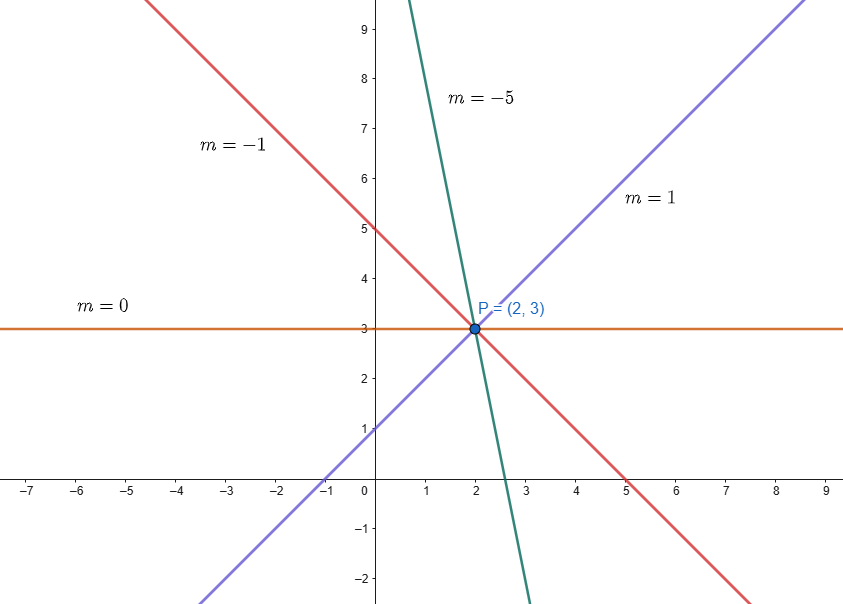
Problem: Find the equation of all lines passing through \(P(2,3)\).
Solution:
A generic line through \(P\) has equation:
\[y-3=m(x-2)\]
with \(m \in \mathbb{R}\).
This equation represents the family of concurrent lines as \(m\) varies, as shown in Fig. 1.
Equivalently, in general form, two particular lines can be chosen:
\[r_1: y – 3 = 0 \quad (\text{horizontal line through P})\]
\[r_2: x – 2 = 0 \quad (\text{vertical line through P})\]
and a representation can be obtained through a linear combination of these two.
The combined form of the family then becomes:
\[(y – 3) + \lambda (x – 2) = 0, \quad \lambda \in \mathbb{R}\]
Interpretation: By varying \(\lambda\), every line passing through \(P(2,3)\) is obtained.
Family of Parallel Lines
A family of parallel lines is a set of lines that are all parallel to one another, so that none of them intersect. It follows immediately that all the lines of a family of parallel lines share the same slope \(m\).
General Equation of the Family of Parallel Lines
If \(m\) denotes the common slope, the generic line of the family of parallel lines can be written in slope-intercept form as:
\[y = mx + b, \quad b \in \mathbb{R}\tag{3}\]
or in general form:
\[y – mx – b = 0, \quad b \in \mathbb{R}\]
Example
Problem: Write all the lines parallel to \(y=2x+1\).
Solution:
- Slope \(m\) = 2
- The generic line of the family can be written using (3) as:
\[y = 2x + b, \quad b \in \mathbb{R}\]
- By varying \(b\), every line parallel to \(y = 2x + 1\) is obtained (Fig. 2).
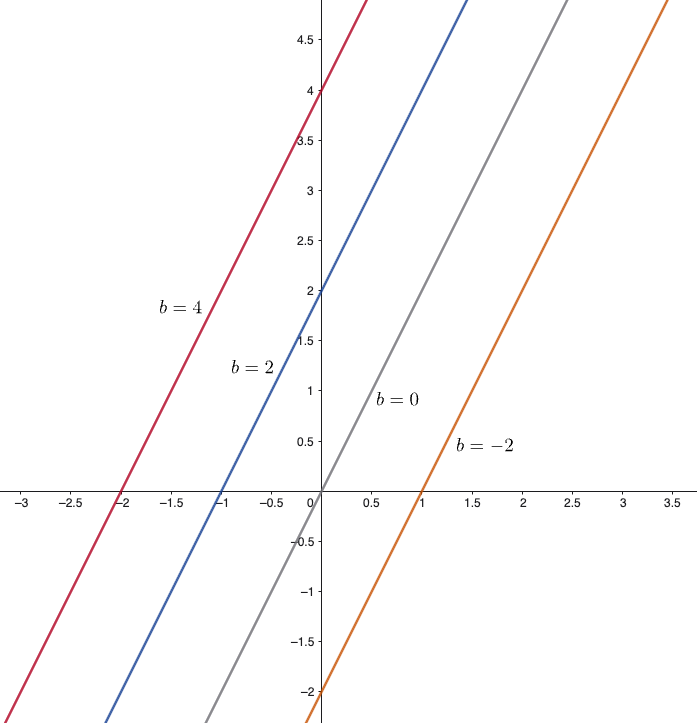
Interpretation: This family has no common point at all, since the lines never meet.
Connections with Other Concepts About Lines
The concept of a family of lines connects naturally with the other fundamental topics on lines already covered, in particular with:
Parallel and Perpendicular Lines: → a family of parallel lines consists of lines that are all parallel to one another, while within a family of concurrent lines it is always possible to find a line perpendicular to a given line.
Slope of a Line → every line of a family has its own slope. In a family of parallel lines the slope is constant, while in a family of concurrent lines it varies as the parameter \(m\) or \(\lambda\) changes.
Distance of a Point from a Line → studying families of lines is useful for finding which line of the family achieves the minimum distance from an external point.
Equation of a Line Through Two Points → every line of a family of concurrent lines can be interpreted as the line passing through the point of concurrency and any external point of the plane.
Families of lines are one of several core topics covered in the complete guide on the line in analytic geometry.
Fully Worked Exercises
Exercise 1: Family of Concurrent Lines
Problem: Find the equation of the family of concurrent lines through \(P(1,-2)\) that contains the line \(y=3x-5\).
Solution:
Using (1), it is straightforward to write the linear combination of the horizontal and vertical lines through \(P(1,-2)\).
The horizontal line through \(P\) has equation:
\[y+2=0\]
The vertical line through \(P\) is represented by the equation:
\[x-1=0\]
Using (1), the family of concurrent lines can therefore be written as:
\[y+2+\lambda(x-1)=0, \quad \lambda \in \mathbb{R}\]
Notice that the same result can be reached using form (2), which gives:
\[y+2=m(x-1), \quad m \in \mathbb{R}\]
This is equivalent to the linear combination of the horizontal and vertical lines through \(P\), where
\[\lambda=-m\]
Finally, to confirm that the given line belongs to the family, it is enough to observe that for \(m=3\) the equation of the family of concurrent lines yields the line \(y=3x-5\).
Exercise 2: Family of Parallel Lines
Problem: Write the equation of the family of lines parallel to \(y = -\frac{1}{2}x + 1\) and passing through a generic point \(P(x_0, y_0)\).
Solution:
- The slope of the given line is \(m = -\frac{1}{2}\)
- The set of lines parallel to the given one can be obtained by writing the equation of the family of parallel lines as follows:
\[y = -\frac{1}{2}x + b\]
- Requiring that it pass through \(P(x_0, y_0)\), substituting the coordinates of \(P\) gives:
\[y_0 = -\frac{1}{2}x_0 + b \Rightarrow b = y_0 + \frac{1}{2}x_0\]
- Substituting the value of \(b\) into the equation of the family of parallel lines gives the final equation of the line through \(P\) and parallel to the given line:
\[y = -\frac{1}{2}x + \left(y_0 + \frac{1}{2}x_0\right)\]
Practical Tips
- Tell the two families apart clearly: students often confuse the two concepts; keep in mind that a point of concurrency exists only for the family of concurrent lines.
- Use the combined form for a family of concurrent lines, since it generates every line of the family by varying a single parameter \(\lambda\).
- Exercises and graphs help visualize each family: a family of concurrent lines “converges” toward a point, while a family of parallel lines stays “parallel.”
Conclusion
Families of lines are a natural extension of the study of the line in the Cartesian plane and represent a central topic in analytic geometry. Understanding families of concurrent and parallel lines:
- makes it possible to solve advanced problems in analytic geometry;
- connects algebra and geometry in an intuitive way;
- makes it easier to understand multiple intersections and problems of parallelism and perpendicularity.
Thanks to the examples and fully worked exercises above, the behavior of lines within each family should now be clear and easy to visualize.
Final Test
Ready to check what you’ve learned? Work through the ten questions below to test your understanding of concurrent and parallel families of lines.
Cite this resource
"No shortcuts went into this one — just careful writing and checking. If it helped you, consider sharing it or citing it as a source."
Citation
HTML link to copy