

Solved exercises on lines in analytic geometry represent a fundamental step for consolidating the understanding of the formulas and methods studied in the theoretical part. After examining the equation of a line, slope, the conditions for parallelism and perpendicularity, and the different forms of the equation, it is through guided application that these tools acquire real operational meaning.
This collection presents a series of solved exercises on the line organized by topic, starting with direct applications of the formulas and progressing to situations that require multiple logical steps and a firmer grasp of the concepts. Each solution is worked out step by step, with a recap of the formulas used and an explanation of the procedure adopted, so as to provide not just the final result, but above all the method.
This section covers the following topics through these exercises on the line:
- finding the equation of a line in different forms
- calculating the slope
- finding the line through two points
- writing the equation of parallel and perpendicular lines
- finding the intersection of two lines
- working with geometric loci and families of lines
Note: For the full theory behind these exercises, see the complete guide on the line in analytic geometry.
Exercises on Slope-Intercept Form and General Form of the Equation of a Line
QUICK THEORY RECAP on SLOPE-INTERCEPT FORM AND GENERAL FORM
Recall that:
- the slope-intercept form of the equation of a line is:
\[y=mx+b\]
- the general form is:
\[ax+by+c=0\]
with \(a\) and \(b\) not both zero.
Exercise 1
Find the slope-intercept form of the line with equation: \(2x-y+3=0\).
SOLUTION
The equation is expressed in general form.
To find the slope-intercept form, we need to isolate the variable \(y\).
In this case, it is enough to move the term \(-y\) to the other side, which gives:
\[2x+3=y\]
This is the equation of the given line written in slope-intercept form.
It is worth pointing out that nothing changes if we write it in the perfectly equivalent form with the dependent variable \(y\) on the left-hand side: \(y=2x+3\).
Exercise 2
Write in general form the line with equation:
\[y=-\frac{1}{2}x + 4\]
The given equation is written in slope-intercept form.
To switch to general form, we need to clear the denominator and move all terms to the left-hand side.
In this case, let’s multiply both sides by 2:
\[2y=-x+8\]
Now let’s move all terms to the left:
\[x+2y-8=0\]
This last equation is the general form of the original equation.
Notice that the coefficients \(a\), \(b\), and \(c\) identifying the line in general form are:
\[a=1\quad b=2\quad c=-8\]
Exercises on Lines Through the Origin
QUICK THEORY RECAP on LINES THROUGH THE ORIGIN
A line is said to pass through the origin when it contains the point \(O(0,0)\).
In slope-intercept form, it necessarily takes the form:
\[y=mx\]
since the \(y\)-intercept \(b\) is zero.
Exercise 1
Find the equation of the line through the origin with slope \(m=4\).
SOLUTION
Substituting the given value of the slope, we get:
\[y=4x\]
This is the required equation.
Exercise 2
Find the equation of the line through the origin and through the point \(P(3,-6)\).
SOLUTION
To find the equation of the line, we first need to calculate the slope.
The slope of the line through the points \(O(0,0)\) and \(P(3,-6)\) is:
\[m=\frac{-6 – 0}{3 – 0}=-2\]
Since the line passes through the origin, its equation is \(y=mx\), so substituting the value of \(m\), we get:
\[y=-2x\]
If we wanted to check that point \(P\) actually lies on the line, we simply need to verify that the point satisfies the given equation.
For \(x_0=3\), the equation gives:
\[y_0=-2x_0=-2(3)=-6\]
Since this matches the \(y\)-coordinate of \(P\), we conclude that point \(P\) does indeed lie on the given line.
Exercise 3
Find the value of the parameter \(a\) for which the line through the origin and through the point \(P(a,2a+1)\) is parallel to the line with equation \(y=3x-2\).
SOLUTION
For two lines to be parallel, they must have the same slope.
The given line has slope: \(m=3\).
Let’s now calculate the slope of the line through the origin and through \(P(a,2a+1)\):
\[m = \frac{2a + 1 – 0}{a – 0}=\frac{2a + 1}{a}\]
For the line to be parallel to the given one, we must have:
\[\frac{2a + 1}{a} = 3\]
Multiplying by \(a\), with \(a \neq 0\):
\[2a+1=3a\]
from which:
\[a=1\]
Exercises on Lines Parallel to the Coordinate Axes
QUICK THEORY RECAP on LINES PARALLEL TO THE COORDINATE AXES
Lines parallel to the axes represent special cases:
- a line parallel to the \(x\)-axis has equation \(y=k\);
- a line parallel to the \(y\)-axis has equation \(x=h\).
In the first case, the slope is \(m=0\);
in the second case, the line has no slope-intercept form.
Exercise 1
Write the equation of the line parallel to the \(x\)-axis and through the point \(Q(2,-3)\).
SOLUTION
A line parallel to the \(x\)-axis has equation: \(y=k\)
Since it must pass through the point \(Q(2,-3)\), the \(y\)-coordinate of the point determines the value of \(k\).
The equation is:
\[y=-3\]
Exercise 2
Find the equation of the line parallel to the \(y\)-axis and through the point \(A(-5,4)\).
SOLUTION
A line parallel to the \(y\)-axis has equation: \(x=k\)
Since it must pass through the point \(A(-5,4)\), the value of \(x\) is constant and equal to \(k=-5\).
The equation of the line is therefore:
\[x=-5\]
Exercise 3
Find the value of the parameter \(t\) for which the line with equation
\[y=(t-2)x+1\]
is parallel to the \(x\)-axis.
SOLUTION
A line is parallel to the \(x\)-axis if and only if its slope is zero.
The slope of the given line is:
\[m=t-2\]
We impose the condition:
\[t-2=0\]
For \(t=2\), the equation becomes:
\[y=1\]
which represents a line parallel to the \(x\)-axis.
Exercises on the Slope of a Line
QUICK THEORY RECAP on SLOPE
The slope of a line is defined as:
\[m = \frac{y_B – y_A}{x_B – x_A}\]
Exercise 1
Given the points \(A(-4,2)\) and \(B(-5,9)\), find the slope of the line through these points.
SOLUTION
To find the slope of a line through two points \(A\) and \(B\), we use the formula:
\[m = \frac{y_B – y_A}{x_B – x_A}\]
Substituting the values, we get:
\[m = \frac{9 – 2}{-5 – (-4)} = \frac{7}{-1} = -7\]
Exercise 2
Given the points \(A(-1,\sqrt{2})\) and \(B(\frac{2}{3},3)\), find the slope of the line through these points.
SOLUTION
As in Exercise 1, we use the same formula, and substituting the numerical values, we get:
\[m = \frac{3 – \sqrt{2}}{\frac{2}{3} – (-1)} = \frac{3 – \sqrt{2}}{\frac{2}{3} + 1} = \frac{3 – \sqrt{2}}{\frac{5}{3}}\]
Dividing by 5/3 is equivalent to multiplying by 3/5:
\[m = (3 – \sqrt{2}) \cdot \frac{3}{5} = \frac{9 – 3\sqrt{2}}{5}\]
Exercises on the Line Through a Point with a Given Slope
Exercise 1
Write the equation of the line through the point \((1/2,-3)\) with slope 5.
SOLUTION
To write the equation of the line through the point
\[\left(\frac{1}{2}, -3\right)\]
with slope \(m=5\), we use the point-slope form:
\[y – y_1 = m(x – x_1)\]
Substituting the values, we get:
\[y – (-3) = 5\left(x – \frac{1}{2}\right)\]
then, working through the calculation and simplifying:
\[y + 3 = 5x – \frac{5}{2}\]
\[y = 5x – \frac{11}{2}\]
Exercise 2
Write the equation of the line through the point \((2,-1/2)\) with slope -7.
SOLUTION
In this case, we can proceed as in the previous exercise, using the point-slope form:
\[y – y_1 = m(x – x_1)\]
Making the appropriate substitutions, we get:
\[y – (-\frac{1}{2}) = -7(x – 2)\]
At this point, we simply simplify as follows:
\[y +\frac{1}{2} = -7x +14\]
\[y =-7x-\frac{1}{2} +14\]
\[y =-7x+\frac{-1+28}{2}\]
\[y =-7x+\frac{27}{2}\]
Exercises on the Equation of a Line Through Two Points
QUICK THEORY RECAP on FINDING THE EQUATION OF A LINE THROUGH TWO POINTS
Recall that the equation of a line through two known points \(A(x_1,y_1)\) and \(B(x_2,y_2)\) is obtained using the following formula:
\[\frac{y-y_1}{y_2-y_1}=\frac{x-x_1}{x_2-x_1}\]
or, if the points lie on the axes, in intercept form:
\[\frac{x}{k}+\frac{y}{h}=1\]
where, in this last case, \(P(k,0)\) and \(Q(0,h)\).
Exercise 1
Write the equation of the line through \(A(8,3)\) and \(B(-2,5)\)
SOLUTION
The formula to apply is:
\[\frac{y-y_1}{y_2-y_1}=\frac{x-x_1}{x_2-x_1}\]
We also know that:
\[y_1 = 3, \quad y_2 = 5, \quad x_1 = 8, \quad x_2 = -2\]
so substituting, we get:
\[\frac{y – 3}{5 – 3} = \frac{x – 8}{-2 – 8}\]
\[\frac{y – 3}{2} = \frac{x – 8}{-10}\]
Let’s multiply both sides by -10 and then by 2 to clear the denominators, which gives:
\[-10(y-3)=2(x-8)\]
\[-10y + 30 = 2x – 16\]
Let’s move all terms to the left-hand side:
\[-2x-10y+46=0\]
Finally, we divide by -2 to simplify, which gives:
\[x+5y-23=0\]
Exercise 2
Find the equation of the line whose x-intercept is at (9,0) and y-intercept is at (0,3), using the intercept form of the equation.
SOLUTION
The intercept form of a line is:
\[\frac{x}{k}+\frac{y}{h}=1\]
where:
- \(k\) is the \(x\)-intercept,
- \(h\) is the \(y\)-intercept.
From the given data, we know that:
- the \(x\)-intercept is \(k=9\)
- the \(y\)-intercept is \(h=3\)
Substituting the numerical values, we get:
\[\frac{x}{9}+\frac{y}{3}=1\]
which is the equation of the required line.
Note that the equation can equivalently be written in slope-intercept form; multiplying both sides by 3 and solving for \(y\), we get:
\[y = -\frac{1}{3}x + 3\]
Exercises on Parallel Lines
QUICK THEORY RECAP on the CONDITION FOR PARALLEL LINES
Two lines in the coordinate plane are parallel if they have the same slope:
\[m_1=m_2\]
In general form
If the lines are written as:
\[a_1x + b_1y + c_1 = 0\]
\[a_2x + b_2y + c_2 = 0\]
then they are parallel if the coefficients of \(x\) and \(y\) are proportional:
\[\frac{a_1}{a_2}=\frac{b_1}{b_2}\]
(if, in addition, the constant term is also proportional, the lines are coincident).
Exercise 1
Find the equation of the line through the point \((6,0)\) and parallel to the line with equation \(x+y-1=0\).
SOLUTION
We know that two (non-vertical) lines are parallel to each other if they have the same slope.
The problem can therefore be solved by first calculating the slope of the given line, then imposing that the line we’re looking for has the same slope and passes through the given point.
The slope of the line can be found right away by writing the given line in slope-intercept form:
\[y=-x+1\]
from which we get the slope \(m=-1\).
At this point, we write the equation of the line in point-slope form and impose the conditions above; this gives:
\[y – y_1 = m(x – x_1)\]
so substituting:
\[y = -(x – 6)\]
and then removing the parentheses:
\[y = -x + 6\]
Exercise 2
Find the equation of the line through the point \((5/2,2)\) and parallel to the line with equation \(3x-5y+1=0\).
SOLUTION
Let’s write the line in slope-intercept form:
\[3x-5y+1=0\]
\[-5y=-3x-1\]
\[y=\frac{3}{5}x+\frac{1}{5}\]
So the slope is:
\[m=\frac{3}{5}\]
Parallel lines have the same slope, so the line we’re looking for must also have slope \(m=\frac{3}{5}\).
At this point, all that remains is to substitute the coordinates of the point the line passes through, along with the value of the slope, into the point-slope form of the equation of a line:
\[y – y_1 = m(x – x_1)\]
so substituting, we get:
\[y – 2 = \frac{3}{5}\left(x – \frac{5}{2}\right)\]
Simplifying, we finally get:
\[y = \frac{3}{5}\left(x – \frac{5}{2}\right)+2\]
\[y = \frac{3}{5}x-\frac{3}{2}+2\]
\[y = \frac{3}{5}x + \frac{1}{2}\]
Exercises on Perpendicular Lines
QUICK THEORY RECAP on the CONDITION FOR PERPENDICULAR LINES
Two lines in the coordinate plane are perpendicular if their slopes \(m_1\) and \(m_2\) satisfy the relation:
\[m_1 \cdot m_2 = -1\]
or, equivalently:
\[m_2 = -\frac{1}{m_1}\]
In general form
If the lines are written as:
\[a_1x + b_1y + c_1 = 0\]
\[a_2x + b_2y + c_2 = 0\]
then they are perpendicular if the following relation holds:
\[a_1 a_2 + b_1 b_2 = 0\]
It can be shown that this last result follows directly from the dot product of two vectors normal to the given lines.
Exercise 1
Find the equation of the line through the point \((0,2)\) and perpendicular to the line with equation \(x-y+5=0\).
SOLUTION
Let’s write the line in slope-intercept form:
\[x-y+5=0\]
\[-y=-x-5\]
\[y=x+5\]
Notice that the slope of the given line is \(m_1=1\).
From the theory of parallel and perpendicular lines, we know that two lines are perpendicular if their slopes are opposite reciprocals of each other; in formulas, we must have:
\[m_2=-\frac{1}{m_1}=-\frac{1}{1}=-1\]
Now let’s write the point-slope equation and impose that the line we’re looking for has slope \(m_2\) and passes through the point \((0,2)\):
\[y – 2 = -(x-0)\]
from which we immediately get the final equation in slope-intercept form:
\[y=-x+2\]
Exercise 2
Find the equation of the line through the point \((9,3)\) and perpendicular to the line with equation \(2x-7y+5=0\).
SOLUTION
The first step is to write the given line in slope-intercept form:
\[2x+5=7y\]
from which
\[y=\frac{2}{7}x+\frac{5}{7}\]
So the slope is:
\[m_1=\frac{2}{7}\]
Recalling that two lines are perpendicular if their slopes are opposite reciprocals of each other, we must have:
\[m_2=-\frac{1}{m_1}=-\frac{1}{2/7}=-\frac{7}{2}\]
At this point, let’s write the point-slope equation and impose that the line we’re looking for has slope \(m_2\) and passes through the point \((9,3)\):
\[y – 3 = -\frac{7}{2}(x-9)\]
which simplifies to:
\[y = -\frac{7}{2}(x-9)+3\]
\[y = -\frac{7}{2}x+\frac{63}{2}+3\]
\[y = -\frac{7}{2}x+\frac{63+6}{2}\]
\[y = -\frac{7}{2}x+\frac{69}{2}\]
Exercises on the Intersection of Two Lines
Exercise 1
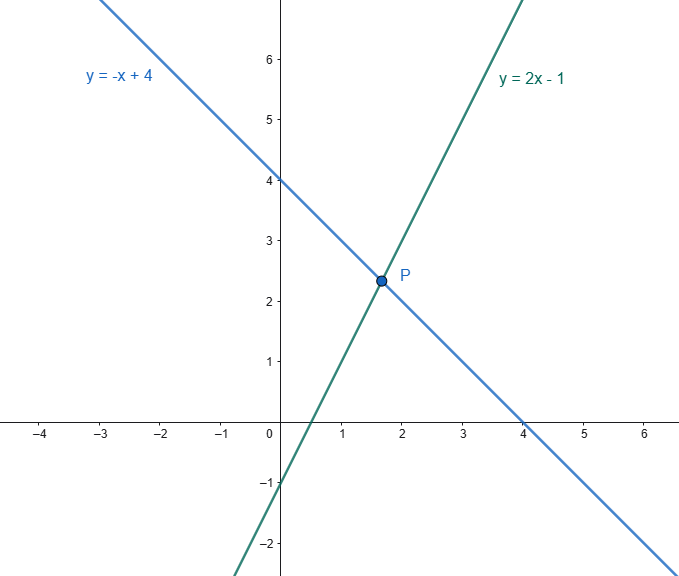
Find the intersection point of the lines:
\[r_1:y=2x-1\]
\[r_2:y=-x+4\]
The intersection point must satisfy both equations, so we can eliminate \(y\) using the comparison method, which gives:
\[2x-1=-x+4\]
At this point, we can move all the \(x\) terms to one side and the numbers to the other:
\[2x+x=4+1\]
\[3x=5\]
\[x=\frac{5}{3}\]
Now, to find the value of \(y\), we simply substitute the value of \(x\) into one of the two equations — for example, into the equation of \(r_1\):
\[y = 2 \cdot \frac{5}{3} – 1 = \frac{10}{3} – \frac{3}{3} = \frac{7}{3}\]
The intersection point of the two lines is therefore:
\[P=(\frac{5}{3},\frac{7}{3})\]
Exercise 2
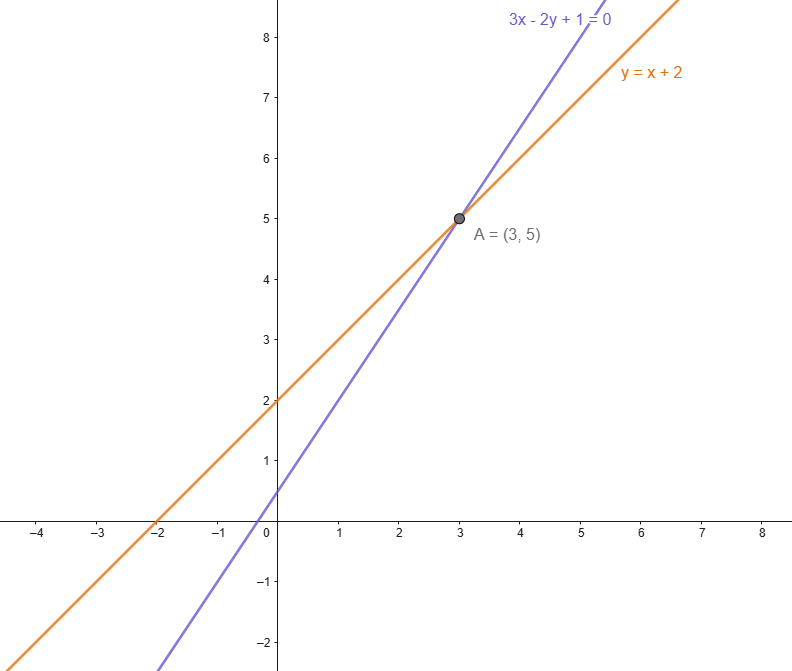
Find the intersection point of the lines:
\[r_1:3x-2y+1=0\]
\[r_2:y=x+2\]
Instead of using the comparison method (as in Exercise 1), we can substitute the second equation into the first to eliminate \(y\), which gives:
\[3x-2(x+2)+1=0\]
then, working through the calculation and simplifying, we get:
\[3x-2x-4+1=0\]
\[x=3\]
which, substituted into one of the two equations (for example \(r_2\)), gives:
\[y=3+2=5\]
The intersection point of the two lines is therefore the point with coordinates:
\[A=(3,5)\]
Exercises on the Distance from a Point to a Line
QUICK THEORY RECAP on the DISTANCE BETWEEN A POINT AND A LINE
The distance \(d\) from a point \(P(x_0, y_0)\) to a line \(ax+by+c=0\) is calculated using the formula:
\[d = \frac{|ax_0 + by_0 + c|}{\sqrt{a^2 + b^2}}\]
All that’s needed is to substitute the coordinates of the point and the coefficients of the line. This formula works for any line in the coordinate plane.
Exercise 1
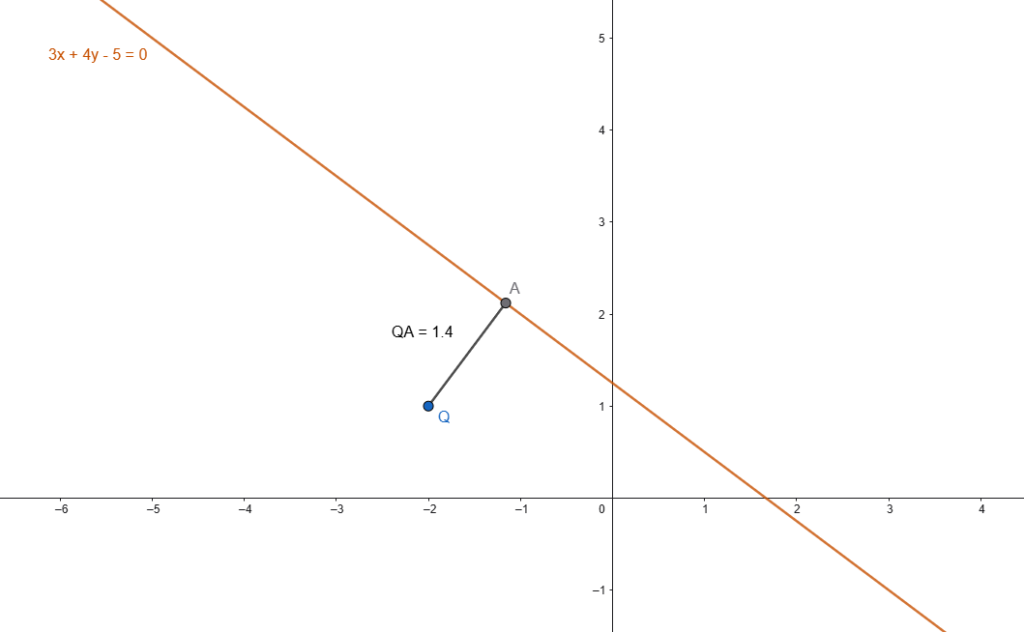
Find the distance from the point \(Q(-2,1)\) to the line with equation \(3x+4y-5=0\).
In this case, we simply apply the formula:
\[d = \frac{|ax_0 + by_0 + c|}{\sqrt{a^2 + b^2}}\]
keeping in mind that:
\[a=3\quad b=4\quad c=-5\]
\[x_0=-2\quad y_0=1\]
Substituting, we get:
\[d = \frac{|3(-2) + 4(1) – 5|}{\sqrt{3^2 + 4^2}}\]
\[d = \frac{|-6 + 4 – 5|}{\sqrt{9 + 16}}\]
\[d = \frac{|-7|}{\sqrt{25}}=\frac{7}{5}=1.4\]
Exercises on the Perpendicular Bisector of a Segment
QUICK THEORY RECAP on the PERPENDICULAR BISECTOR OF A SEGMENT
Let \(A(x_1, y_1)\) and \(B(x_2, y_2)\) be the endpoints of a segment.
The perpendicular bisector of the segment is the locus of points \(P(x,y)\) such that:
\[PA=PB\]
that is:
\[ \sqrt{(x-x_1)^2 + (y-y_1)^2} = \sqrt{(x-x_2)^2 + (y-y_2)^2} \]
Squaring both sides gives the equivalent condition:
\[(x-x_1)^2 + (y-y_1)^2 = (x-x_2)^2 + (y-y_2)^2\]
This equation represents the perpendicular bisector of segment \(AB\) in the coordinate plane.
Exercise 1
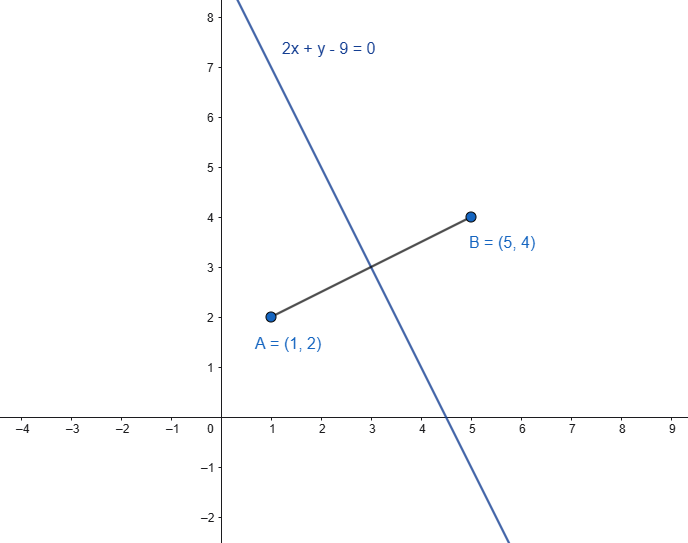
Find the equation of the perpendicular bisector of the segment with endpoints \(A(1,2)\) and \(B(5,4)\) using the definition of the locus of points equidistant from the endpoints of the segment.
SOLUTION
A generic point \(P(x,y)\) lies on the perpendicular bisector of segment \(AB\) if the relation \(PA=PB\) holds, that is, in other words:
\[(x-1)^2 + (y-2)^2 = (x-5)^2 + (y-4)^2\]
Now let’s expand the squares:
\[x^2 -2x +1 + y^2 -4y +4 = x^2 -10x +25 + y^2 -8y +16\]
Let’s cancel out \(x^2\) and \(y^2\):
\[-2x -4y +5 = -10x -8y +41\]
Now let’s move all terms to the left-hand side and combine like terms, which gives:
\[8x+4y-36=0\]
then dividing by 4:
\[2x+y-9=0\]
which is the equation of the perpendicular bisector of segment \(AB\).
Exercises on the Angle Bisector
QUICK THEORY RECAP on the ANGLE BISECTOR
The angle bisectors are the loci of points equidistant from the two lines
If the sides of the angle are represented by the lines
\[r_1:a_1x+b_1y+c_1=0\]
\[r_2:a_2x+b_2y+c_2=0\]
a point \(P(x,y)\) lies on the bisector if its distance from the two lines is the same:
\[\frac{|a_1x + b_1y + c_1|}{\sqrt{a_1^2 + b_1^2}} = \frac{|a_2x + b_2y + c_2|}{\sqrt{a_2^2 + b_2^2}}\]
This condition allows us to find the equations of the bisectors of the angle formed by the two lines.
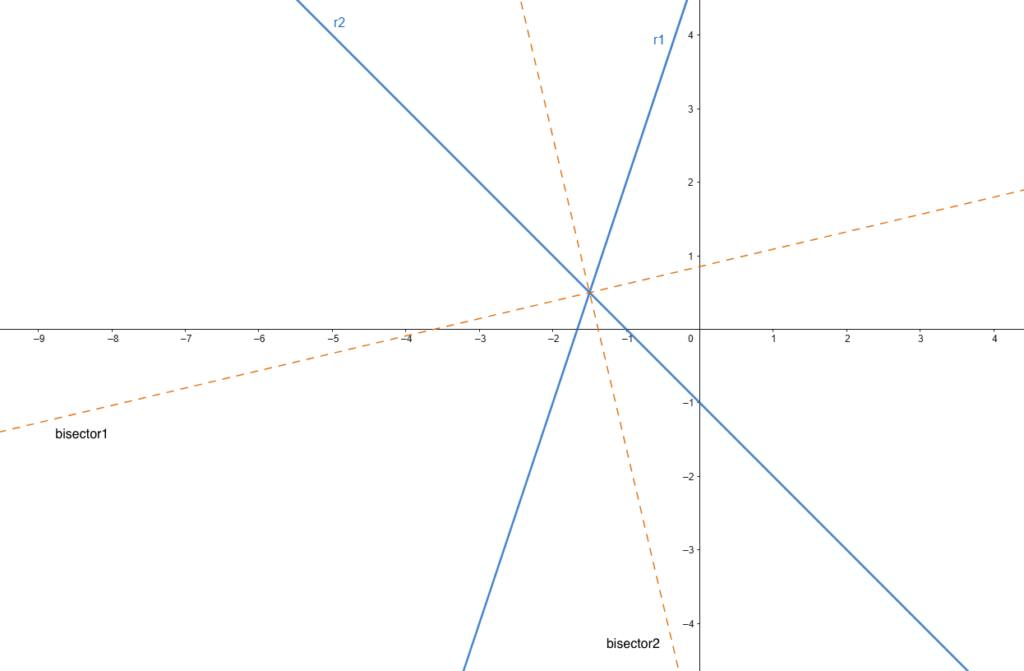
Exercise 1
Find the equations of the bisectors of the angle formed by the lines
\[r_1: y = 3x + 5\]
\[r_2: y=-x-1\]
SOLUTION
First, let’s write the equations of the lines in general form:
\[r_1:3x-y+5=0\]
\[r_2:x+y+1=0\]
The bisectors are the locus of points equidistant from the two lines, so we impose that the distances of a generic point \(P(x,y)\) are equal:
\[\frac{|3x – y + 5|}{\sqrt{3^2 + (-1)^2}} = \frac{|x + y + 1|}{\sqrt{1^2 + 1^2}}\]
then simplifying further:
\[\frac{|3x – y + 5|}{\sqrt{10}} = \frac{|x + y + 1|}{\sqrt{2}}\]
At this point, we can clear the denominators as follows:
\[\sqrt{2}\cdot |3x – y + 5| = \sqrt{10}\cdot |x + y + 1|\]
Removing the absolute values gives two equations:
\[\sqrt{2}(3x – y + 5) = \sqrt{10}(x + y + 1)\]
and
\[\sqrt{2}(3x – y + 5) = -\sqrt{10}(x + y + 1)\]
Simplifying and combining like terms in each equation gives the equations of the bisectors of the angles formed by lines \(r_1\) and \(r_2\).
First bisector
\[(3\sqrt{2}-\sqrt{10})x + (-\sqrt{2}-\sqrt{10})y + (5\sqrt{2}-\sqrt{10}) = 0\]
Second bisector
\[(3\sqrt{2}+\sqrt{10})x + (-\sqrt{2}+\sqrt{10})y + (5\sqrt{2}+\sqrt{10}) = 0\]
Solved Exercises on Parametric Equations of a Line
Exercise 1
Find a parametric representation of the line with equation:
\[4x+y-6=0\]
SOLUTION
The first step is to write the line in slope-intercept form:
\[y=-4x+6\]
Now let’s set
\[x=t \quad \text{with} \quad t \in \mathbb{R}\]
which, substituted into the slope-intercept equation, gives \(y=-4t+6\).
A parametric representation of the line can therefore be written in the form given by the following system, with \(t \in \mathbb{R}\):
\[x = t\]
\[y = -4t + 6\]
Exercise 2
Find the Cartesian equation of the line given by the parametric representation, with \(t \in \mathbb{R}\):
\[x = 2 + 3t\]
\[y = 5 – 2t\]
SOLUTION
In this case, we can proceed by solving for the parameter \(t\) from one of the two equations — for example, the first one; we then get:
\[t=\frac{x-2}{3}\]
which, substituted into the second equation, lets us rewrite it as:
\[y=5-2(\frac{x-2}{3})\]
At this point, all that’s needed is to carry out the calculation and move all terms to one side, which gives the following Cartesian form of the equation:
\[2x+3y-19=0\]
Exercises on Families of Lines Through a Fixed Point
QUICK THEORY RECAP on FAMILIES OF LINES THROUGH A FIXED POINT
A family of lines through a fixed point is the set of all lines that pass through the same point, called the point of concurrency.
Its general equation can be written as
\[y-y_0=m(x-x_0)\]
where \((x_0,y_0)\) is the center and \(m\) is the generic slope, ranging over all real values.
Each line in the family therefore has a different slope, but all of them share the same center.
It is also worth noting that this equation cannot describe the vertical line (in that case, \(m\) is undefined).
Exercise 1
Represent analytically the lines of the family with point of concurrency \(A(3,-4)\).
SOLUTION
From the theory, we know that the lines of a family through a fixed point can be represented as:
\[y-y_0=m(x-x_0)\]
where \(x_0\) and \(y_0\) are the coordinates of \(A\).
Substituting the coordinates, we get:
\[y+4=m(x-3)\]
which, rearranged, can also be written in slope-intercept form as follows:
\[y=mx-3m-4\]
However, it’s worth noting that this last equation, since the slope cannot be infinite, cannot represent the vertical line through \(A\). We conclude that the vertical line through point \(A\) must be added to the equation found, with equation:
\[x=3\]
Exercise 2
The equation
\[y-6=m(x-1)\]
represents a family of lines.
- Find the point of concurrency.
- Determine which line cannot be represented by this equation.
SOLUTION
The equation is written in the form:
\[y-y_0=m(x-x_0)\]
This is the point-slope form, which represents all lines through the point \((x_0, y_0)\).
Comparing this equation with the given one, we immediately get:
\[x_0=1\quad y_0=6\]
which are the coordinates of the point of concurrency. Indeed, as \(m\) varies, the line always passes through the point \((1,6)\).
There is, however, one line through \((1,6)\) that cannot be written in the form seen above: the vertical line through the center of the family.
The vertical line through \((1,6)\) has equation:
\[x=1\]
This line cannot be represented in the form \(y-6=m(x-1)\) because it would have an undefined slope.
Final result
- The point of concurrency is \(C(1,6)\)
- The line through the center that cannot be represented by the given equation is: \(x=1\).
Exercise 3
Find the equation of the line through the point \(P(0,-1/2)\) with slope \(m=1/5\).
SOLUTION
Using the point-slope form of the equation of a line:
\[y – y_0 = m (x – x_0)\]
and substituting the numerical values:
\[x_0 = 0, \quad y_0 = -\frac{1}{2}, \quad m = \frac{1}{5}\]
we get:
\[y – \left(-\frac{1}{2}\right) = \frac{1}{5} (x – 0)\]
from which, after working through a few simple steps:
\[y=\frac{1}{5}x-\frac{1}{2}\]
Exercises on Families of Parallel Lines
QUICK THEORY RECAP on FAMILIES OF PARALLEL LINES
A family of parallel lines is the set of all lines parallel to one another, that is, sharing the same slope m.
Its general equation is:
\[y=mx+b\]
with \(b\) ranging over the real numbers.
If the lines are perpendicular to a given line, their slope is the opposite reciprocal of the slope of the given line.
Exercise 1
Write the equation of the family of lines parallel to the line with equation \(y = -\sqrt{2}\,x + 5\).
SOLUTION
A family of parallel lines is the set of all lines that are parallel to one another, that is, sharing the same slope.
The given line has slope:
\[m = -\sqrt{2}\]
All parallel lines will therefore have the form:
\[y = -\sqrt{2}\,x + b\]
where:
- \(-\sqrt{2}\) is the fixed slope,
- \(b \in \mathbb{R}\) is the real parameter that varies (the constant term).
The family of parallel lines to the given line is:
\[y = -\sqrt{2}\,x + b \quad \text{with } b \in \mathbb{R}\]
Exercise 2
Write the equation of the family of lines perpendicular to the line with equation \(y=\frac{2}{7}x+4\).
SOLUTION
From the equation, we can immediately see that the slope is:
\[m=\frac{2}{7}\]
Two lines are perpendicular if their slopes are opposite reciprocals, that is:
\[m_\perp = -\frac{1}{m}\]
\[m_\perp = -\frac{1}{\frac{2}{7}}=-\frac{7}{2}\]
The family of lines consists of all lines with fixed slope \(-\frac{7}{2}\).
Its general equation is:
\[y = -\frac{7}{2}x + b\]
with \(b \in \mathbb{R}\).
Exercise 3
In the family of lines perpendicular to the line with equation \(3x-9y+1=0\), find the one whose y-intercept has ordinate 4.
SOLUTION
Let’s write the line in slope-intercept form:
\[3x-9y+1=0\]
\[-9y = -3x – 1\]
\[y = \frac{1}{3}x + \frac{1}{9}\]
The slope is:
\[m=\frac{1}{3}\]
Perpendicular lines have opposite reciprocal slopes:
\[m_\perp = -\frac{1}{m} = -3\]
So the family of lines consists of all lines:
\[y = -3x + b\]
A line has y-intercept with ordinate 4 when:
\[b=4\]
Substituting, we get the required equation:
\[y = -3x + 4\]
Exercises on the Family of Lines Generated by Two Lines
Exercise 1
Find the equation of the family of lines generated by the lines:
\[r_1:x+y-3=0\]
\[r_2:2x-y+1=0\]
using the two-parameter form.
SOLUTION
The family generated by lines \(r_1\) and \(r_2\) can be written as a linear combination of the two lines, in formulas:
\[\lambda(x+y-3)+\mu (2x-y+1)=0\]
where \(\lambda\), \(\mu\) \(\in \mathbb{R}\) are not both zero at the same time.
As these parameters vary, all the lines of the family are obtained, that is, all the lines that pass through the intersection point of the two generating lines \(r_1\) and \(r_2\).
Parametric Problems on the Line
Exercise 1
Find the value of the parameter \(k\) for which the equation
\[(k-1)x+2y-5=0\]
represents a line with slope equal to 3.
SOLUTION
The equation is given in general form.
To find the slope, we need to obtain the slope-intercept form.
So let’s isolate \(y\):
\[2y=-(k-1)x+5\]
\[y = -\frac{k-1}{2}x + \frac{5}{2}\]
The slope is therefore:
\[m = -\frac{k-1}{2}\]
We impose the required condition:
\[-\frac{k-1}{2} = 3\]
Multiplying both sides by 2, we get:
\[-k+1=6\]
from which:
\[k=-5\]
Exercise 2
Find the value of the parameter \(k\) for which the lines:
\[r_1: x-(k+3)y+2k=0\]
\[r_2: kx-\frac{y}{2}+(1-k)=0\]
are perpendicular.
SOLUTION
For the two lines to be perpendicular to each other, their slopes must be opposite reciprocals of each other.
In other words, denoting by \(m_1\) the slope of \(r_1\) and by \(m_2\) the slope of \(r_2\), the following relation must hold:
\[m_1=-\frac{1}{m_2}\]
Let’s first find the slopes of the lines one at a time.
For \(r_1\), we get:
\[y=\frac{x+2k}{k+3}\]
from which
\[m_1=\frac{1}{k+3}\]
Proceeding in the same way for line \(r_2\), we get:
\[\frac{y}{2}=kx+1-k\]
\[y=2kx+2(1-k)\]
from which
\[m_2=2k\]
Now imposing the perpendicularity condition, we must have:
\[\frac{1}{k+3}=-\frac{1}{2k}\]
and so
\[2k=-(k+3)\]
which, solved, gives the solution
\[k=-1\]
Cite this resource
"This page didn't write itself — every word here was written and checked by hand. If it helped you, sharing it or citing it as a source helps it reach the next student who needs it."
Citation
HTML link to copy