
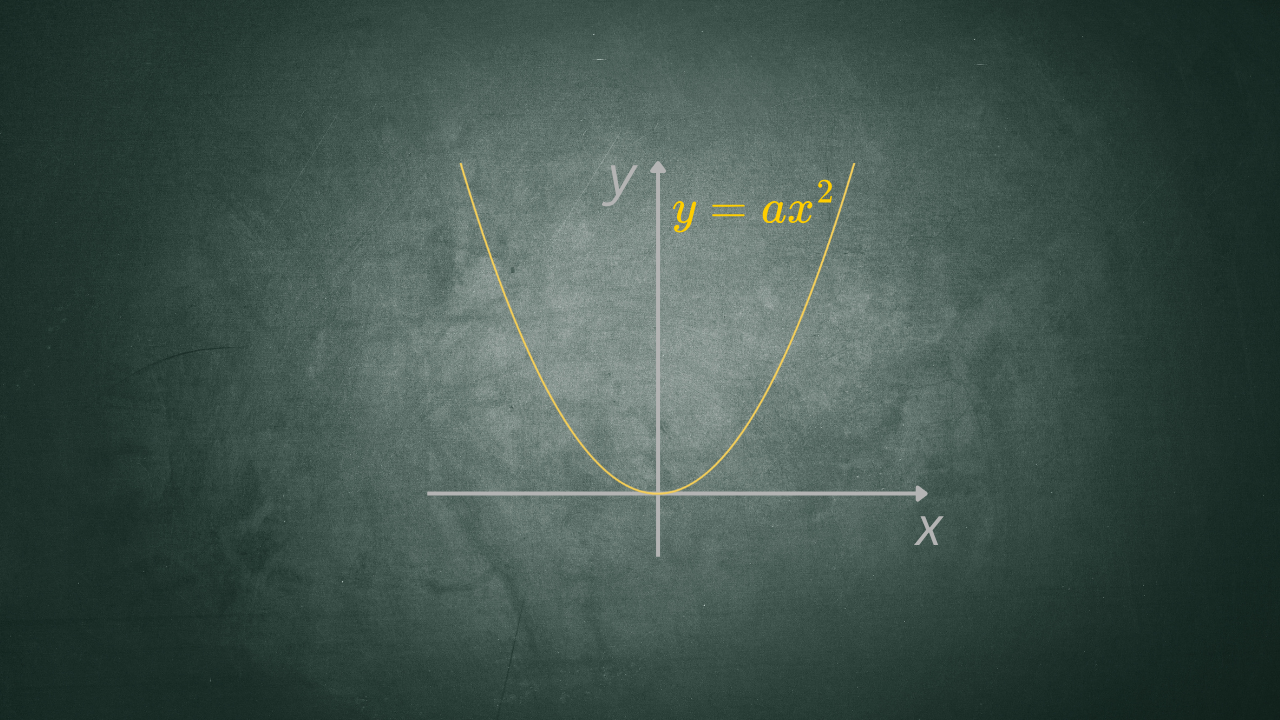
The equation of a parabola with vertex at the origin is one of the foundational topics in analytic geometry. Knowing how to identify the vertex, axis of symmetry, direction of opening, focus, and directrix of a parabola makes it possible to fully analyze this important conic section and to correctly interpret its graph on the coordinate plane.
In this guide we will work step by step through the structure of this equation of a parabola and show how to identify its key geometric elements directly from the equation. We will also work through fully explained examples, useful for building confidence in studying the parabola and in solving related problems.
The Parabola as a Locus of Points
A parabola is defined as the locus of points in the plane equidistant from a fixed point \(F\), called the focus, and a fixed line \(d\), called the directrix.
Deriving the Equation of a Parabola with Vertex at the Origin
Referring to Fig. 1, consider a generic point \(P(x,y)\) equidistant from a fixed point \(F\) (the focus), located on the \(y\)-axis at a distance \(m\) from the \(x\)-axis, and from a line \(d\) (the directrix), positioned symmetrically to the focus \(F\) with respect to the \(x\)-axis.
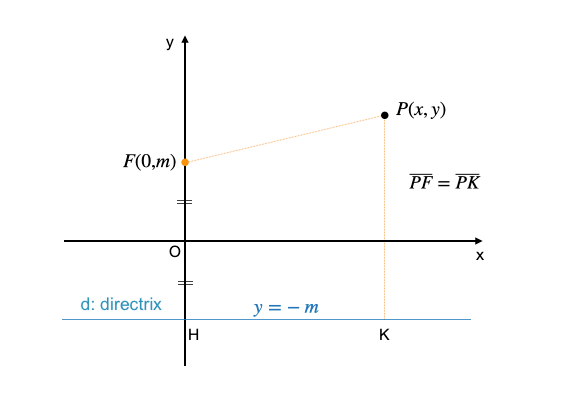
Based on this setup, the following relationship must hold:
\[\overline{PF}=\overline{PK} \tag{1}\]
Since the distance between points \(P\) and \(F\) can be expressed using the standard distance formula between two points in the plane, this gives:
\[\overline{PF}=\sqrt{x^2+(y-m)^2} \tag{2}\]
while the distance between point \(P\) and the directrix \(d\) is:
\[\overline{PK}=|y+m| \tag{3}\]
Substituting (2) and (3) into (1) gives:
\[\sqrt{x^2+(y-m)^2}=|y+m|\]
Squaring both sides:
\[x^2+(y-m)^2=(y+m)^2\]
Expanding and simplifying:
\[x^2+y^2+m^2-2my=y^2+m^2+2my\]
\[x^2-2my=+2my\] \[x^2=+4my\]
from which:
\[y=\frac{1}{4m}x^2\]
If we now set:
\[a=\frac{1}{4m} \tag{4}\]
we obtain
\[y=ax^2 \tag{5}\]
Equation (5) is the equation of the parabola with vertex at the origin, and represents a parabola with axis of symmetry coinciding with the \(y\)-axis.
Vertex and Axis of Symmetry of a Parabola with Vertex at the Origin
Notice that equation (5) is symmetric with respect to the \(y\)-axis, satisfying the symmetry condition:
\[f(x)=f(-x)\]
Indeed:
\[y=a(-x)^2=ax^2\]
and therefore the \(y\)-axis is the axis of symmetry of (5).
The vertex \(V\) of the parabola (5) is the point on the parabola lying on the axis of symmetry, equidistant from the focus and the directrix: it coincides with the origin \(O\).
Focus and Directrix of a Parabola with Vertex at the Origin
We can now find the coordinates of the focus and the equation of the directrix of (5). Looking at Fig. 1 and using (4), the focus \(F\) of the parabola has coordinates:
\[F(0,m) \rightarrow F\!\left(0,\frac{1}{4a}\right) \tag{6}\]
while the directrix (in this case always a horizontal line) has equation:
\[y=-m \rightarrow y=-\frac{1}{4a} \tag{7}\]
where, from (4), \(m=1/(4a)\) with \(a \neq 0\).
Plotting the Parabola \(y=ax^2\) Point by Point
Let’s now construct the parabola \(y=ax^2\) for three different values of \(a\). Specifically, we choose \(a=1/4\), \(a=1\), and \(a=2\), and compute the values of the function for several values of \(x\), as shown in the table below:
| \(x=-3\) | \(x=-2\) | \(x=-1\) | \(x=0\) | \(x=1\) | \(x=2\) | \(x=3\) | |
| \(a=1/4\) | 9/4 | 1 | 1/4 | 0 | 1/4 | 1 | 9/4 |
| \(a=1\) | 9 | 4 | 1 | 0 | 1 | 4 | 9 |
| \(a=2\) | 18 | 8 | 2 | 0 | 2 | 8 | 18 |
Table 1 – Values of the function \(y=ax^2\) as \(a\) varies.
Fig. 2 below shows the graphs of the three parabolas for these values of \(a\).
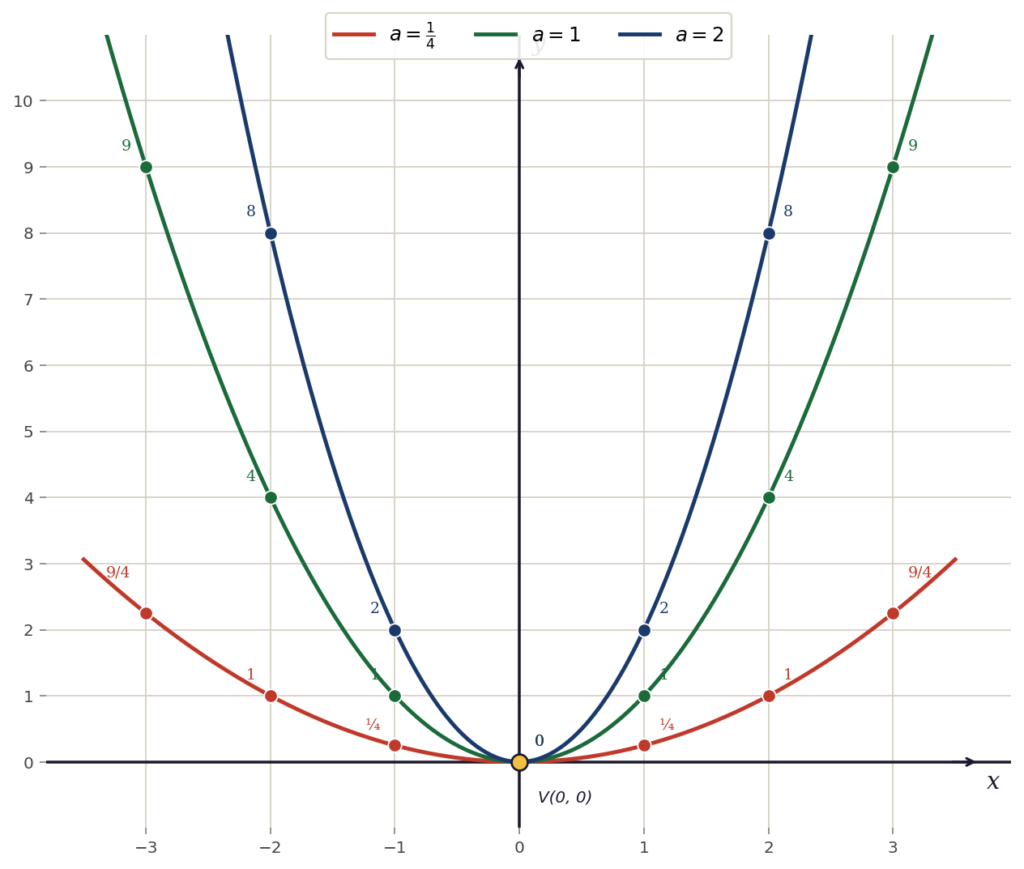
Notice from Fig. 2 that the curves are symmetric with respect to the \(y\)-axis, and that as \(|a|\) decreases, the parabola widens, and as \(|a|\) increases, the parabola becomes narrower. The vertex \(V\) of these parabolas always coincides with the origin \(O\).
If we now choose values of \(a\) opposite to the previous ones (\(a=-1/4\), \(a=-1\), \(a=-2\)), we obtain functions of the form
\[g(x)=-f(x)\]
from which we conclude that when the parameter \(a\) is chosen with the opposite sign, the parabola becomes the reflection across the \(x\)-axis (as shown in Fig. 3):
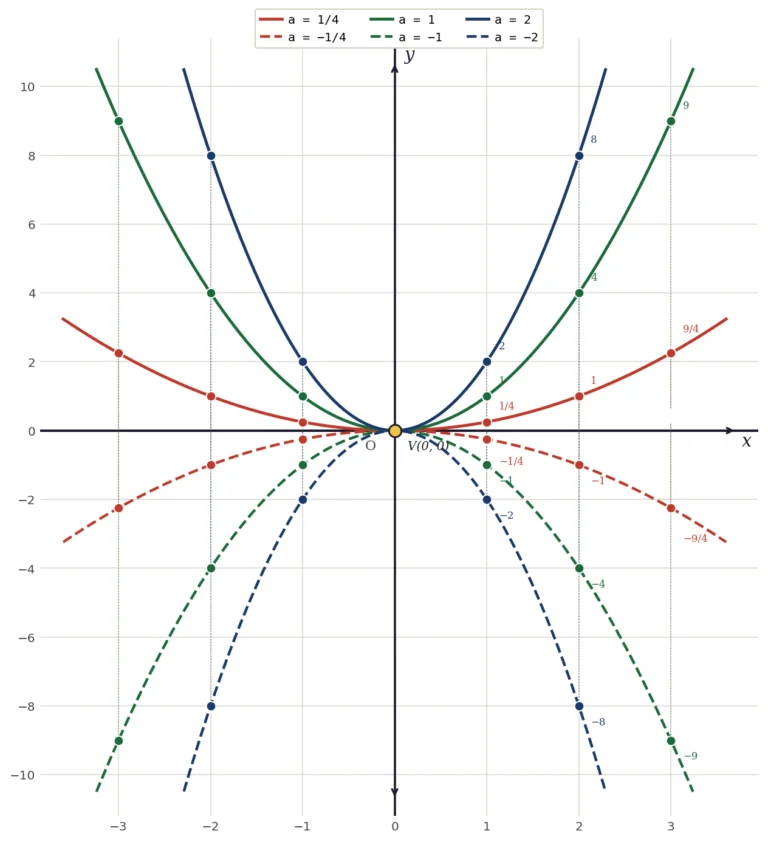
The figure below shows the behavior of the parabola \(y=ax^2\) as \(a\) varies dynamically, highlighting the direction in which it opens.
In particular, we can observe that for:
- \(a>0\) the parabola opens upward;
- \(a<0\) the parabola opens downward;
- \(a=0\) the parabola reduces to the line of equation \(y=0\), which is the \(x\)-axis.
Note. In effect, the equation \(y=ax^2\) represents a family of parabolas as \(a\) varies.
Equation of a Parabola with Vertex at the Origin - Summary of Properties
| Property | Expression |
|---|---|
| Equation of a parabola with vertex at the origin | \(y = ax^2 \quad (a \neq 0)\) |
| Vertex | \(V(0,\ 0)\) |
| Axis of symmetry | \(x = 0\) (the \(y\)-axis) |
| Focus | \(\displaystyle F\!\left(0,\ \frac{1}{4a}\right)\) |
| Directrix | \(\displaystyle y = -\frac{1}{4a}\) |
| Opens upward | \(a > 0\) |
| Opens downward | \(a < 0\) |
| Degenerate case | \(a = 0\) — the line \(y = 0\) |
Table 2 – Summary of the properties of the parabola \(y = ax^2\).
Worked Examples on the Parabola with Vertex at the Origin
EXAMPLE 1
Graph the parabola of equation
\[y=3x^2\]
SOLUTION
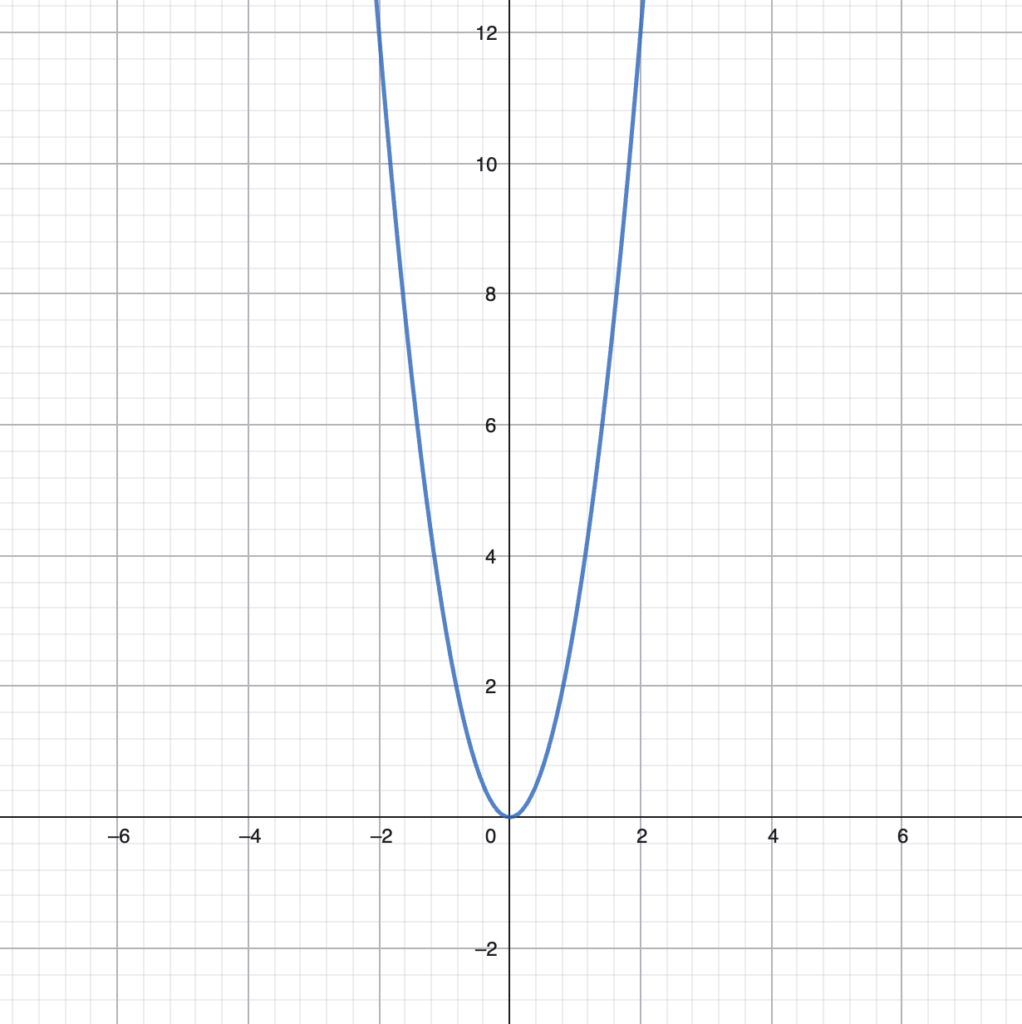
This is a parabola that opens upward, since \(a=3>0\), lying in Quadrants I and II of the coordinate plane, with vertex \(V\) coinciding with the origin.
The graph can be constructed point by point, as shown in the table below:
| \(x\) | \(y\) |
| 0 | 0 |
| 1 | 3 |
| 2 | 12 |
| 3 | 27 |
| 4 | 48 |
| 5 | 75 |
We also know that the function is symmetric with respect to the \(y\)-axis, so for every value the function takes at \(x\), it takes the identical value at \(-x\). Fig. 4 below shows the graph of the function.
EXAMPLE 2
Find the focus and directrix of the parabola of equation
\[y=-5x^2\]
SOLUTION
The leading coefficient is \(a=-5\), so, using (6) and (7), we get:
\[F\!\left(0,\frac{1}{4a}\right)\ \rightarrow F\!\left(0,-\frac{1}{20}\right)\]
\[y=-\frac{1}{4(-5)}=\frac{1}{20}\]
EXAMPLE 3
Write the equation of the locus of points equidistant from the line \(y=1\) and the point \(F(0,-1)\).
SOLUTION
Using equations (2) and (3):
\[\overline{PF}=\sqrt{x^2+(y+1)^2}\] \[\overline{PK}=|y-1|\]
and then applying (1) again:
\[\sqrt{x^2+(y+1)^2}=|y-1|\]
Squaring both sides and simplifying:
\[x^2+(y+1)^2=(y-1)^2\] \[x^2+y^2+1+2y=y^2+1-2y\] \[x^2=-4y\] \[y=-\frac{1}{4}x^2\]
This is the equation of the locus of points sought: a parabola with a vertical axis, vertex at the origin, and opening downward.
EXAMPLE 4
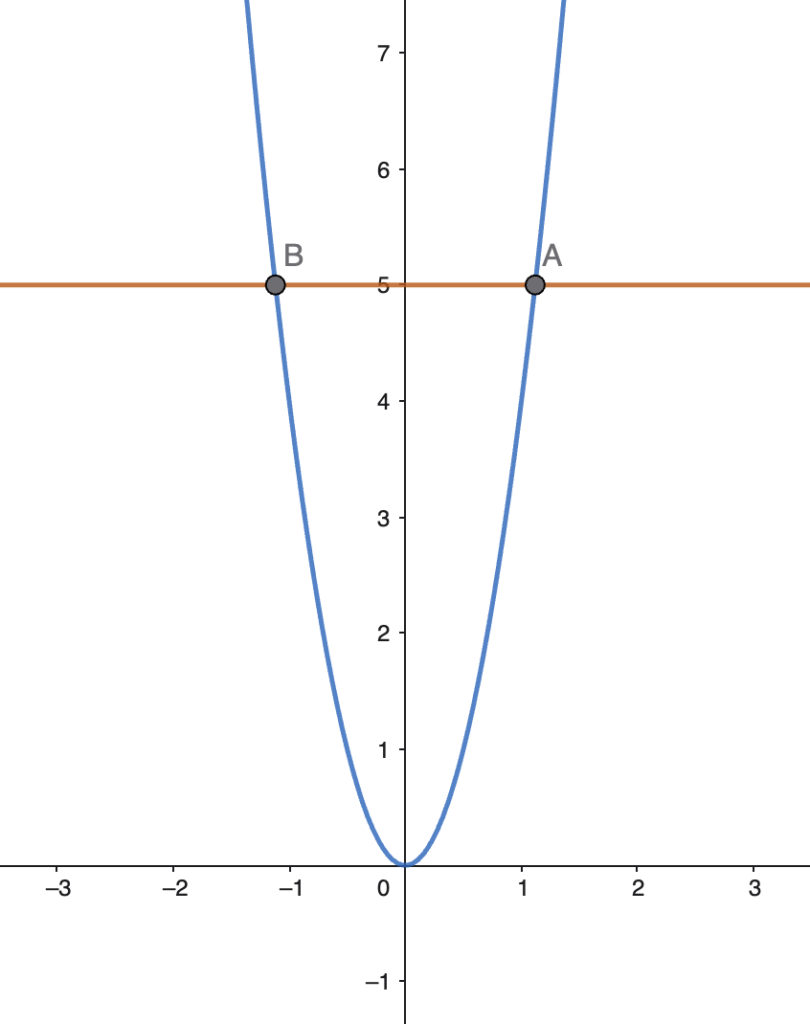
Find the \(x\)-coordinates of the intersection points between the parabola of equation \(y=4x^2\) and the line of equation \(y=5\), and sketch the graph.
SOLUTION
This problem can be solved by setting up the system formed by the parabola and the line:
\[ \left\{\begin{matrix}y=4x^2 \\ y=5 \end{matrix}\right.\]
from which:
\[5=4x^2\] \[x=\pm \frac{\sqrt{5}}{2}\]
EXAMPLE 5
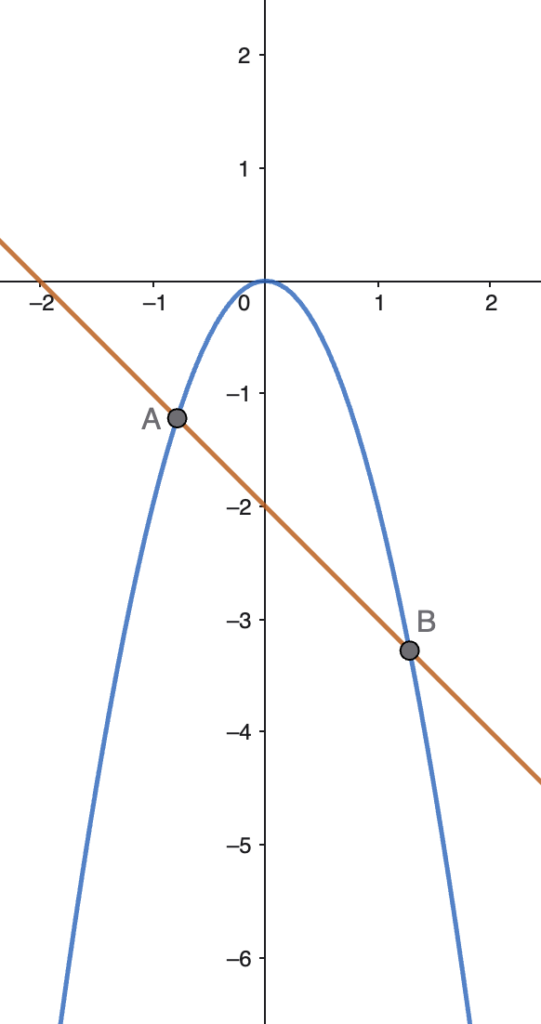
Find the \(x\)-coordinates of the intersection points between the parabola of equation \(y=-2x^2\) and the line of equation \(y=-x-2\), and sketch the graph.
SOLUTION
Once again, this problem can be solved by setting up the system formed by the parabola and the line:
\[ \left\{\begin{matrix}y=-2x^2 \\ y=-x-2 \end{matrix}\right.\]
Comparing the two equations in the system:
\[-2x^2=-x-2\] \[2x^2-x-2=0\]
and then, solving this quadratic equation:
\[\Delta=1^2-4(2)(-2)=17\] \[x_{1,2}=\frac{1\pm\sqrt{17}}{4}\]
Conclusions
The parabola with vertex at the origin \(y = ax^2\) represents the simplest and most fundamental case of this curve: the vertex coincides with the origin, and the axis of symmetry coincides with the \(y\)-axis. Its geometric elements — vertex, axis of symmetry, focus, and directrix — are all derived directly from the coefficient \(a\), which governs both how wide the curve opens and its direction of opening.
Mastering this equation is an essential prerequisite for tackling the general case, in which the vertex is located at an arbitrary point in the coordinate plane and the equation takes the standard form \(y = ax^2 + bx + c\). This is exactly where the next article picks up.
Final Test
Test your understanding of the topics covered in this article. The test consists of 10 multiple-choice questions on the parabola with vertex at the origin: its equation, key geometric elements, and applications.
Cite this resource
"If this explanation saved you some confusion, passing it along costs you nothing and might save someone else the same struggle."
Citation
HTML link to copy