
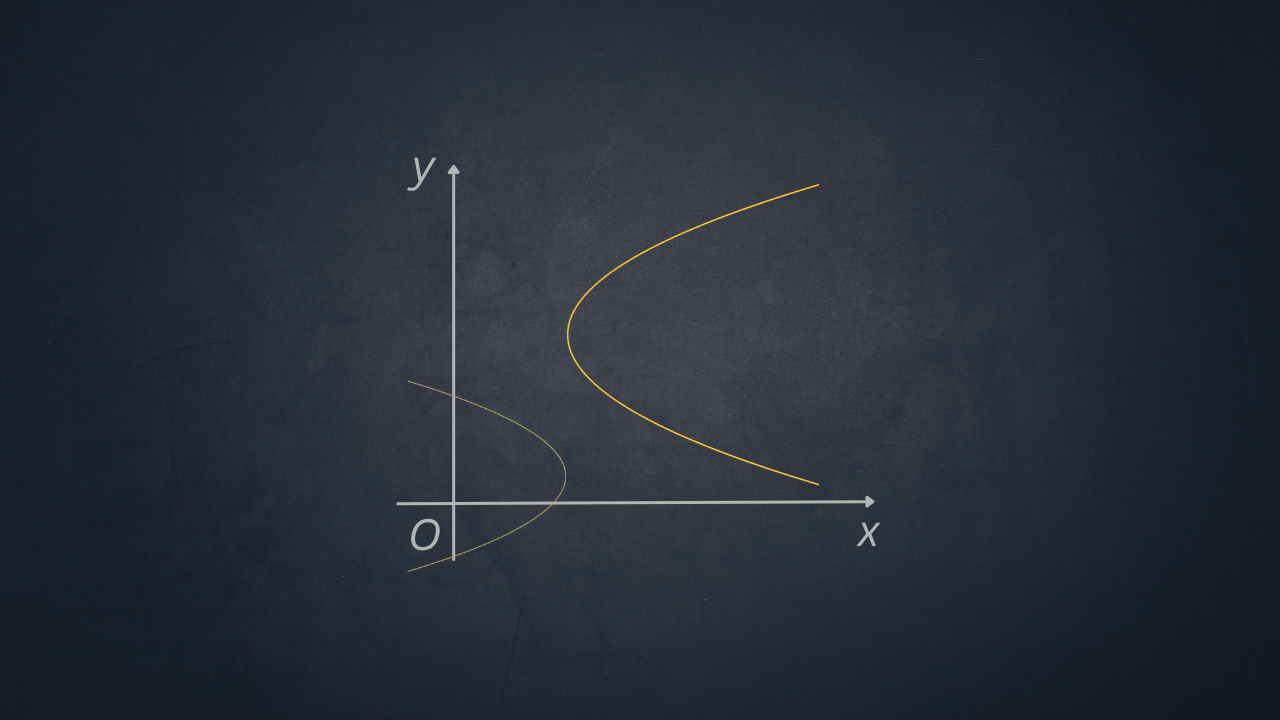
The study of the parabola in analytic geometry occasionally leads to a special case: the parabola whose axis of symmetry is parallel to the x-axis, also known as a parabola with a horizontal axis or, more simply, a horizontal parabola.
This article first introduces the theory behind the parabola with a horizontal axis, starting from the case of the parabola with a vertical axis, and then studies several useful worked examples, step by step.
Deriving the Equation of a Parabola with a Horizontal Axis
If the variables \(x\) and \(y\) are interchanged in the standard form of the equation of a parabola with a vertical axis, \(y=ax^2+bx+c\), the result is:
\[x=ay^2+by+c \tag{1}\]
Next, note that interchanging \(x\) and \(y\), that is, the transformation
\[(x,y)\rightarrow(y,x)\]
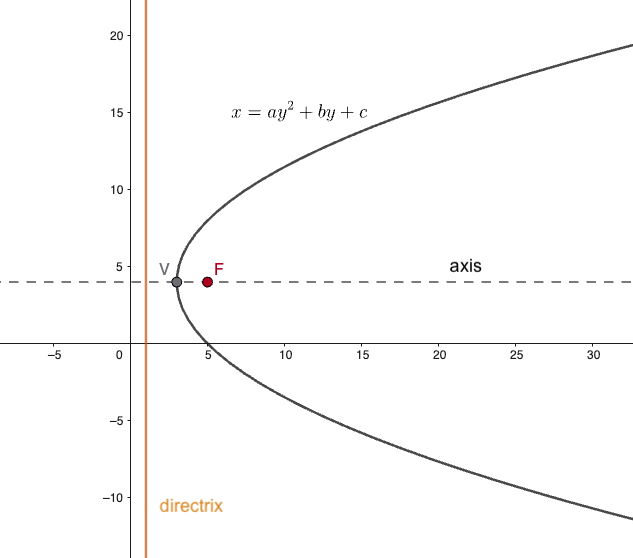
is the reflection across the line \(y=x\), which bisects the first and third quadrants. It follows that equation (1) represents the reflection of a parabola with a vertical axis across that line, and therefore a parabola with a horizontal axis, that is, one whose axis is parallel to the x-axis (Fig. 1).
Formulas for a Parabola with a Horizontal Axis
The characteristics of a parabola with a horizontal axis do not need to be derived again, as was done for the case of the parabola with a vertical axis. Such an exercise would in fact be superfluous: starting from the vertical case, the corresponding characteristics of the horizontal case follow in the same way simply by interchanging \(x\) and \(y\), as summarized below.
| Description | Formula/Condition |
|---|---|
| vertex | \(V\left(-\frac{\Delta}{4a},-\frac{b}{2a}\right)\) |
| axis of symmetry | \(y=-\frac{b}{2a}\) |
| focus | \(F\left(\frac{1-\Delta}{4a},-\frac{b}{2a}\right)\) |
| directrix | \(x=-\frac{1+\Delta}{4a}\) |
| opens to the right | \(a>0\) |
| opens to the left | \(a<0\) |
REMARKS: compared with the case of the parabola with a vertical axis, the directrix is now a vertical line, while the axis of symmetry is horizontal.
It is worth noting that a parabola with a horizontal axis opens to the right or to the left depending on the sign of the coefficient of the quadratic term \(a\).
Note also that the vertex lies at distance \(\frac{1}{4|a|}\) from both the focus and the directrix, on opposite sides of the vertex; this distance is often denoted \(|p|\), with \(p=\frac{1}{4a}\).
Example 1
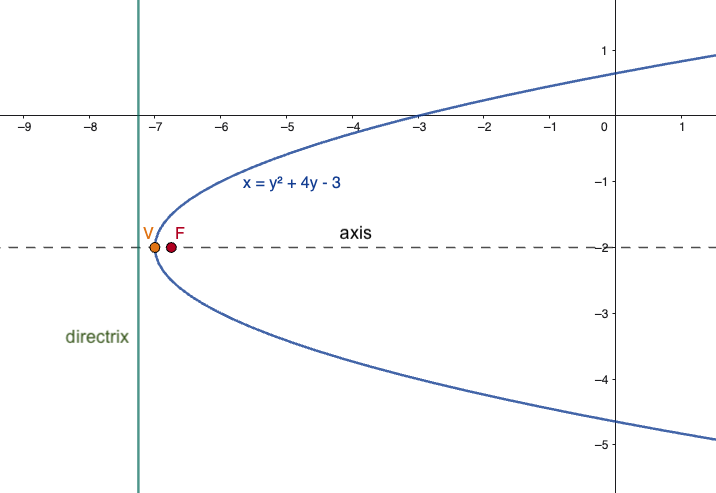
Given the parabola with equation \(x=y^2+4y-3\), find the vertex, focus, axis of symmetry, and directrix.
SOLUTION
The solution in this case is immediate. It suffices to note that the parabola with a horizontal axis has the following coefficients:
\[a=1\]
\[b=4\]
\[c=-3\]
and therefore:
\[\Delta=b^2-4ac=16-4(1)(-3)=28\]
from which the coordinates of the focus follow:
\[F\left(\frac{1-\Delta}{4a},-\frac{b}{2a}\right)=F\left(-\frac{27}{4},-2\right)\]
To find the vertex, we use the formula:
\[V\left(-\frac{\Delta}{4a},-\frac{b}{2a}\right)=V\left(-7,-2\right)\]
Next, the axis of symmetry is:
\[y=-\frac{b}{2a}=-2\]
and finally the directrix:
\[x=-\frac{1+\Delta}{4a}=-\frac{29}{4}\]
Since \(a>0\), the parabola opens to the right.
Example 2
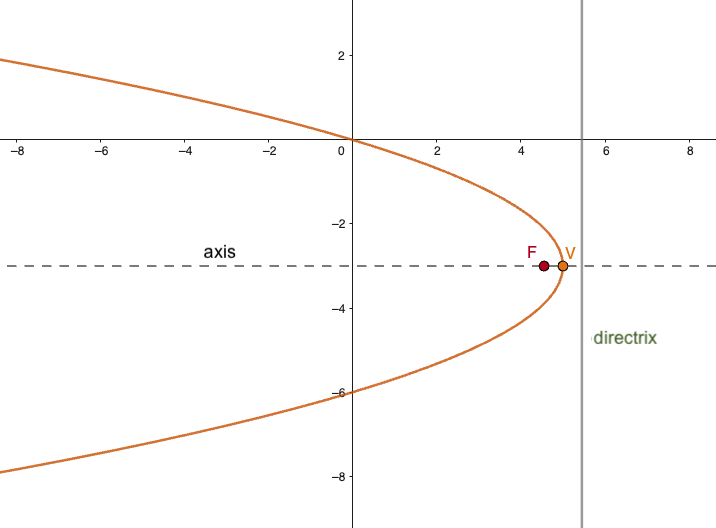
Find the equation of the parabola with a horizontal axis that passes through the origin and has its vertex at the point with coordinates \((5,-3)\).
SOLUTION
The equation of a parabola with a horizontal axis passing through the origin follows immediately from (1) by setting \(c=0\), so it reduces to:
\[x=ay^2+by\]
Solving the problem essentially amounts to determining the coefficients \(a,b\).
Using the vertex formulas, it must hold that:
\[V\left(-\frac{\Delta}{4a},-\frac{b}{2a}\right)=(5,-3)\]
and therefore the following system of equations:
\[\begin{cases} -\frac{\Delta}{4a}=5 \\ -\frac{b}{2a}=-3 \end{cases}\]
whose solution determines the unknown coefficients.
Taking into account that \(c=0\) in this particular case, the system above simplifies to:
\[\begin{cases} -\frac{b^2}{4a}=5 \\ -\frac{b}{2a}=-3 \end{cases}\]
which can be solved by dividing the first equation by the second:
\[\frac{-\frac{b^2}{4a}}{-\frac{b}{2a}}=-\frac{5}{3} \rightarrow \frac{b}{2}=-\frac{5}{3}\]
from which, after simplifying, we immediately obtain:
\[b=-\frac{10}{3}\]
and then, using the second equation for example:
\[-\frac{b}{2a}=-3 \rightarrow a=\frac{b}{6}=-\frac{5}{9}\]
The final equation of the parabola is therefore:
\[x=-\frac{5}{9}y^2-\frac{10}{3}y\]
Example 3
Find the equation of the parabola with a horizontal axis that passes through the origin and has its focus at the point with coordinates \((3,4)\).
SOLUTION
As in the previous example, the equation of a parabola with a horizontal axis passing through the origin is written:
\[x=ay^2+by\]
Imposing the conditions on the coordinates of the focus, we must have:
\[F\left(\frac{1-\Delta}{4a},-\frac{b}{2a}\right)=(3,4)\]
from which the following system of equations follows:
\[\begin{cases} \frac{1-\Delta}{4a}=3 \\ -\frac{b}{2a}=4 \end{cases}\]
whose solution determines the unknown coefficients.
Taking into account that \(c=0\) in this case as well, the system above simplifies to:
\[\begin{cases} \frac{1-b^2}{4a}=3 \\ -\frac{b}{2a}=4 \end{cases}\]
from which
\[\begin{cases} 1-b^2=12a \\ b=-8a \end{cases}\]
Substituting the second equation into the first gives:
\[1-64a^2=12a\]
\[64a^2+12a-1=0\]
whose solutions are:
\[a_{1,2}=\frac{-12\pm20}{128}\]
that is,
\[a_1=\frac{1}{16}\]
\[a_2=-\frac{1}{4}\]
The corresponding values of \(b\) are, respectively:
\[b_1=-8a_1 \rightarrow b_1=-8(\frac{1}{16})=-\frac{1}{2}\]
\[b_2=-8a_2 \rightarrow b_2=-8(-\frac{1}{4})=2\]
The equations of the required parabolas are therefore:
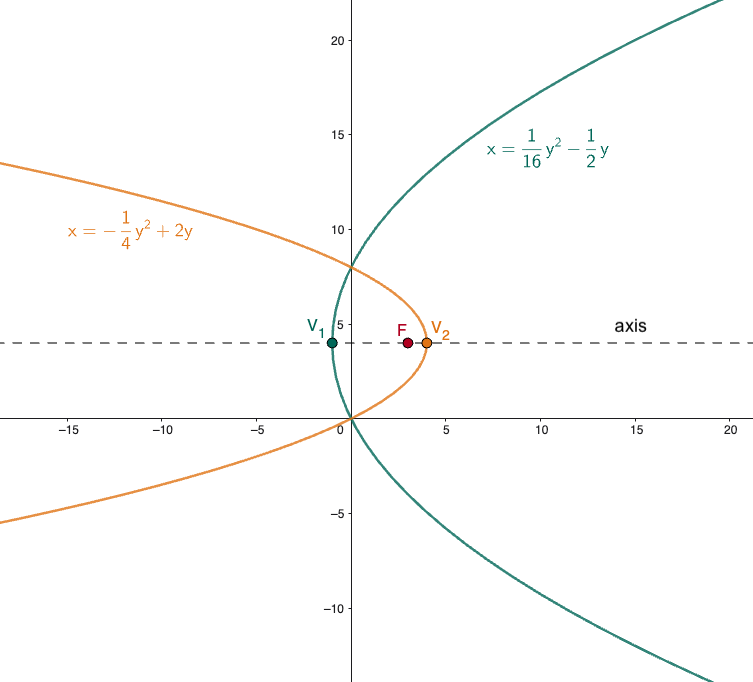
\[x=\frac{1}{16}y^2-\frac{1}{2}y\]
and
\[x=-\frac{1}{4}y^2+2y\]
Note: unlike the previous example (where the vertex was prescribed), this time the condition on the focus yields not one but two parabolas: one opens to the right and has its vertex \(V_1\) to the left of the focus, while the other opens to the left and has its vertex \(V_2\) to the right of the common focus (see Fig. 4).
Common Mistakes
Below are some of the mistakes students make when working with a parabola with a horizontal axis.
- One of the most common mistakes is mixing up the variables \(x\) and \(y\) and, as a result, incorrectly rewriting the equation given in the problem in the form \(y=ax^2+bx+c\), which instead represents a parabola with a vertical axis.
- Misusing the formulas for the vertex, focus, directrix, and axis by swapping the positions of the coordinates. This mistake likely stems from greater familiarity with exercises on the parabola with a vertical axis, a case that is far more common and widely used in mathematics.
- Other cases come down to simple calculation errors, such as forgetting to change a sign or getting stuck while solving a system of equations, which is often required when conditions such as passing through a given point or a prescribed focus are imposed.
- Students sometimes do not remember the relationship between the direction in which a parabola with a horizontal axis opens and the coefficient of the quadratic term \(a\), reversing the direction of opening and therefore sketching the parabola incorrectly.
Conclusions
The parabola with a horizontal axis does not necessarily require a separate theoretical treatment: its properties (vertex, focus, axis of symmetry, directrix, and direction of opening) follow directly from those of the parabola with a vertical axis by interchanging the variables \(x\) and \(y\), by virtue of the reflection across the line \(y=x\), the bisector of the first and third quadrants. The fact that an upward or downward opening becomes an opening to the right or to the left is likewise not an exception but a direct consequence: when the roles of the axes are interchanged, what was previously oriented vertically is now oriented horizontally.
The worked examples covered both types of problems: determining the geometric features from the equation, and determining the equation from conditions on the vertex or the focus. In particular, they showed that prescribing the focus, unlike prescribing the vertex, admits two distinct solutions.
The parabola with a horizontal axis completes the study of the main forms of the parabola in the coordinate plane.
FINAL TEST
Below is a short test to check the knowledge acquired about the parabola with a horizontal axis.
Cite this resource
"Behind this article: hours of writing, checking, and rewriting to get it right. If it was useful, a share or citation helps it find the next person who needs it."
Citation
HTML link to copy