
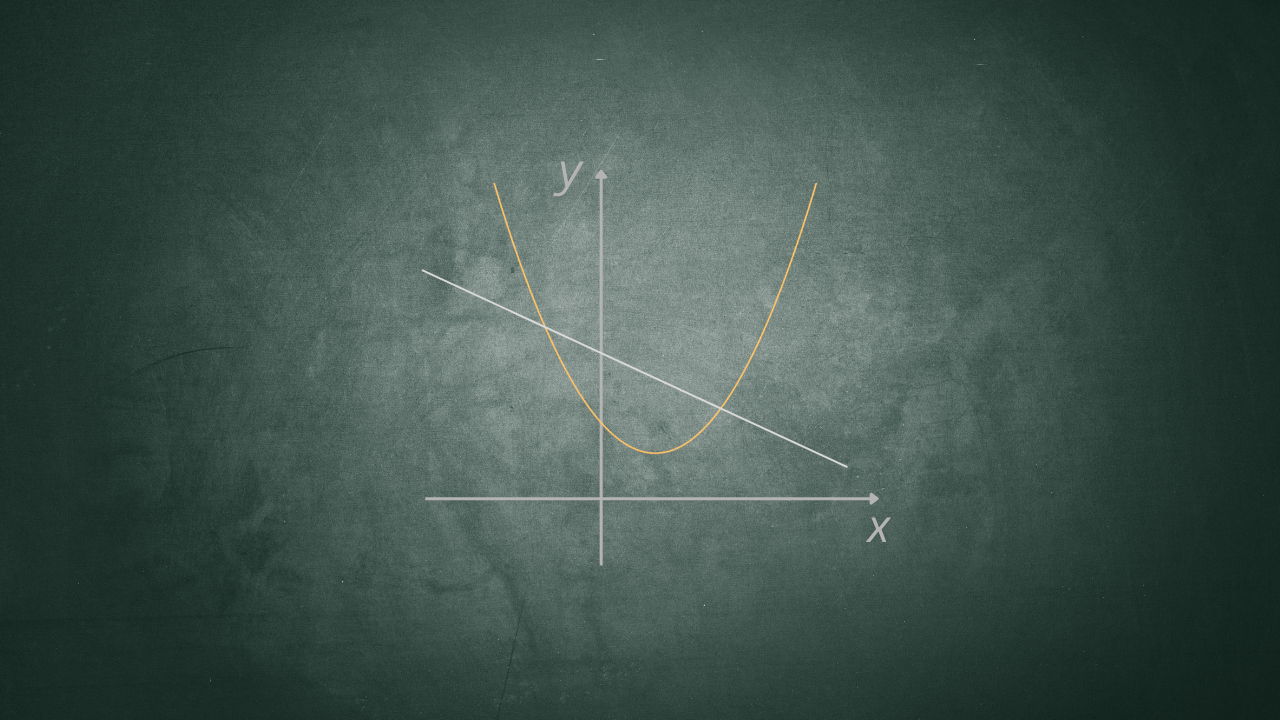
This article studies the relative position of a line and a parabola.
In the Cartesian plane, a line and a parabola can occupy different relative positions: the line can be tangent, secant, or external to the parabola.
The goal of this article is to provide an analytic approach to the problem for both the parabola with a vertical axis and the parabola with a horizontal axis. After a brief (but important) theoretical introduction, we go through several worked examples to consolidate the concepts.
How to Study the Relative Position of a Line and a Parabola
Line and Parabola with a Vertical Axis
Studying the relative position of a line and a parabola with a vertical axis reduces to solving the following system of equations:
\[\begin{cases} y=ax^2+bx+c \\ y=mx+k \end{cases} \tag{1}\]
where
\[y=ax^2+bx+c \quad (a\neq0)\]
is the equation of a general parabola with a vertical axis, while
\[y=mx+k\]
represents a general non-vertical line.
In particular, if system (1) has two distinct real solutions, the line is secant to the parabola at two distinct points; if the system has one repeated real solution, the line is tangent to the parabola at a single point; if the system has no real solutions, the line does not intersect the parabola.
SPECIAL CASE: VERTICAL LINE
For a vertical line, system (1) is rewritten as:
\[\begin{cases} y=ax^2+bx+c \\ x=x_0 \end{cases} \tag{2}\]
from which the y-coordinate of the point with x-coordinate \(x=x_0\) follows directly:
\[y=ax_0^2+bx_0+c \tag{3}\]
Equation (3) always gives exactly one value of \(y\), so in this case the line intersects the parabola at exactly one point.
Line and Parabola with a Horizontal Axis
By analogy with the previous case, studying the relative position of a line and a parabola with a horizontal axis reduces to solving the following system of equations:
\[\begin{cases} x=ay^2+by+c \\ y=mx+k \end{cases} \tag{4}\]
where
\[x=ay^2+by+c \quad (a\neq0)\]
is the equation of a general parabola with a horizontal axis, while
\[y=mx+k \quad (m\neq0)\]
represents a general line that is neither vertical nor horizontal.
If system (4) has two distinct real solutions, the line is secant to the parabola at two distinct points; if the system has one repeated real solution, the line is tangent to the parabola at a single point; if the system has no real solutions, the line does not intersect the parabola.
Note: For a vertical line, system (4) cannot be used and must be rewritten as:
\[\begin{cases} x=ay^2+by+c \\ x=x_0 \end{cases} \tag{5}\]
which yields the equation:
\[ay^2+by+c-x_0=0\]
This equation can have two distinct real solutions, one repeated real solution, or no real solutions in \(y\), depending on the sign of its discriminant.
SPECIAL CASE: HORIZONTAL LINE (\(m=0\))
For a horizontal line and a parabola with a horizontal axis, the system to solve is:
\[\begin{cases} x=ay^2+by+c \\ y=y_0 \end{cases} \tag{6}\]
and therefore the x-coordinate of the intersection point is:
\[x=ay_0^2+by_0+c \tag{7}\]
Example 1 – Line Secant to the Parabola
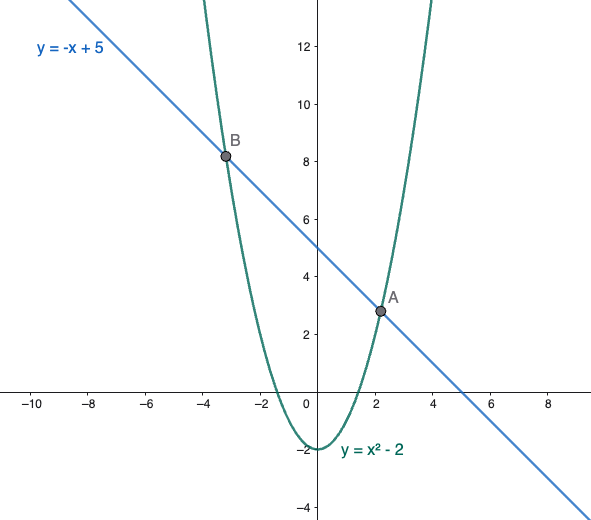
Determine the relative position of the parabola with equation \(y=x^2-2\) and the line with equation \(y=-x+5\). Also determine any points of intersection.
SOLUTION
Setting up the system formed by the parabola and the line gives:
\[\begin{cases} y=x^2-2 \\ y=-x+5 \end{cases}\]
Substituting the second equation into the first yields:
\[-x+5=x^2-2\]
\[x^2+x-7=0\]
Solving the resulting quadratic equation gives:
\[\Delta=1^2-(4)(1)(-7)=29\]
\[x_{1,2}=\frac{-1\pm\sqrt{29}}{2}\]
The two distinct solutions are the x-coordinates of the points of intersection between the line and the parabola, and therefore the line is secant to the parabola.
Next, the y-coordinates of the points of intersection are computed using the equation of the line:
\[y_1=-x_1+5=-\frac{-1+\sqrt{29}}{2}+5=\frac{11-\sqrt{29}}{2}\]
\[y_2=-x_2+5=-\frac{-1-\sqrt{29}}{2}+5=\frac{11+\sqrt{29}}{2}\]
Note: The y-coordinates of the points of intersection could also have been computed using the equation of the parabola (since these points belong to it); however, it is preferable to always use the simplest equation available (in this case, the equation of the line).
Example 2 – Line Tangent to the Parabola
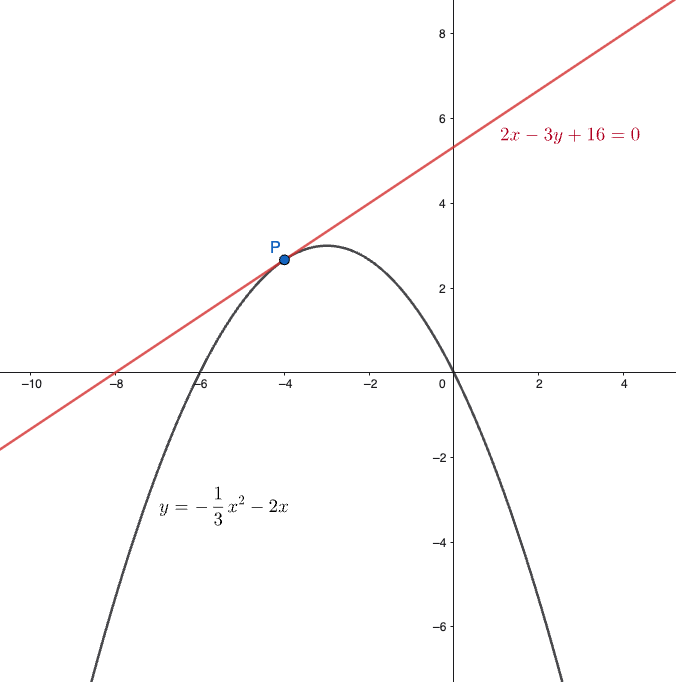
Determine the relative position of the line with equation \(2x-3y+16=0\) and the parabola \(y=-\frac{1}{3}x^2-2x\).
SOLUTION
The system formed by the line and the parabola is:
\[\begin{cases} 2x-3y+16=0 \\ y=-\frac{1}{3}x^2-2x \end{cases}\]
Substituting the second equation into the first yields:
\[2x-3\left(-\frac{1}{3}x^2-2x\right)+16=0\]
\[x^2+8x+16=0\]
Solving the resulting quadratic equation gives:
\[\Delta=8^2-(4)(1)(16)=0\]
\[x_1=x_2=-\frac{8}{2}=-4\]
The two solutions coincide, so the line is tangent to the parabola at the point with x-coordinate \(x=-4\).
Finally, the y-coordinate of the point of intersection is computed using the equation of the line solved for \(y\):
\[y_1=\frac{2x_1+16}{3}=\frac{2(-4)+16}{3}=\frac{8}{3}\]
The point of tangency \(P\) has coordinates:
\[P\left(-4,\frac{8}{3}\right)\]
Example 3 – Line External to the Parabola
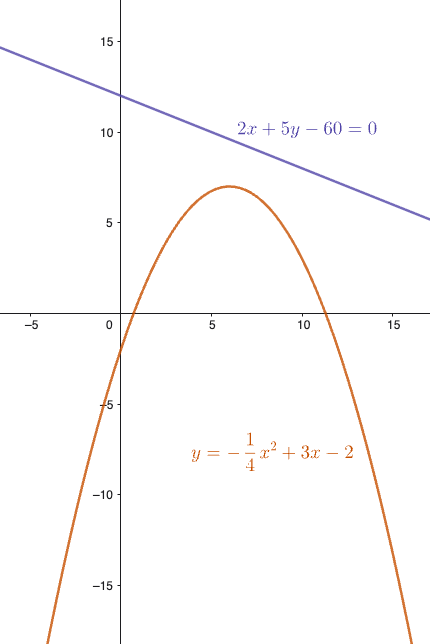
Determine the relative position of the line with equation \(2x+5y-60=0\) and the parabola \(y=-\frac{1}{4}x^2+3x-2\).
SOLUTION
The system formed by the line and the parabola is:
\[\begin{cases} 2x+5y-60=0 \\ y=-\frac{1}{4}x^2+3x-2 \end{cases}\]
Substituting the second equation into the first yields:
\[2x+5\left(-\frac{1}{4}x^2+3x-2\right)-60=0\]
\[5x^2-68x+280=0\]
Computing the discriminant of the last equation gives:
\[\Delta=(-68)^2-(4)(5)(280)=-976<0\]
Therefore, there are no real intersections between the line and the parabola, and consequently the line is external to it.
Example 4 – Vertical Line
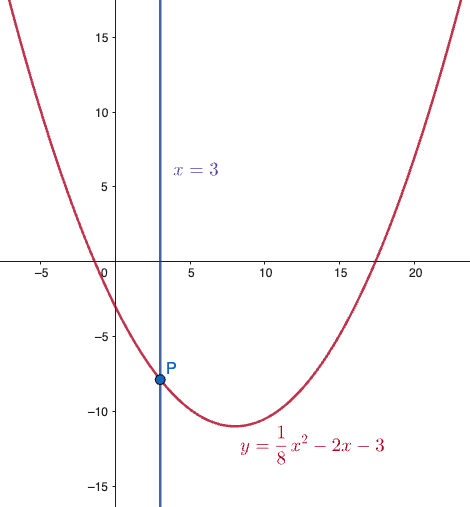
Determine the relative position of the line with equation \(x-3=0\) and the parabola \(y=\frac{1}{8}x^2-2x-3\).
SOLUTION
Setting up the system formed by the parabola and the line gives:
\[\begin{cases} y=\frac{1}{8}x^2-2x-3 \\ x-3=0 \end{cases}\]
Substituting the second equation into the first yields:
\[\begin{cases} y=\frac{1}{8}(3)^2-2(3)-3=-\frac{63}{8} \\ x=3 \end{cases}\]
The point of intersection \(P\) has coordinates:
\[P\left(3,-\frac{63}{8}\right)\]
Example 5 – Parametric Problem with a Horizontal-Axis Parabola (Interactive)
Determine for which values of the parameter \(k\) the line with equation \(y=x+k\) is secant, tangent, or external to the parabola with a horizontal axis with equation \(x=\frac{1}{2}y^2-3y\).
SOLUTION
The system formed by the line and the parabola is:
\[\begin{cases} x=\frac{1}{2}y^2-3y \\ y=x+k \end{cases}\]
Substituting the second equation into the first yields:
\[x=\frac{1}{2}(x+k)^2-3(x+k)\]
which, once simplified, becomes:
\[2x=x^2+k^2+2kx-6(x+k)\]
\[x^2+k^2+2kx-6x-6k-2x=0\]
and, simplifying further and ordering with respect to \(x\):
\[x^2+(2k-8)x+k^2-6k=0\]
Starting from this last resulting equation, different cases arise depending on the value of the discriminant. In particular:
- \(\Delta>0\): secant line
- \(\Delta=0\): line tangent at a single point
- \(\Delta<0\): external line
The discriminant of the resulting equation is therefore computed as follows:
\[\Delta=(2k-8)^2-4(1)(k^2-6k)=\]
\[=4k^2+64-32k-4k^2+24k=\]
\[=-8k+64\]
Imposing the condition for a secant line (\(\Delta>0\)) gives:
\[-8k+64>0\]
which holds for
\[k<8\]
The line is instead tangent at a single point for \(\Delta=0\), that is, for:
\[-8k+64=0\]
which gives
\[k=8\]
Finally, for
\[k>8\]
the discriminant is negative (\(\Delta<0\)), and therefore there is no intersection between the line and the parabola.
Interactive Exploration: Line and Parabola with a Horizontal Axis
Fixed parabola x = ½y² − 3y. The slider varies k in the line y = x + k, showing how the relative position changes.
Common Errors in Studying the Relative Position of a Line and a Parabola
Several errors are easy to make when studying the relative position of a line and a parabola. The most frequent ones are listed below.
1. Forgetting to reduce the system to a quadratic equation
To establish whether the line is secant, tangent, or external, the equation of the line must be substituted into that of the parabola, which yields a single quadratic equation. A frequent error is to compare the two equations directly without performing the substitution.
2. Computing the discriminant incorrectly
Once the quadratic equation has been obtained, the discriminant must be computed correctly. Sign errors in the algebra can lead to a wrong classification of the position of the line.
3. Reversing the conditions on the discriminant
The correct conditions are:
- \(\Delta>0\): the line is secant (two points of intersection);
- \(\Delta=0\): the line is tangent (a single point of contact);
- \(\Delta<0\): the line is external (no real points of intersection).
Students frequently mix up exactly this point.
4. Using the wrong form of the parabola
Parabolas can have a vertical or a horizontal axis, so the correct form of the equation must be used. A common error, for example, is to write the equation \(y=ax^2+bx+c\) for a parabola with a horizontal axis, whereas this equation is valid only for a parabola with a vertical axis.
5. Believing that a tangent line always touches the parabola at the vertex
A tangent line can touch the parabola at any of its points, not necessarily at the vertex. The vertex is only one of the possible points of tangency!
6. Forgetting to determine the point of tangency or the points of intersection (although this is not always required)
When the discriminant is zero, the line has been shown to be tangent, but the exercise often also asks for the coordinates of the point of tangency.
To find them, it is enough to substitute the repeated root into the equation of the line or of the parabola and solve for the coordinates of the point.
The same procedure, applied to each of the two distinct roots, gives the coordinates of the points of intersection when the line is secant.
Conclusions
Studying the relative position of a line and a parabola is an important application of analytic geometry, and it links the geometric meaning of intersections or tangency with the algebraic meaning of quadratic equations.
The basic idea is to set up the system formed by the equation of the line and that of the parabola, and to analyze the number of real solutions of the resulting equation:
- two distinct real solutions indicate that the line is secant to the parabola;
- one repeated real solution indicates that the line is tangent;
- no real solutions indicate that the line is external.
We have also seen how the setup of the problem changes depending on whether the parabola has a vertical axis or a horizontal axis, and how careful attention is needed for the special cases of vertical and horizontal lines.
In particular, the discriminant of the quadratic equation obtained from the system is the main tool for classifying the relative position of a line and a parabola, turning a geometric problem into a simple algebraic analysis.
Mastering this method makes it possible not only to solve standard exercises but also to tackle more complex parametric problems, in which the task is often to determine for which values of a parameter a line is secant, tangent, or external to the parabola (as discussed in Example 5).
FINAL TEST
The short quiz below checks the concepts covered in this article on the relative position of a line and a parabola.
Cite this resource
"If this explanation saved you some confusion, passing it along costs you nothing and might save someone else the same struggle."
Citation
HTML link to copy