
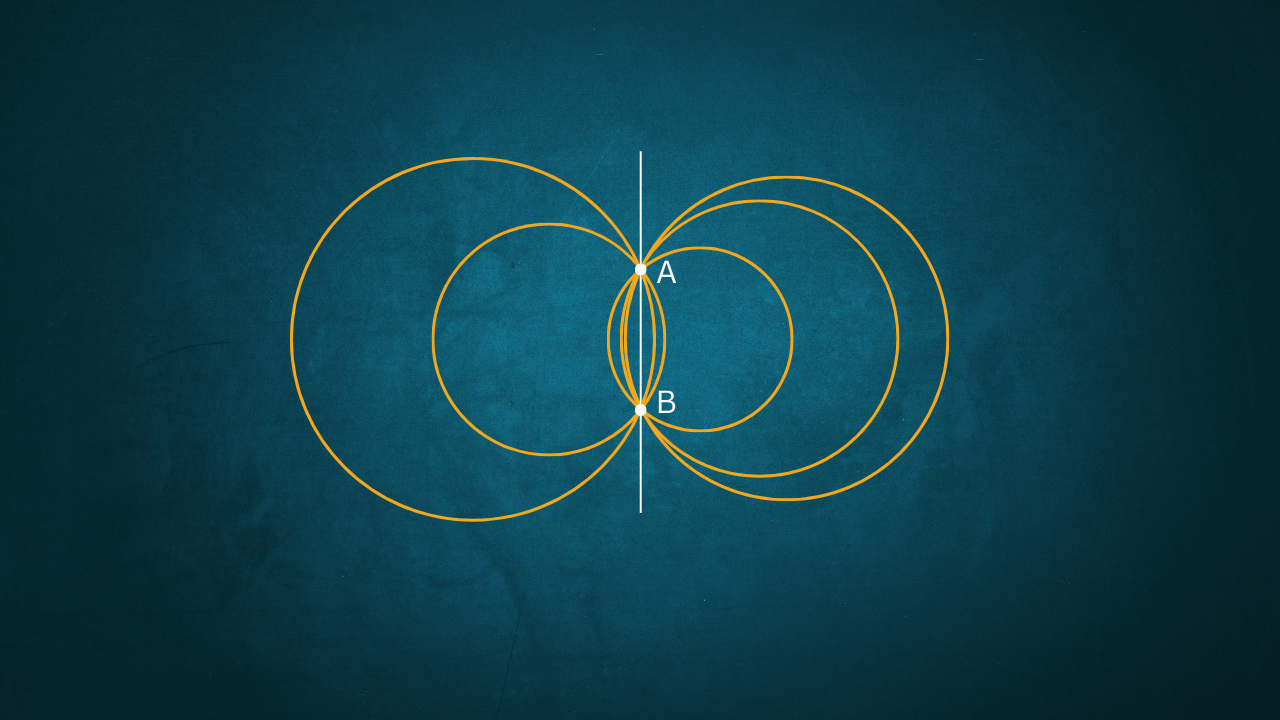
A pencil of circles, sometimes also called a family of circles, is a powerful and elegant tool in analytic geometry. It provides a way to describe infinitely many circles with a single equation and to solve, in an elegant way, many problems, such as determining a circle through given points or studying particular geometric configurations.
This article covers:
- what a pencil of circles is and how it is constructed from two generating circles;
- the different types of pencils;
- the main applications, with fully worked examples.
What Is a Pencil of Circles
A pencil of circles is an infinite family of circles obtained by taking linear combinations of the equations of two circles.
Specifically, let two circles be given with equations:
\[C_1: \; x^2+y^2+D_1 x+E_1 y+F_1=0\]
\[C_2: \; x^2+y^2+D_2 x+E_2 y+F_2=0\]
The pencil generated by \(C_1\) and \(C_2\) is the set of circles described by:
\[C_\lambda: \; C_1+\lambda C_2=0\]
and therefore
\[x^2+y^2+D_1 x+E_1 y+F_1+\lambda(x^2+y^2+D_2 x+E_2 y+F_2)=0\tag{1}\]
where \(\lambda\) is a real parameter.
Geometric Interpretation
Each value of \(\lambda\) identifies a specific circle in the pencil. As \(\lambda\) varies, infinitely many circles are obtained, sharing certain properties in common. The reasons for this are worth examining in detail.
Equation (1) can be written as:
\[(1+\lambda)x^2+(1+\lambda)y^2+(D_1+\lambda D_2) x+(E_1+\lambda E_2) y+F_1+\lambda F_2=0\tag{2}\]
and therefore again, dividing by \(1+\lambda\):
\[x^2+y^2+\frac{(D_1+\lambda D_2)}{1+\lambda} x+\frac{(E_1+\lambda E_2)}{1+\lambda} y+\frac{F_1+\lambda F_2}{1+\lambda}=0\tag{3}\]
under the assumption that \(\lambda\neq-1\).
It is clear that, as the parameter \(\lambda\) varies, equation (3) describes infinitely many circles. Consequently, (3), which follows directly from (1), also represents the equation of the pencil of circles generated by \(C_1\) and \(C_2\) as \(\lambda\) varies.
IMPORTANT REMARKS
For \(\lambda=0\), equation (1) coincides with the equation of circle \(C_1\) (the first generator), while the equation of \(C_2\) cannot be obtained from formulation (1) for any value of \(\lambda\).
Note also that for \(\lambda=-1\), equation (2), and consequently equation (1), reduces to the equation of the radical axis of circles \(C_1\) and \(C_2\), which can be regarded as the particular degenerate circle of infinite radius belonging to the pencil (a line can, in fact, be thought of as the particular circle whose radius is infinite).
Another property of the pencil of circles is that the centers of all circles in the pencil generated by \(C_1\) and \(C_2\) lie on the same line, and that this line is perpendicular to the radical axis.
If the generators \(C_1\) and \(C_2\) intersect at points \(A\) and \(B\), the coordinates of these points satisfy the equations of \(C_1\) and \(C_2\) simultaneously; consequently, \(A\) and \(B\) always satisfy (1), for any value of \(\lambda\), and therefore all the infinitely many circles of the pencil generated by \(C_1\) and \(C_2\) always pass through points \(A\) and \(B\) (Fig.1) as \(\lambda\) varies. Because of this property, \(A\) and \(B\) are called the base points of the pencil.
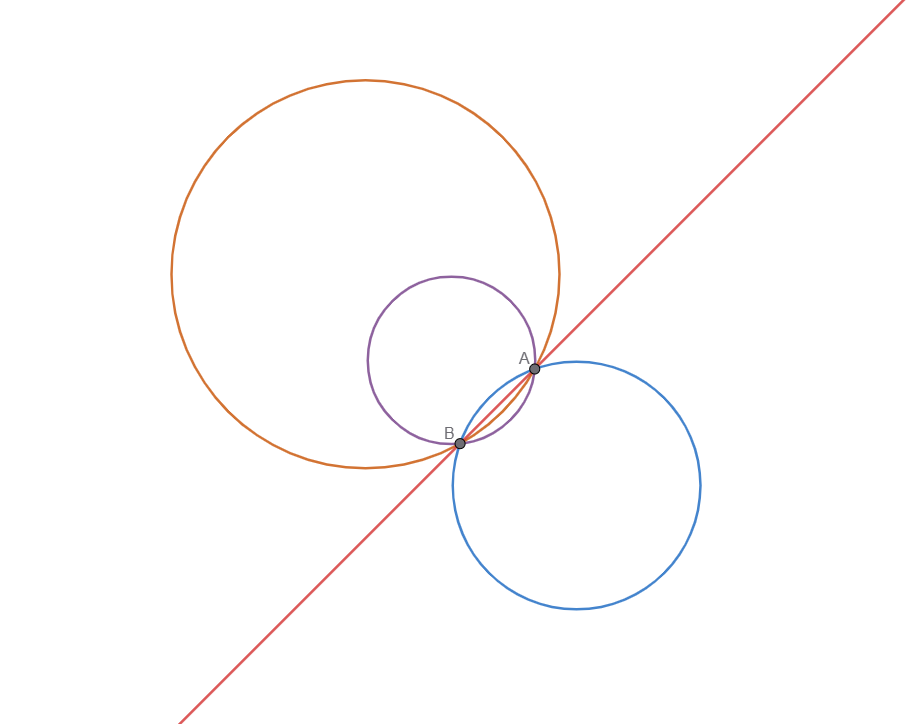
Furthermore, it follows that the radical axis of \(C_1\) and \(C_2\) is also the radical axis of any other pair of circles in the pencil: in this case, it is called the radical axis of the pencil.
It may instead happen that circles \(C_1\) and \(C_2\) are tangent at a point \(P_t\). In that case, every circle in the pencil passes through \(P_t\) (base point), as in Fig.2. Clearly, in this last case the radical axis is tangent to every circle of the pencil at the point \(P_t\).
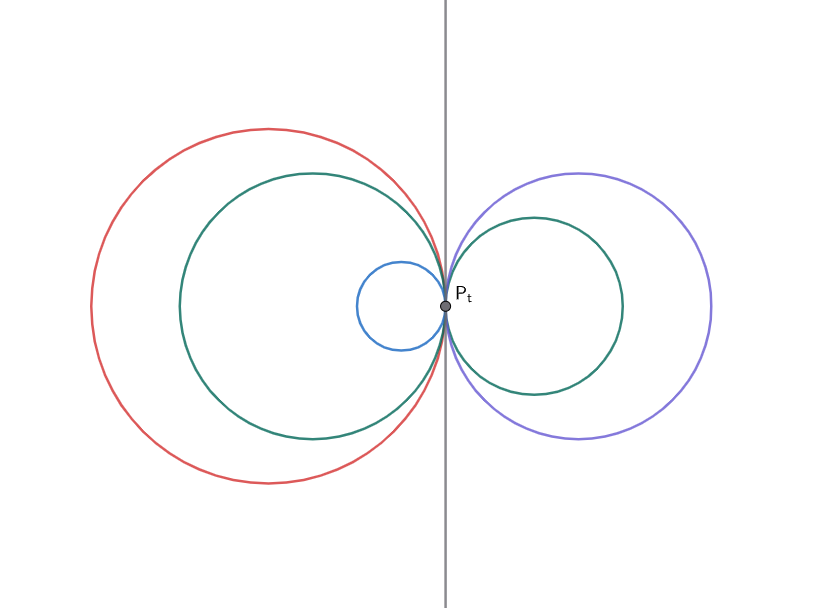
N.B. In the case of tangent circles, by convention, the degenerate circle of zero radius centered at \(P_t\) is also considered to belong to the pencil of circles.
Finally, setting
\[\lambda=\frac{m}{n}\]
equation (1) can be rewritten as:
\[n(x^2+y^2+D_1 x+E_1 y+F_1)+m(x^2+y^2+D_2 x+E_2 y+F_2)=0\tag{4}\]
which allows every circle of the pencil to be obtained, including the second generator \(C_2\) for \(n=0\).
Types of Pencils of Circles
Depending on the relative position of the two generating circles, the following cases can be distinguished:
- Intersecting circles — in this case, the two circles intersect at two distinct points. All circles of the pencil pass through these points, which, as seen earlier, are called the base points of the pencil.
- Tangent circles — in this case, they have a single point in common, and all circles of the pencil pass through that point. This case can be viewed as a limiting situation of the intersecting case, in which the intersection points coincide.
- Non-intersecting circles — finally, there is the case where the circles share no points at all. In this situation, no real base points exist, but the equation of the pencil remains valid from an analytic standpoint. This case is generally less common in exercises, but it completes the classification of the possible relative positions.
Worked Examples on Pencils of Circles
Example 1
Determine the equation of the pencil generated by the circles:
\[C_1: x^2+y^2-4=0\] \[C_2: x^2+y^2-2x=0\]
SOLUTION
In this case, the pencil of circles is obtained simply by applying equation (1):
\[C_1+\lambda C_2=0\] \[x^2+y^2-4+\lambda(x^2+y^2-2x)=0\]
Note also that, expanding the products and collecting like terms, the equation can be rewritten in an entirely equivalent way in form (2):
\[(1+\lambda)x^2+(1+\lambda)y^2-2\lambda x-4=0\]
which is an alternative representation of (1).
The following interactive graph illustrates the pencil as \(\lambda\) varies, showing the infinitely many circles generated by the two given circles.
Didactic note: the graph represents the pencil of circles generated by \(C_1: x^2+y^2-4=0\) and \(C_2: x^2+y^2-2x=0\). As \(\lambda\) varies, a family of circles is obtained, all sharing the point \(P(2,0)\). For \(\lambda=-1\), the pencil degenerates into the line \(x=2\), which is the radical axis.
Example 2
Write the equation of the pencil of circles passing through the points \(A(-1,-3)\) and \(B(2,2)\).
SOLUTION
To solve this exercise, it helps to first consider the circle having \(AB\) as its diameter.
In that case, the center \(C(x_c,y_c)\) of the circle will have coordinates coinciding with the midpoint of segment \(AB\), in formulas:
\[x_c=\frac{x_a+x_b}{2}=\frac{-1+2}{2}=\frac{1}{2}\] \[y_c=\frac{y_a+y_b}{2}=\frac{-3+2}{2}=-\frac{1}{2}\]
Next, the radius \(r\) of this circle is computed, which equals the distance \(CA\):
\[r=CA=\sqrt{(x_a-x_c)^2+(y_a-y_c)^2}=\sqrt{(-1-1/2)^2+(-3+1/2)^2}=\frac{\sqrt{34}}{2}\]
Recalling from the theory that the equation of a circle given its center and radius is written as:
\[(x-x_c)^2+(y-y_c)^2=r^2\]
substituting the numerical values gives
\[(x-\frac{1}{2})^2+(y+\frac{1}{2})^2=\frac{34}{4}\]
which can also be written in general form as
\[x^2+y^2-x+y-8=0 \quad \text{(first generator)}\]
Considering the radical axis as that particular circle of infinite radius passing through the base points \(A\) and \(B\) of the pencil, its equation is obtained simply by computing the equation of the line through two points, which in this case gives:
\[y=\frac{5}{3}x-\frac{4}{3}\]
which can be rewritten as:
\[5x-3y-4=0 \quad \text{(radical axis)}\]
Finally, the equation of the pencil of circles is obtained through the linear combination of the circle just found (first generator) and the radical axis (as the limiting case of a circle of infinite radius); recalling (1) and substituting the equations gives:
\[x^2+y^2-x+y-8+\lambda(5x-3y-4)=0 \]
Didactic note: the graph represents the pencil of circles passing through the base points \(A(-1,-3)\) and \(B(2,2)\), shown as \(x^2+y^2-x+y-8+\lambda(5x-3y-4)=0\). The generating circle \(C_1\) corresponds to \(\lambda=0\), while the line \(5x-3y-4=0\) is the radical axis of the pencil, itself a generator. Every circle of the pencil passes through \(A\) and \(B\) regardless of \(\lambda\).
Example 3
Determine the equation of the pencil of circles tangent to the line \(x+3y-2=0\) at its point \(P\) with abscissa 3.
SOLUTION
Since point \(P\) belongs to the line, its ordinate can be found immediately. Indeed:
\[y=\frac{-x+2}{3}\]
from which
\[y(3)=\frac{-3+2}{3}=-\frac{1}{3}\]
Recall from the theory that the degenerate circle of zero radius also belongs to the pencil, and so it can be written as:
\[(x-3)^2+(y+\frac{1}{3})^2=0\]
which, after expanding the squares, can be rewritten as:
\[x^2+y^2-6x+\frac{2}{3}y+\frac{82}{9}=0\]
which represents the first generator of the pencil.
The second generator is the tangent line at P, which is also the radical axis of the pencil whose equation is \(x+3y-2=0\).
Linearly combining the two generators gives the equation of the pencil of circles tangent at \(P\) to the given line:
\[x^2+y^2-6x+\frac{2}{3}y+\frac{82}{9}+\lambda (x+3y-2)=0\]
Didactic note: the graph represents the pencil of circles tangent to the line \(x+3y-2=0\) at the base point \(P(3,-\frac{1}{3})\), shown as \(x^2+y^2-6x+\frac{2}{3}y+\frac{82}{9}+\lambda(x+3y-2)=0\). At \(\lambda=0\) the pencil reduces to the degenerate circle of zero radius centered at \(P\), which is the first generator. Every circle of the pencil is tangent to the line at \(P\), regardless of \(\lambda\).
Example 4
Determine the base points of the pencil of circles with equation
\[x^2+y^2+3(1-k)x-(k+2)y-2k-1=0\]
SOLUTION
First, the given equation must be put into form (1). This gives:
\[x^2+y^2+3x-3kx-ky-2y-2k-1=0\]
so, rearranging according to form (1):
\[x^2+y^2+3x-2y-1+k(-3x-y-2)=0\]
which represents the equation of the pencil of circles generated by the circle:
\[x^2+y^2+3x-2y-1=0 \quad \text{(first generator)}\]
and by the radical axis with equation:
\[-3x-y-2=0 \quad \text{(second generator)}\]
The base points of the pencil can be found as the intersection of the first generator and the radical axis, by solving the following system:
\[\left\{\begin{matrix}x^2+y^2+3x-2y-1=0\\-3x-y-2=0\end{matrix}\right.\]
Solving the system (substituting, for example, the second equation into the first after solving it for \(y\)):
From the second equation:
\[y=-3x-2\]
Substituting into the first gives:
\[x^2+(-3x-2)^2+3x-2(-3x-2)-1=0\]
from which, simplifying:
\[x^2+9x^2+4+12x+3x+6x+4-1=0\] \[10x^2+21x+7=0\]
Computing the discriminant of this last equation:
\[\Delta=21^2-4(10)(7)=441-280=161\]
and therefore the solutions:
\[x_{1,2}=\frac{-21 \pm \sqrt{161}}{20}\]
Finally, computing the values of \(y\):
\[y_{1,2}=\frac{23\mp3\sqrt{161}}{20}\]
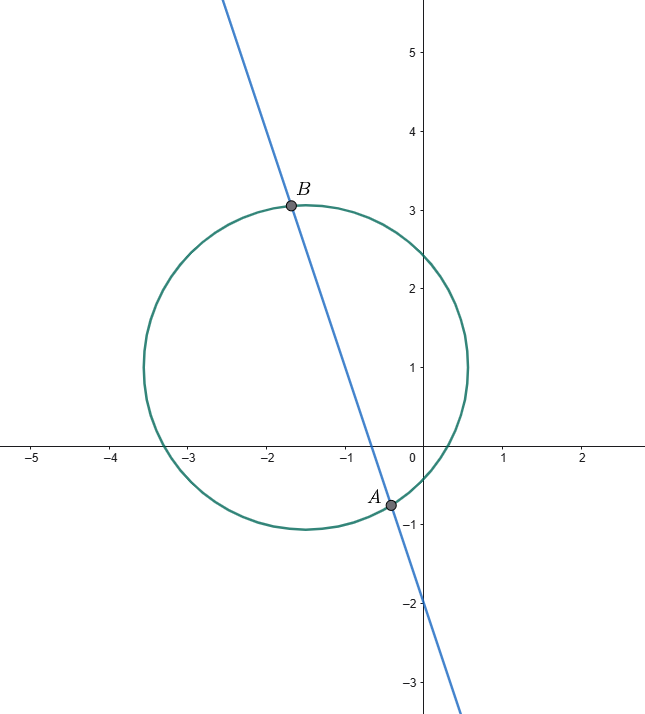
This gives the intersection points \(A(x_1,y_1)\) and \(B(x_2,y_2)\), which are the base points of the pencil of circles (Fig.3).
Common Mistakes with Pencils of Circles
When studying pencils of circles, it is easy to fall into a few common mistakes, often related to algebraic missteps as well as to a careless reading of the geometric meaning. Being aware of these pitfalls makes it possible to avoid incorrect steps and to approach the exercises with more confidence.
A first mistake consists of forgetting the parameter λ. The pencil of circles is defined precisely as the linear combination of two equations, and the parameter is what makes it possible to obtain an entire family of circles. If λ does not appear, a pencil is no longer being described, but a single circle — and the point of the problem is lost entirely.
Another frequent difficulty concerns simplifying the equation. After expanding the calculations, it is essential to correctly collect like terms and write the equation in standard form \(x^2 + y^2 + Dx + Ey + F = 0\). Leaving the expression in a disorganized form can make it harder to identify the center, radius, or other geometric properties of the circles in the pencil.
It is also important not to confuse the different types of pencil. Not every pencil of circles has the same characteristics: in some cases two real base points exist, in others they do not. For this reason it is necessary to check whether the circles have points in common and, if so, to determine them explicitly.
A particularly tricky mistake is failing to consider special cases of the parameter λ. Certain values of the parameter can radically change the equation — for example, causing the quadratic terms to vanish. In these situations the circle degenerates into a line, which represents a limiting element of the pencil. Overlooking these cases means failing to fully describe the family of curves.
Finally, there is often a tendency to focus only on the calculations, without interpreting the result geometrically. It is instead essential to ask what the fixed points of the pencil are, how the centers of the circles move, and what role the radical axis plays. A correct geometric interpretation not only helps in understanding the problem better, but also helps prevent mistakes in the algebraic steps.
In summary, the most common mistakes stem from a superficial handling of the parameter, insufficient attention to the form of the equation, and a missing geometric interpretation. Taking care of these aspects makes the study of pencils of circles far clearer and more systematic.
Conclusion
The pencil of circles is a fundamental tool in analytic geometry, since it makes it possible to describe an entire family of circles with a single expression. This approach provides a more orderly and systematic way to tackle even complex problems, avoiding the need to study every single case separately. It also offers a deeper view of the relationships between geometric figures, highlighting common elements such as the base points, the radical axis, and the transformations that connect the different circles of the pencil.
For the full context — standard and general form, tangent lines, relative position, and more — see the circle in coordinate geometry guide.
FINAL TEST
Test your understanding of pencils of circles with this short multiple-choice quiz. The questions cover the main concepts, equations, and geometric properties discussed throughout the article.
Cite this resource
"This page didn't write itself — every word here was written and checked by hand. If it helped you, sharing it or citing it as a source helps it reach the next student who needs it."
Citation
HTML link to copy