

The circle is one of the most important topics in analytic geometry. This collection offers circle practice problems with step-by-step solutions, each worked through in full detail with a clear explanation of every stage.
The problems cover the main question types: the equation of a circle, center and radius, whether a point lies on the circle, the relative position between a line and a circle, tangent lines, chords, and geometric problems in the coordinate plane.
Each problem is solved gradually, highlighting the key steps and the most common methods. This collection can be used both to review the theory and to build fluency in solving circle problems.
For the theory behind the general equation of a circle, see the dedicated article on the equation of a circle.
PROBLEM 1 — Finding the Center and Radius from the General Form
Find the coordinates of the center and the radius of the circle with equation
\[x^2+y^2+6x-1=0\]
SOLUTION
The given equation is written in general form
\[x^2+y^2+D x+E y +F=0\]
with
\[D=6\] \[E=0\] \[F=-1\]
so the coordinates of the center \(C(h,k)\) are
\[h=-\frac{D}{2}=-\frac{6}{2}=-3\] \[k=-\frac{E}{2}=0\]
The radius can then be found as
\[r=\sqrt{h^2+k^2-F}=\sqrt{(-3)^2+1}=\sqrt{10}\]
PROBLEM 2 — Center and Radius with Fractional Coefficients
Find the coordinates of the center and the radius of the circle with equation
\[5x^2+5y^2-6x-10y-3=0\]
SOLUTION
The first step is to rewrite the equation in general form by dividing through by 5:
\[x^2+y^2-\frac{6}{5}x-2y-\frac{3}{5}=0\]
The coefficients of the equation are
\[D=-\frac{6}{5}\] \[E=-2\] \[F=-\frac{3}{5}\]
so the coordinates of the center \(C(h,k)\) and the radius \(r\) are respectively:
\[C(h,k)=C(-\frac{D}{2},-\frac{E}{2})=(\frac{3}{5},1)\]
\[r=\sqrt{h^2+k^2-F}=\sqrt{\frac{9}{25}+1+\frac{3}{5}}=\sqrt{\frac{49}{25}}=\frac{7}{5}\]
PROBLEM 3 — Equation of a Circle from Its Center and Radius
Write the general equation of the circle with center \((-2,-5)\) and radius 3.
SOLUTION
Here it is convenient to use the standard form of the equation of a circle
\[(x-h)^2+(y-k)^2=r^2\]
where \(h,k\) are the coordinates of the center and \(r\) is the radius.
Substituting the given values gives
\[(x+2)^2+(y+5)^2=3^2\]
which is a valid equation of the required circle. However, this last equation is not the general form of the circle, which can be obtained from this result by expanding the squares and rearranging as:
\[x^2+4+4x+y^2+25+10y-9=0\]
and simplifying
\[x^2+y^2+4x+10y+20=0\]
PROBLEM 4 — Equation of a Circle Through the Origin with a Known Center
Write the equation of the circle with center \(C(2,3)\) that passes through the origin.
SOLUTION
Since the coordinates of the center \(C\) are known, the coefficients \(D\) and \(E\) of the general equation of a circle can be found immediately, recalling that
\[h=-\frac{D}{2}\] \[k=-\frac{E}{2}\]
from which it follows that
\[D=-2h\] \[E=-2k\]
where \(h\) and \(k\) are the coordinates of the center \(C\).
Substituting the numerical values gives:
\[D=-2h=-2 \cdot 2=-4\] \[E=-2k=-2 \cdot 3= -6\]
Since the circle must pass through the origin, it must also be true that
\[F=0\]
Indeed, if the circle passes through the origin, the equation \(x^2+y^2+D x+E y +F=0\) must be satisfied at the point \(O(0,0)\). In symbols, this requires:
\[0^2+0^2+D \cdot 0+E \cdot 0 +F=0\]
which gives the solution \(F=0\).
The required equation can therefore be written in general form as
\[x^2+y^2+D x+E y +F=0\]
so, substituting the values of \(D\), \(E\) and \(F\), we get
\[x^2+y^2-4 x-6 y=0\]
PROBLEM 5 — Intersections with the Axes and with a Given Line
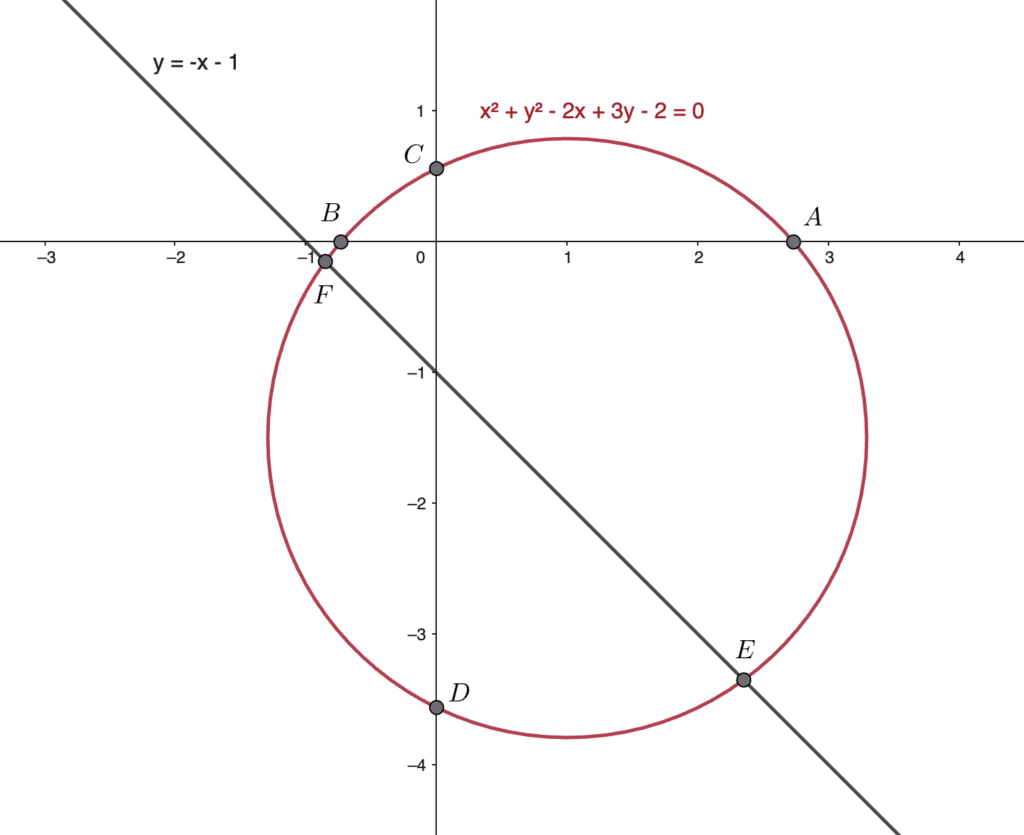
Find the coordinates of the intersection points of the circle \(x^2+y^2-2x+3y-2=0\)
- with the \(x\)-axis;
- with the \(y\)-axis;
- with the line \(y=-x-1\).
SOLUTION
1. Any intersection points between the circle and the \(x\)-axis (which has equation \(y=0\)) are found by solving the system:
\[\left\{\begin{matrix}x^2+y^2-2x+3y-2=0\\y=0\end{matrix}\right.\]
Substituting the second equation into the first gives:
\[x^2-2x-2=0\]
We compute the discriminant
\[\Delta=4+8=12\]
so the solutions are
\[x_{1,2}=\frac{2\pm2\sqrt{3}}{2}=1\pm\sqrt{3}\]
The intersection points with the \(x\)-axis can therefore be written as
\[A(1+\sqrt{3},0) \quad B(1-\sqrt{3},0)\]
2. Any intersection points between the circle and the \(y\)-axis (equation \(x=0\)) are found by solving the system:
\[\left\{\begin{matrix}x^2+y^2-2x+3y-2=0\\x=0\end{matrix}\right.\]
which, after substituting the second equation into the first, gives:
\[y^2+3y-2=0\]
Solving this equation gives
\[y_{1,2}=\frac{-3\pm\sqrt{17}}{2}\]
The intersection points with the \(y\)-axis can therefore be written as
\[C(0,\frac{-3+\sqrt{17}}{2}) \quad D(0,\frac{-3-\sqrt{17}}{2})\]
3. Any intersection points between the circle and the line \(y=-x-1\) are found by solving the system:
\[\left\{\begin{matrix}x^2+y^2-2x+3y-2=0\\y=-x-1\end{matrix}\right.\]
Substituting the second equation into the first gives
\[x^2+(-x-1)^2-2x+3(-x-1)-2=0\]
which simplifies to
\[2x^2-3x-4=0\]
whose solutions are
\[x_{1,2}=\frac{3\pm\sqrt{41}}{4}\]
Substituting into the equation of the line then gives the corresponding \(y\)-coordinates of the intersection points:
\[y_1=-\frac{3+\sqrt{41}}{4}-1\] \[y_2=-\frac{3-\sqrt{41}}{4}-1\]
The intersection points can therefore be expressed as
\[E(\frac{3+\sqrt{41}}{4},-\frac{3+\sqrt{41}}{4}-1) \quad F(\frac{3-\sqrt{41}}{4},-\frac{3-\sqrt{41}}{4}-1)\]
PROBLEM 6 — Circle Through Three Points
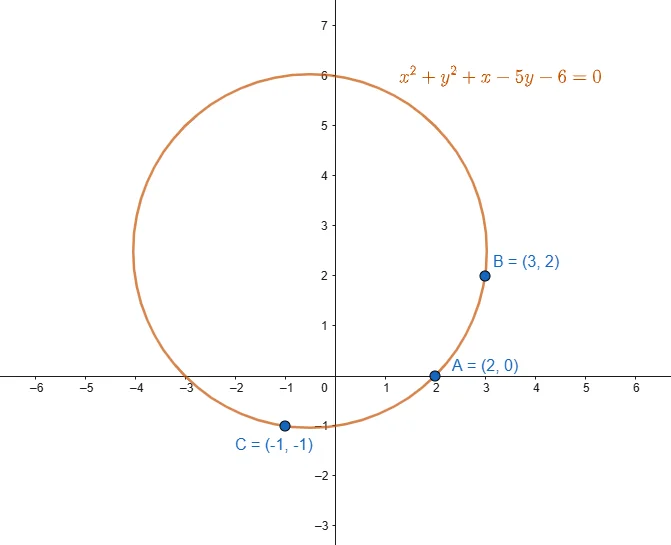
Write the equation of the circle passing through the points \(A(2,0), B(3,2), C(-1,-1)\).
SOLUTION
Given three non-collinear points in the plane, there exists exactly one circle passing through them.
For the general circle \(x^2+y^2+D x+E y+F=0\) to pass through the given points, its equation must be satisfied at each of the points \(A,B,C\).
This requires:
\[A \rightarrow 2^2+2D+F=0\] \[B \rightarrow 3^2+2^2+3D+2E+F=0\] \[C \rightarrow (-1)^2+(-1)^2-D-E+F=0\]
In other words, we must solve the system
\[\begin{cases} 2D+F+4=0 \\ 3D+2E+F+13=0 \\ -D-E+F+2=0 \end{cases}\]
From the first equation, solving for \(F\) gives
\[F=-2D-4\]
Substituting this into the second and third equations gives
\[\begin{cases} 3D+2E-2D-4+13=0 \\ -D-E-2D-4+2=0 \end{cases}\]
\[\begin{cases} D+2E+9=0 \\ -3D-E-2=0 \end{cases}\]
Multiplying the second equation of this last system by 2 gives
\[\begin{cases} D+2E+9=0 \\ -6D-2E-4=0 \end{cases}\]
Adding the two equations then gives
\[-5D+5=0\] \[5D=5\] \[D=1\]
Substituting this value into one of the two equations of the system (for instance, the second) gives
\[E=-3D-2=-3(1)-2=-5\]
and using the first of the three original equations again gives
\[F=-2D-4=-2(1)-4=-6\]
Substituting the values of \(D,E,F\) found from the system into the general equation of the circle gives
\[x^2+y^2+x-5y-6=0\]
which is the equation of the circle passing through the given points \(A,B,C\), and thus the solution to the problem.
For a deeper look at the procedure for finding a circle through three points, along with the analytical method and further worked examples, see the dedicated article “Circle Through Three Points“.
PROBLEM 7 — Relative Position Between a Line and a Circle
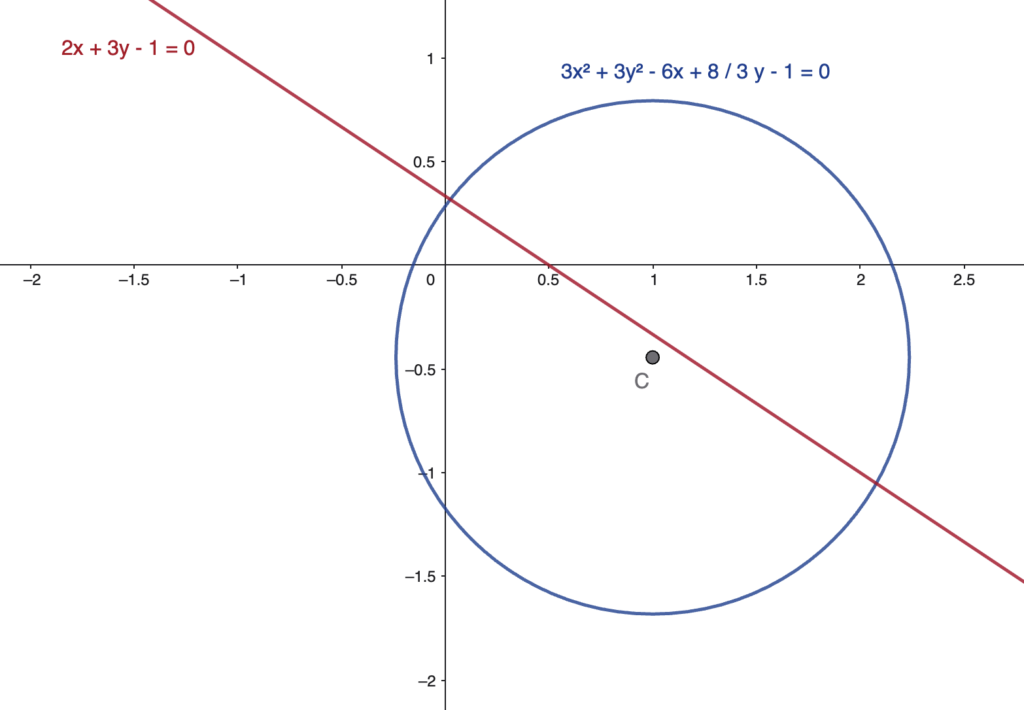
Determine whether the line \(2x+3y-1=0\) is secant, tangent, or external to the circle with equation \(3x^2+3y^2-6x+\frac{8}{3}y-1=0\).
SOLUTION
One method for determining the relative position between a line and a circle is to compare the distance between the center \(C\) and the line with the radius of the circle.
First, the circle must be rewritten in the form
\[x^2+y^2+D x+E y +F=0\]
so dividing the given equation by 3 gives
\[x^2+y^2-2x+\frac{8}{9}y-\frac{1}{3}=0\]
We find the center \(C(h,k)\) and the radius \(r\) as
\[C(h,k)=C(-\frac{D}{2},-\frac{E}{2})=(1,-\frac{4}{9})\]
\[r=\sqrt{h^2+k^2-F}=\sqrt{1+\frac{16}{81}+\frac{1}{3}}=\frac{2\sqrt{31}}{9}\]
Next, the distance between the center \(C\) and the line:
\[d=\frac{|ah+bk+c|}{\sqrt{a^2+b^2}}\]
where \(a,b\) and \(c\) are the coefficients of the line written in general form:
\[a=2\] \[b=3\] \[c=-1\]
Substituting the numerical values gives:
\[d=\frac{|2\cdot1+3\cdot(-\frac{4}{9})-1|}{\sqrt{4+9}}=\frac{1}{3\sqrt{13}}\]
From these results we observe that
\[\frac{2\sqrt{31}}{9}>\frac{1}{3\sqrt{13}}\]
which is equivalent to saying that
\[r>d\]
and therefore the line is secant to the circle at two distinct points.
PROBLEM 8 — Tangent Lines to a Circle from an External Point
After finding the coordinates of the center and the radius of the circle with equation
\[x^2+y^2-4x-2y+1=0\]
write the equations of the lines tangent to it that pass through the origin.
SOLUTION
The equation of the circle is already written in general form, so the coordinates of the center \(C\) are
\[h=-\frac{D}{2}=-\frac{-4}{2}=2\] \[k=-\frac{E}{2}=-\frac{-2}{2}=1\]
while the radius can be computed as
\[r=\sqrt{h^2+k^2-F}=\sqrt{2^2+1^2-1}=2\]
To find the tangent lines to the circle, recall that the analytical condition for tangency between a line and a circle can be expressed as
\[\Delta=0\]
applied to the equation obtained by solving the system formed by the circle and the general line of slope \(m\) passing (in this case) through the origin. In symbols:
\[\begin{cases} x^2+y^2-4x-2y+1=0 \\ y=mx \end{cases}\]
To solve this system, we can substitute the second equation into the first, obtaining
\[x^2+(mx)^2-4x-2(mx)+1=0\]
which, rearranged in \(x\), becomes
\[(1+m^2)x^2-2(2+m)x+1=0\]
Now we compute the discriminant of this equation and impose the tangency condition \(\Delta=0\), then solve for the unknown value of \(m\):
\[\Delta=0 \Rightarrow 4(2+m)^2-4(1+m^2)=0\]
which simplifies to
\[4+m^2+4m-1-m^2=0\] \[4m=-3\] \[m=-\frac{3}{4}\]
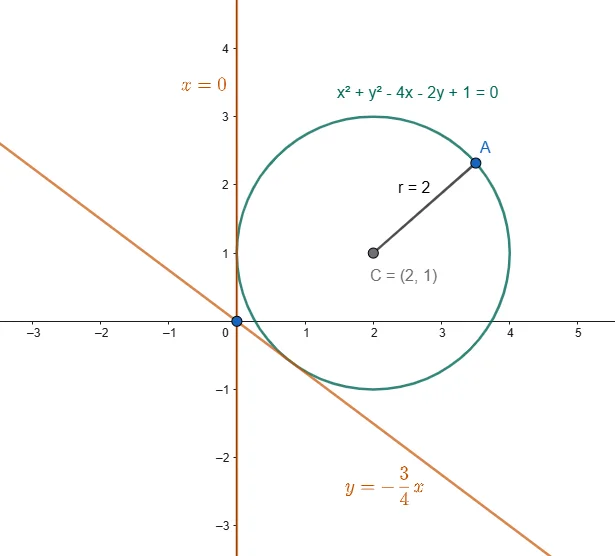
Note: the elimination of the quadratic term in the second-to-last step for computing \(m\) implicitly reduces the equation to first degree, giving a single analytical solution (here \(m=-3/4\)). However, notice (see Fig.4) that there are two lines tangent to the given circle:
the line
\[y=-\frac{3}{4}x\]
and the line coinciding with the \(y\)-axis, with equation
\[x=0\]
This last line, however (which is in fact one of the two tangents), cannot be found through the analytical procedure above, since the slope \(m\) is undefined for a vertical line.
To confirm that the line \(x=0\) is indeed tangent to the circle, it suffices to check that the distance between this line and the center \(C\) of the circle equals the radius.
Using the formula for the distance from a point to a line:
\[d=\frac{|ah+bk+c|}{\sqrt{a^2+b^2}}\]
with
\[a=1, \quad b=c=0\]
the coefficients of the line \(x=0\). Substituting the numerical values gives
\[d=|ah|=1(2)=2\]
Since this distance equals the radius of the circle, we conclude that the line \(x=0\) is indeed tangent to it.
PROBLEM 9 — Tangent Line at a Point on the Circle
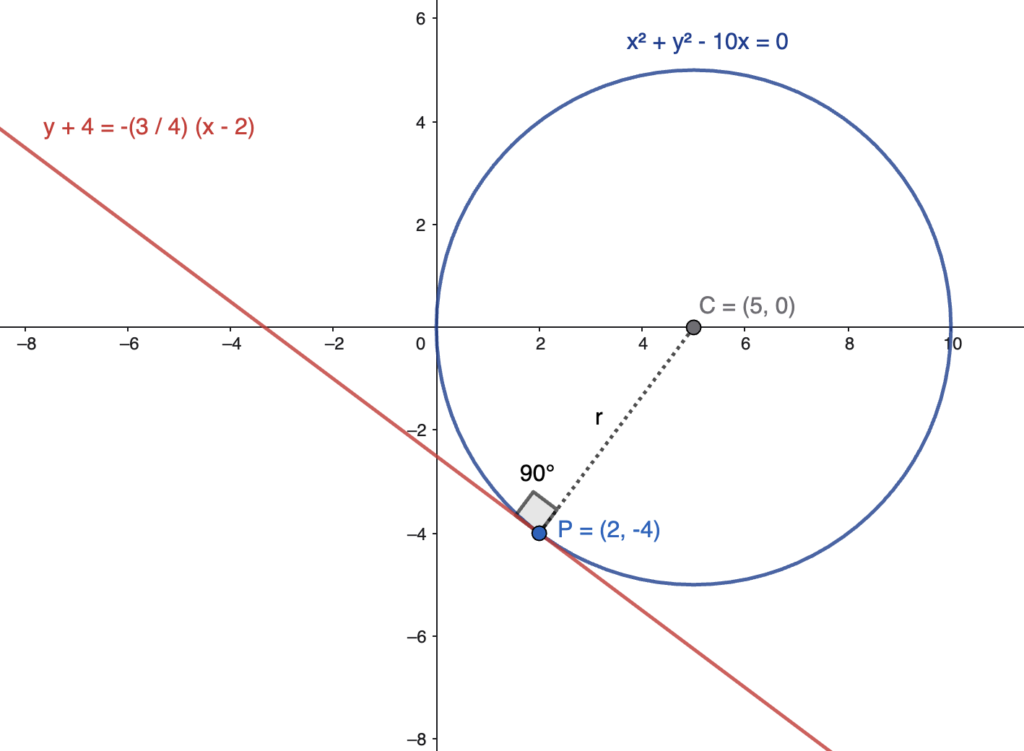
After checking that the point \(P(x_P,y_P)=(2,-4)\) lies on the circle \(x^2+y^2-10x=0\), find the equation of the line tangent to the circle at that point.
SOLUTION
To check that the point \(P\) lies on the circle, it suffices to verify that its equation is satisfied at that point. We therefore write
\[2^2+(-4)^2-10(2)=0\]
which is true, so \(P\) does indeed lie on the given circle.
We also know from the theory that the line tangent to a circle at a point \(P\) is perpendicular to the radius \(CP\) connecting the center to that point.
Computing the slope \(m\) of the line through \(C\) and \(P\) gives:
\[m=\frac{y_P-y_C}{x_P-x_C}=\frac{-4-0}{2-5}=\frac{4}{3}\]
from which the slope of the perpendicular line follows:
\[m_\perp=-\frac{1}{m}=-\frac{1}{4/3}=-\frac{3}{4}\]
To write the equation of the tangent line at \(P\), we use the point-slope form:
\[y-y_P=m_\perp (x-x_P)\]
Substituting the values gives the required tangent line:
\[y+4=-\frac{3}{4} (x-2)\]
PROBLEM 10 — Length of a Chord Cut by a Line
Find the length of the chord cut by the line \(x+y+1=0\) on the circle with center \((0,1)\) and radius 2.
SOLUTION
We begin by finding the equation of the circle from its known center and radius
\[(x-h)^2+(y-k)^2=r^2\]
Substituting the numerical values gives
\[x^2+(y-1)^2=2^2\]
which, after expanding the squares, can equivalently be rewritten as
\[x^2+y^2-2y-3=0\]
Let’s now sketch both the circle and the line (Fig.6).
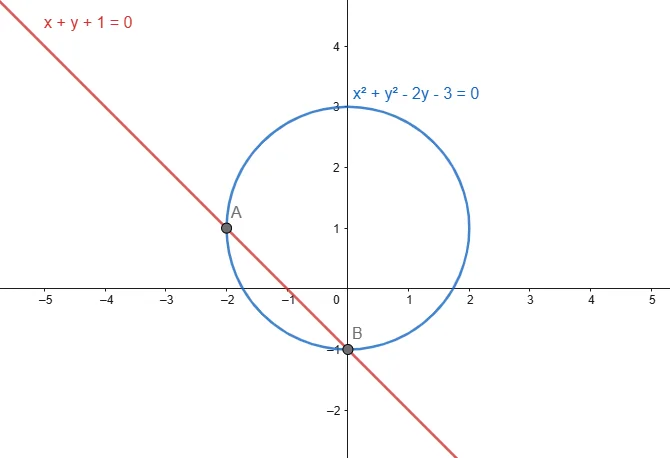
From Fig.6, the problem asks for the length of the segment \(\overline{AB}\), that is, the chord cut by the line on the circle.
This can be solved by first finding the coordinates of the intersection points between the line and the circle, and then computing the distance between points \(A\) and \(B\).
We proceed by solving the following system:
\[\begin{cases} x^2+y^2-2y-3=0 \\ x+y+1=0 \end{cases}\]
We substitute the second equation into the first, after solving for \(y\), as follows
\[\begin{cases} x^2+(-x-1)^2-2(-x-1)-3=0 \\ y=-x-1 \end{cases}\]
Expanding the squares in the first equation of this last system and simplifying gives
\[x^2+2x=0\]
from which
\[x(x+2)=0\]
whose solutions are
\[x_1=-2\] \[x_2=0\]
with corresponding \(y\)-coordinates (immediately found from the equation of the line)
\[y_1=y(x_1)=y(-2)=-(-2)-1=1\] \[y_2=y(x_2)=y(0)=-1\]
The coordinates of points \(A\) and \(B\) are therefore
\[A(x_1,y_1)=A(-2,1)\] \[B(x_2,y_2)=B(0,-1)\]
Finally, we compute the distance between points \(A\) and \(B\) using the standard formula:
\[\overline{AB}=\sqrt{(x_2-x_1)^2+(y_2-y_1)^2}=\sqrt{(0+2)^2+(-1-1)^2}=2\sqrt{2}\]
which is the required chord length.
PROBLEM 11 — Intersections of Two Circles and the Radical Axis
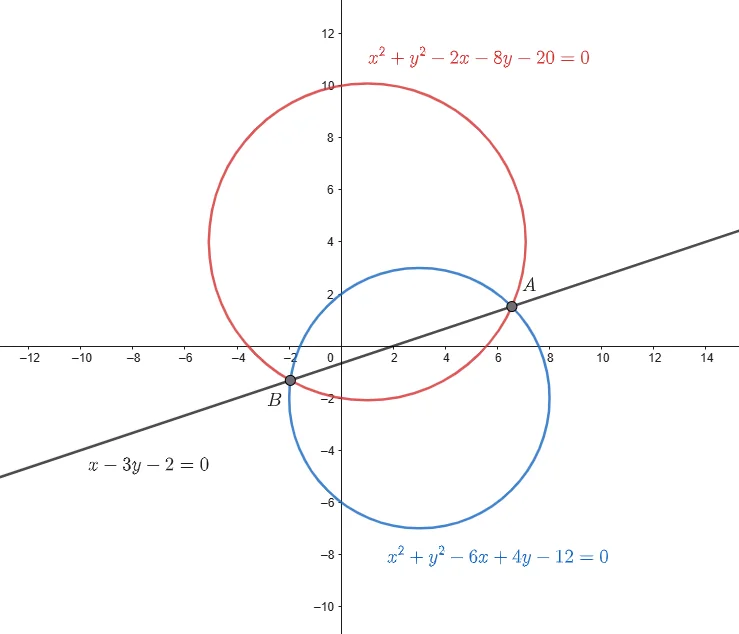
Given the circles \(\Gamma_1\) and \(\Gamma_2\) with equations
\[\Gamma_1: \quad x^2+y^2-6 x+4 y-12=0\] \[\Gamma_2: \quad x^2+y^2-2 x+8 y-20=0\]
find any intersection points. Also find the radical axis.
SOLUTION
Here it is convenient to subtract the two equations, which gives:
\[x^2+y^2-6 x+4 y-12-(x^2+y^2-2 x+8 y-20)=0\]
which simplifies to
\[-4x+12y+8=0\]
Dividing both sides by -4
\[x-3y-2=0\]
which is the radical axis of the two circles.
To find the intersection points, we can intersect the radical axis just found with one of the two circles, say \(\Gamma_1\), obtaining the system:
\[\begin{cases} x^2+y^2-6 x+4 y-12=0 \\ x-3y-2=0 \end{cases}\]
which can be solved, for instance, by isolating \(x\) in the second equation and substituting it into the first:
\[\begin{cases} (3y+2)^2+y^2-6 (3y+2)+4 y-12=0 \\ x=3y+2 \end{cases}\]
Simplifying the first of these two equations gives
\[9y^2+12y+4+y^2−18y−12+4y−12=0\] \[10y^2-2y-20=0\]
Dividing by 2
\[5y^2-y-10=0\]
which gives
\[\Delta=(-1)^2-4(5)(-10)=201\] \[y_{1,2}=\frac{1\pm\sqrt{201}}{10}\]
Now we compute \(x\):
\[x_1=3y_1+2=3 \frac{1+\sqrt{201}}{10}+2=\frac{23+3\sqrt{201}}{10}\] \[x_2=3y_2+2=3 \frac{1-\sqrt{201}}{10}+2=\frac{23-3\sqrt{201}}{10}\]
The required intersection points are therefore
\[A=\left(\frac{23+3\sqrt{201}}{10},\frac{1+\sqrt{201}}{10}\right)\]
\[B=\left(\frac{23-3\sqrt{201}}{10},\frac{1-\sqrt{201}}{10}\right)\]
For further worked examples, or to explore the theory behind the relative position of two circles — including the possible cases, the common tangent, intersection points, and other configurations of the radical axis — see the dedicated article – Relative Position Between Two Circles.
PROBLEM 12 — Secant, Tangent, or External Line Depending on a Parameter
Find the values of \(\lambda\) for which the line \(x+2y+\lambda=0\) is secant, tangent, or external to the circle \(x^2+y^2+6x+4y-3=0\).
SOLUTION
Consider the system formed by the circle and the line:
\[\begin{cases} x^2+y^2+6 x+4 y-3=0 \\ x+2y+\lambda=0 \end{cases}\]
and we want to determine the values of \(\lambda\) for which the line is
- secant;
- tangent;
- external.
From the line we get
\[x=-2y-\lambda\]
and substitute into the circle, obtaining
\[(−2y−\lambda)^2+y^2+6(−2y−\lambda)+4y-3=0\]
Expanding the squares and rearranging with respect to \(y\) gives
\[5y^2+(4\lambda-8)y+\lambda^2-6\lambda-3=0\]
which is a second-degree equation in \(y\).
To determine whether the line is tangent, secant, or external to the circle, we study the discriminant of this last equation. In particular:
- two real solutions → secant line;
- one repeated real solution → tangent line;
- no real solutions → external line.
We compute the discriminant:
\[\Delta=b^2-4ac\]
with
\[a=5,\qquad b=4\lambda-8,\qquad c=\lambda^2-6\lambda-3\]
So:
\[\Delta=(4\lambda-8)^2-20(\lambda^2-6\lambda-3)\] \[\Delta=16\lambda^2-64\lambda+64-20\lambda^2+120\lambda+60\] \[\Delta=-4\lambda^2+56\lambda+124\]
Factoring out −4:
\[\Delta=-4(\lambda^2-14\lambda-31)\]
Tangency condition
The line is tangent when:
\[\Delta=0\]
that is:
\[\lambda^2-14\lambda-31=0\]
which gives
\[\lambda=\frac{14\pm\sqrt{320}}{2}=7\pm4\sqrt{5}\]
Secant line
\[\Delta>0\] \[-4(\lambda^2-14\lambda-31)>0\] \[\lambda^2-14\lambda-31<0\]
whose solution is
\[7-4\sqrt5<\lambda<7+4\sqrt5\]
External line
\[\Delta<0\] \[\lambda^2-14\lambda-31>0\]
\[\lambda<7-4\sqrt5 \quad \text{or} \quad \lambda>7+4\sqrt5\]
Below is an interactive graph for a dynamic visualization of the solutions as the parameter \(\lambda\) varies.
PROBLEM 13 — Circle Problem with a Parametric Line and a Condition on the Chord
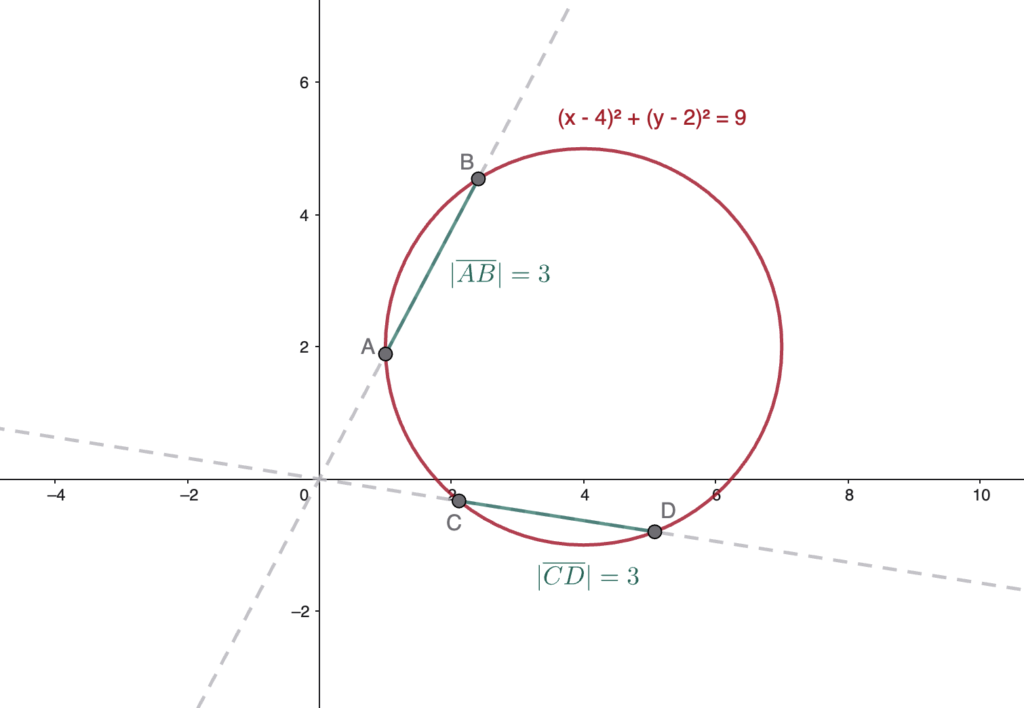
Given the circle with equation \((x-4)^2+(y-2)^2=9\), find the values of the parameter \(\lambda\) such that the line \(y=\lambda x\) cuts a chord on the circle equal in length to the radius.
SOLUTION
We first find the center \(C(h,k)\) of the circle:
\[h=-\frac{D}{2}=4\] \[k=-\frac{E}{2}=2\]
and the radius
\[r=\sqrt{h^2+k^2-F}=\sqrt{4^2+2^2-11}=3\]
keeping in mind that the equation of the circle, after expanding the squares and rearranging, can be written in general form as
\[x^2+y^2-8x-4y+11=0\]
with
\[D=-8\] \[E=-4\] \[F=+11\]
To find the solution, we must first intersect the line with the circle by solving the system:
\[\begin{cases} x^2+y^2-8x-4y+11=0 \\ y=\lambda x \end{cases}\]
Substituting the second equation into the first gives:
\[x^2+\lambda^2x^2-8x-4\lambda x+11=0\]
and rearranging with respect to \(x\)
\[(1+\lambda^2)x^2-4(\lambda+2)x+11=0\]
Now we compute the discriminant of this last equation:
\[\Delta=16(\lambda+2)^2-44(1+\lambda^2)\]
which, after further simplification once the squares are expanded, becomes
\[\Delta=-28\lambda^2+64\lambda+20\]
Next we compute the \(x\)-coordinates of the intersection points between the line and the circle as
\[x_{A,B}=\frac{4(\lambda+2)\pm \sqrt{\Delta}}{2(1+\lambda^2)}\]
and the \(y\)-coordinates of the intersection points \(y_A\) and \(y_B\), which can be found directly from the equation of the line \(y=\lambda x\), since these points must also lie on it. We can therefore write:
\[y_A=\lambda x_A\] \[y_B=\lambda x_B\]
We now impose the condition required by the problem, namely
\[|\overline{AB}|=r\]
so, using the formula for the distance between two points in the plane:
\[\sqrt{(x_B-x_A)^2+(y_B-y_A)^2}=r\]
Squaring both sides of this last equation and expressing \(y_A\) and \(y_B\) solely as functions of \(x\) gives:
\[(x_B-x_A)^2+(\lambda x_B-\lambda x_A)^2=r^2\]
which simplifies as follows:
\[(x_B-x_A)^2+\lambda^2(x_B-x_A)^2=r^2\] \[(1+\lambda^2)(x_B-x_A)^2=r^2\]
We then eliminate \(x_A\) and \(x_B\) by substituting:
\[(1+\lambda^2)\left(\frac{4(\lambda+2)-\sqrt{\Delta}}{2(1+\lambda^2)}-\frac{4(\lambda+2)+ \sqrt{\Delta}}{2(1+\lambda^2)}\right)^2=r^2\]
which simplifies to
\[\frac{(1+\lambda^2)}{4(1+\lambda^2)^2}(-2 \sqrt{\Delta})^2=r^2\]
so we simplify further, obtaining
\[\frac{\Delta}{1+\lambda^2}=r^2\]
and, multiplying both sides by \(1+\lambda^2\), we get
\[\Delta=(1+\lambda^2)r^2\]
Substituting the values \(\Delta=-28\lambda^2+64\lambda+20\) and \(r=3\) into this last equation gives:
\[-28\lambda^2+64\lambda+20=(1+\lambda^2)\cdot 3^2\]
which simplifies to
\[37\lambda^2-64\lambda-11=0\]
solving this equation (left to the reader) gives the values
\[\lambda_{1,2}=\frac{32\pm \sqrt{1431}}{37}\]
For the full theory behind every problem type above, see the complete guide to the circle in coordinate geometry.
FINAL TEST
You have studied the main types of circle problems: reading the parameters from the general form, finding the center and radius, intersections with the axes and with lines, the relative position between a line and a circle, tangent lines, and the radical axis. Test your understanding now with the questions below, and you'll get immediate feedback with an explanation for each answer.
Cite this resource
"Behind this article: hours of writing, checking, and rewriting to get it right. If it was useful, a share or citation helps it find the next person who needs it."
Citation
HTML link to copy