
The circle is one of the most extensively studied figures in plane coordinate geometry. It belongs to the family of conic sections (which also includes the parabola, ellipse, and hyperbola) and appears throughout coordinate geometry, from tangency problems to intersections between lines and curves.
Studying the circle makes it possible to address a wide range of problems, including:
- finding the center and radius from its equation;
- determining the relative position of a line and a circle;
- finding the equations of tangent lines;
- constructing circles through given points;
- analyzing pencils of circles;
- graphically interpreting certain radical inequalities using semicircles.
This guide covers all the fundamental concepts related to the circle in the coordinate plane, from the basic definitions through the most important applications. The discussion begins with the definition of a locus of points and proceeds through the main solution methods used in exercises.
What Is a Circle in the Coordinate Plane
Definition of a Circle
In the coordinate plane, a circle is defined as the locus of points equidistant from a fixed point called the center. The constant distance between this locus of points and the center is called the radius \(r\).
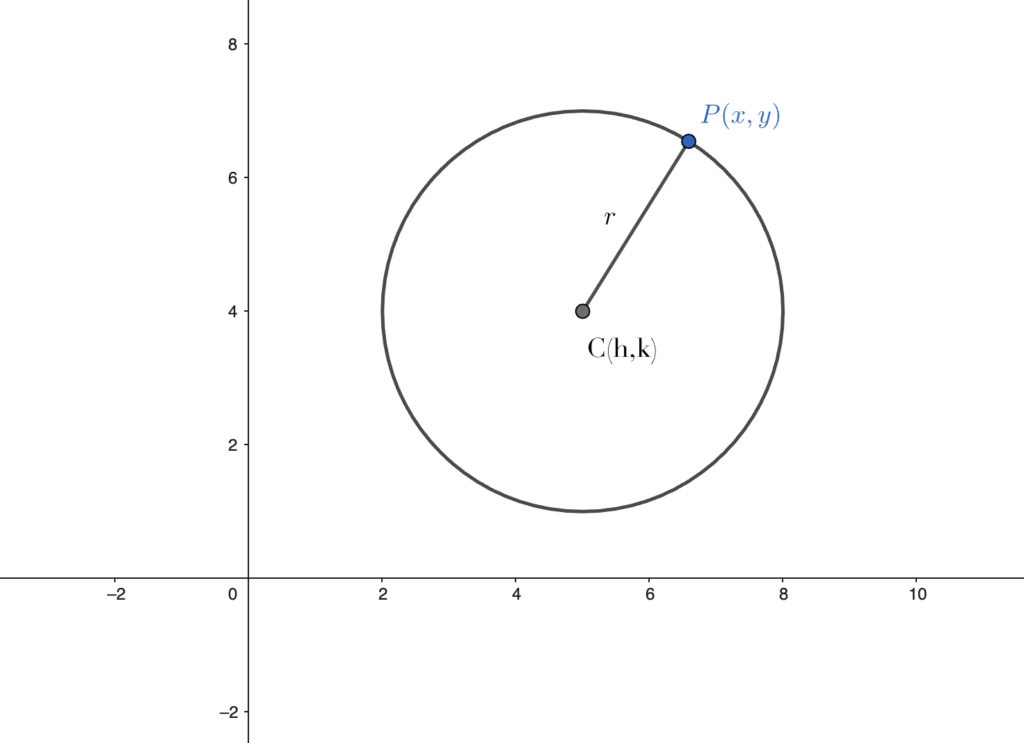
Denoting the center by \(C(h,k)\) and a generic point on the circle by \(P(x,y)\), the distance \(CP\) must always equal the radius \(r\).
From an analytic standpoint, the equation of a circle follows directly from the distance formula between two points in the coordinate plane.
Since by definition of a circle
\[CP=r \tag{1}\]
the distance between the center \(C(h,k)\) and a generic point \(P(x,y)\) can be written as:
\[CP = \sqrt{(x-h)^2 + (y-k)^2}\]
Setting this distance equal to the radius \(r\) gives:
\[\sqrt{(x-h)^2 + (y-k)^2} = r\]
Squaring both sides yields the equation of the circle in the form:
\[(x-h)^2 + (y-k)^2 = r^2 \tag{2}\]
Center and Radius
Every circle is fully determined by two elements:
- the center \(C(h,k)\), which fixes the circle’s position in the plane;
- the radius \(r\), which determines its size.
The radius is always a positive number, while the coordinates of the center can take any real value.
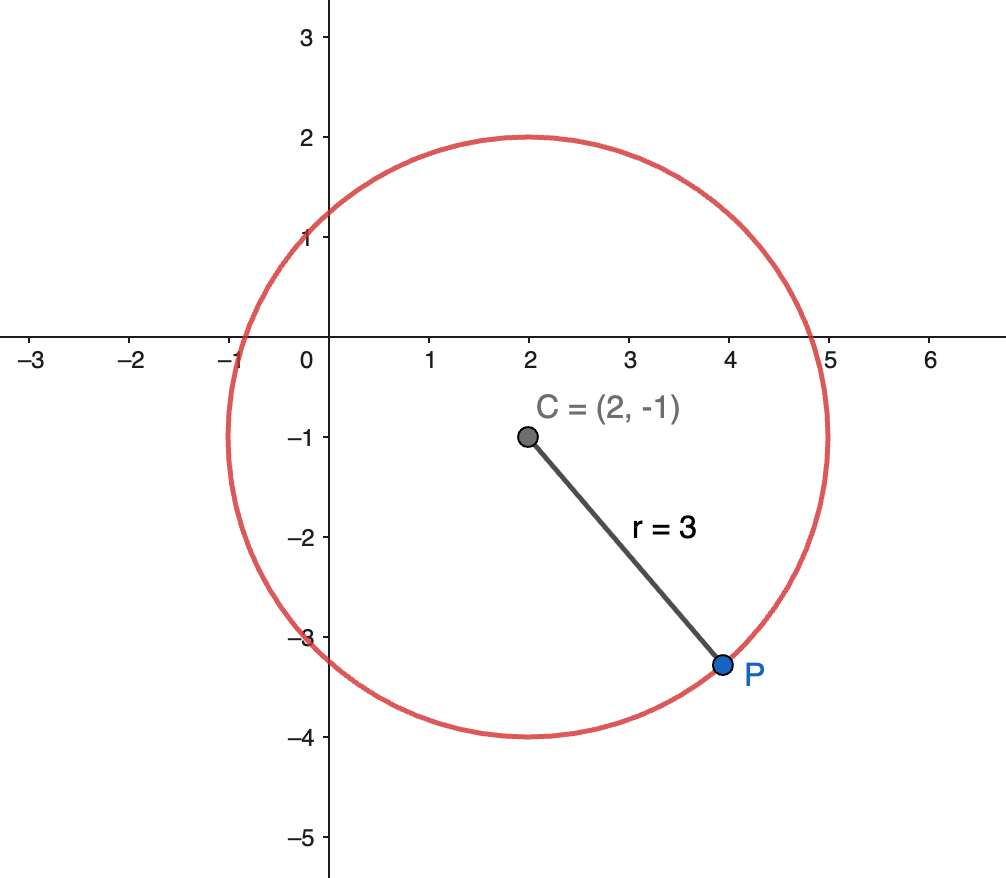
For example, a circle with center \(C(2,-1)\) and radius \(r=3\) is the set of all points in the plane whose distance from \(C\) is exactly 3 (Fig.2).
Equation of a Circle Given Center and Radius
Equation (2) represents a particular form of the circle equation, since it directly displays the center \(C\) and the radius \(r\), making it immediate to picture the conic in the coordinate plane.
EXAMPLE
Consider the circle:
\[(x-3)^2 + (y+2)^2 = 16\]
Comparing this equation with (2) gives directly:
\[h=3\] \[k=-2\] \[r^2=16 \rightarrow r=\sqrt{16}=4\]
The center \(C\) therefore has coordinates:
\[C(3,-2)\]
while the radius \(r\) equals:
\[r=4\]
The center-radius form of the circle equation (2) is certainly among the easiest to interpret geometrically, and it is often the end result of completing the square starting from the general form.
General Form of a Circle
A circle is very often written in the form:
\[x^2 + y^2 + Dx + Ey + F = 0 \tag{3}\]
Equation (3) is the general form of a circle. Unlike the center-radius form (2), the center and radius are not immediately visible here and must be recovered using techniques such as completing the square (though this is not the only method).
When an Equation Represents a Circle
Equation (3) does not represent a circle for every possible combination of the coefficients \(D, E,\) and \(F\). A quadratic equation in \(x\) and \(y\) represents a circle only when the following conditions are all satisfied simultaneously:
- the coefficients of \(x^2\) and \(y^2\) are equal to each other;
- there is no \(xy\) mixed term;
- the radius of the circle is positive.
EXAMPLE
The equation:
\[x^2 + y^2-4x+6y-12 = 0\]
trivially satisfies the first two conditions above, since the coefficients of the quadratic terms are identical and no mixed term is present. To confirm that this equation represents a real circle, however, the radius must also come out positive. Checking this, as already mentioned, can be done by completing the square (although this is not the only technique available). Let’s see how.
The equation can be rewritten as:
\[x^2-4x+y^2+6y-12 = 0\]
and then as
\[x^2-4x + 4 + y^2 + 6y + 9-25 = 0\]
and finally as
\[(x-2)^2+(y+3)^2=25\]
which is the equation of a circle with radius five, centered at \(C(2,-3)\).
Caution
For example, the equation:
\[2x^2 + y^2-3 = 0\]
does not represent a circle, because the coefficients of \(x^2\) and \(y^2\) are different from each other.
Or consider the equation
\[x^2+y^2+2x-8y+20 = 0\]
which does not represent any real circle. Completing the square gives:
\[(x+1)^2-1+(y-4)^2-16+20=0\]
from which
\[(x+1)^2+(y-4)^2=-3\]
This equation cannot represent any real curve, since a sum of squares can never equal a negative number (here, -3). The given equation therefore does not represent a circle.
Finding the Center and Radius of a Circle
One method for recovering the center and radius of a circle from the general form is completing the square, applied separately to the \(x\)-terms and the \(y\)-terms.
EXAMPLE
Consider the circle in general form:
\[x^2 + y^2 – 6x + 4y – 3 = 0\]
Group the terms:
\[(x^2 – 6x) + (y^2 + 4y) = 3\]
Complete the square in \(x\) by adding and subtracting 9, and in \(y\) by adding and subtracting 4:
\[(x^2 – 6x + 9) – 9 + (y^2 + 4y + 4) – 4 = 3\]
\[(x-3)^2 + (y+2)^2 = 16\]
From this we obtain:
- center \(C(3,-2)\);
- radius \(r=\sqrt{16}=4\).
The article “Equation of a Circle” explores this derivation in more depth, with the analytical method for finding the center and radius from \(D\), \(E\), and \(F\), including the condition that the radius must be real and positive.
How to Find the Equation of a Circle
Among the most common problems in coordinate geometry is finding the equation of a circle from known conditions. For example, the center and radius may be known and the equation must be found. Or the center and a point on the circle may be given, or three points through which the circle must pass.
Circle Given Center and Radius
If the center \(C(h,k)\) and the radius \(r\) are known, form (2) can be used directly by substituting the known values.
EXAMPLE
Find the equation of the circle with center \(C(1,-2)\) and radius \(r=2\).
Substituting the center’s coordinates and the radius into form (2) gives directly:
\[(x-1)^2 + (y+2)^2 = 4\]
Circle with Known Center Through a Point
If the center \(C(h,k)\) and a point \(P(x_1,y_1)\) on the circle are known, the radius can be found immediately using the distance formula between two points.
EXAMPLE
Center \(C(-3,-5)\), point \(P(1,2)\).
\[r = \sqrt{(1+3)^2 + (2+5)^2} = \sqrt{65}\]
The equation of the circle is again obtained using (2):
\[(x+3)^2 + (y+5)^2 = 65\]
Circle Through Three Points
One of the classic problems encountered in coordinate geometry when studying the circle is finding its equation from three known points on it.
It is a known result that three non-collinear points in the plane determine one, and only one, circle. In this case, form (3) is the most convenient starting point:
\[x^2 + y^2 + Dx + Ey + F = 0\]
Substituting the known coordinates of the three points into the equation produces a linear system of three equations in the three unknowns \(D\), \(E\), and \(F\). Solving the system gives the coefficients of the equation sought.
EXAMPLE
Find the circle through \(A(1,0)\), \(B(0,1)\), \(C(-1,0)\).
Substituting the coordinates of the three points one at a time into the general equation gives the following linear system of three equations in three unknowns:
\[\begin{cases} 1 + 0 + D + 0 + F = 0 \\ 0 + 1 + 0 + E + F = 0 \\ 1 + 0-D + 0 + F = 0 \end{cases}\]
that is
\[\begin{cases} 1 + D + F = 0 \\ 1 + E + F = 0 \\ 1-D + F = 0 \end{cases}\]
whose solution is
\[D=E=0\] \[F=-1\]
Substituting these values into equation (3) gives the equation of the circle:
\[x^2 + y^2-1 = 0\]
that is, the circle with center \(C(0,0)\) and radius \(r=1\).
The full analytical method, along with several additional worked examples, is covered in a dedicated article on finding a circle from three given points.
Relative Position of a Line and a Circle
A line and a circle in the coordinate plane can be arranged in three different ways relative to each other:
- secant: the line intersects the circle at two distinct points;
- tangent: the line has exactly one point in common with the circle;
- external: the line has no points in common with the circle and lies entirely outside it.
This classification rests on comparing the distance \(d\) from the circle’s center to the line with the radius \(r\).
Recall that the distance from a point \(C(h,k)\) to a line with equation \(ax+by+c=0\) is given by:
\[d = \frac{|ah + bk + c|}{\sqrt{a^2+b^2}}\]
For each of the three cases, the conditions are given in the subsections below.
Secant Line
A line is secant to the circle when it intersects the circle at two distinct points. This occurs when the distance \(d\) between the center and the line is less than the radius:
\[d<r\]
Tangent Line
A line is tangent to the circle when it has only one point in common with it. In that case:
\[d = r\]
In other words, the distance \(d\) between the center and the line equals the radius.
External Line
A line is external to the circle when it has no points in common with it. In this last case the condition is:
\[d>r\]
In other words, the distance \(d\) between the center and the line is greater than the radius.
Analytic Method Using the Discriminant
An alternative to comparing the center-line distance with the radius is to set the equations of the line and the circle as a system, producing a quadratic equation. Analyzing the discriminant \(\Delta\) of this equation gives the following classification:
\[\begin{cases} \Delta>0 \Rightarrow \text{secant line} \\ \Delta=0 \Rightarrow \text{tangent line} \\ \Delta<0 \Rightarrow \text{external line} \end{cases}\]
The two methods — one based on the center-line distance, the other on the discriminant — are entirely equivalent and always lead to the same classification. The discriminant method, however, applies more generally and can be used for any other conic section.
For a more in-depth treatment, consider looking at the article on the “Relative Position of a Line and a Circle” that works through this classification in full, including the discriminant method applied to several worked examples.
Tangent Line to a Circle
A line is called tangent to a circle if it has exactly one point in common with it. In that case, the point of contact is called the point of tangency. The tangent line to a circle has an important property: at the point of tangency, the line is perpendicular to the circle’s radius drawn to that point.
Equation of the Tangent Line Through a Known Point on the Circle
Given the circle with equation:
\[x^2 + y^2 + Dx + Ey + F = 0\]
with center
\[h=-\frac{D}{2}\] \[k=-\frac{E}{2}\]
and a point \(P(x_P,y_P)\) on it, the equation of the line tangent to the circle at \(P\) is:
\[y-y_P=-\frac{1}{m}(x-x_P) \tag{4}\]
with
\[m=\frac{y_P-k}{x_P-h} \tag{5}\]
This result is not surprising, since (4) is the point-slope form of the line through \(P\) with slope equal to the negative reciprocal (perpendicularity condition) of the slope of the line through \(C\) and \(P\) defined by (5).
Note: This method applies when \(x_P\ne h\). If \(x_P=h\), the radius \(CP\) is vertical, so the tangent line is horizontal and has equation \(y=y_P\).
Example
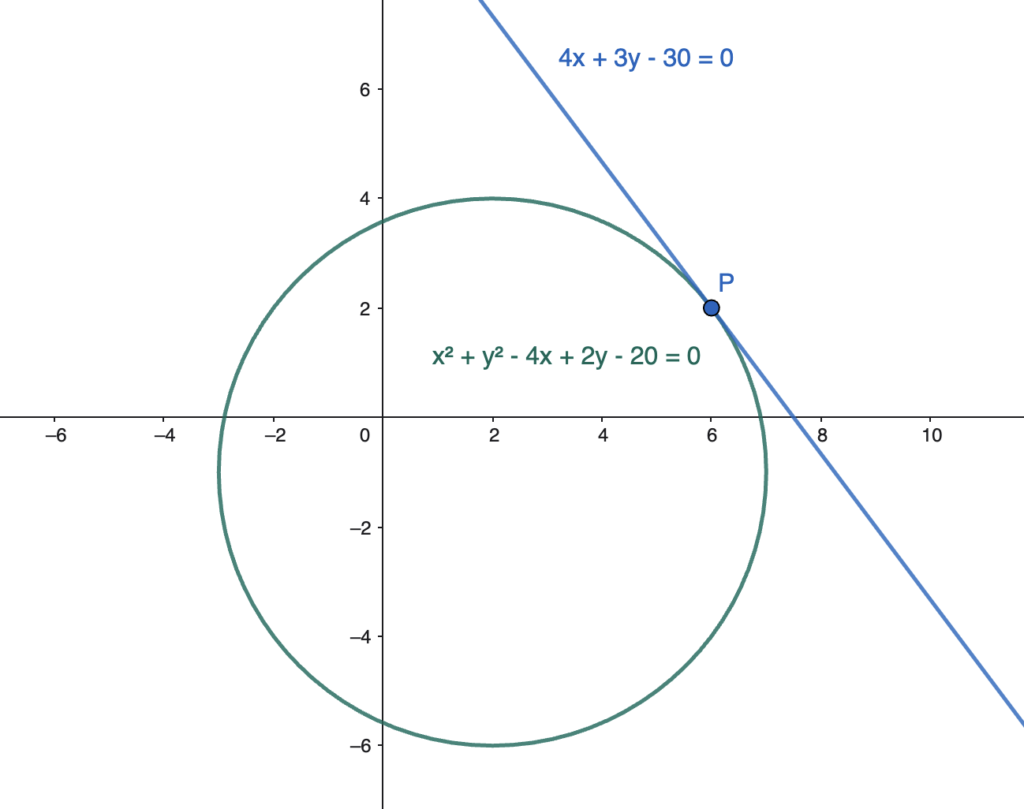
Find the tangent line to the circle \(x^2 + y^2-4x + 2y-20 = 0\) at the point \(P(6,2)\).
First check that \(P\) lies on the circle by substituting its coordinates into the equation:
\[36 + 4-24 + 4-20 = 0\]
which is true, so \(P\) lies on the circle.
Next, find the coordinates of the center \(C\):
\[h=-\frac{-4}{2}=2\] \[k=-\frac{2}{2}=-1\]
Applying (4) and (5) with these values:
\[m=\frac{2+1}{6-2}=\frac{3}{4}\]
\[y-2=-\frac{4}{3}(x-6)\]
which simplifies to
\[4x + 3y-30 = 0\]
that’s the equation of the line tangent to the given circle at \(P\) (Fig.3).
Tangent Lines to a Circle from an External Point
If a point \(Q(x_1,y_1)\) is external to the circle, two distinct tangent lines can be drawn from it. The general method for finding them is to impose the tangency condition \(d = r\), where \(d\) is the distance from the center to the line, or to set the discriminant of the line-circle system equal to zero.
Both methods for finding tangent lines, the distance approach and the discriminant approach, are covered step by step, with numerous worked examples, in this in-depth article on Tangent Lines to a Circle.
Relative Position of Two Circles
In the coordinate plane, two circles can be arranged in several relative positions, classified by comparing the distance \(d\) between their centers with the radii \(r_1\) and \(r_2\).
Denoting by \(C_1\) and \(C_2\) the centers of two given circles and by \(d = |C_1C_2|\) the distance between the centers, the following cases can occur.
External and Internal Circles
Two circles are external to each other when they have no points in common and each lies outside the other. The analytic condition is:
\[d>r_1 + r_2\]
In this case, four common tangent lines can be drawn: two external tangents and two internal tangents.
A related case is that of internal circles, where one circle lies entirely inside the other and, again, they share no common point. The analytic condition here is:
\[d<|r_1 – r_2|\]
A special case of internal circles occurs when the centers coincide (\(d=0\)) but the radii differ: these are concentric circles, which likewise admit no common tangent line.
Externally and Internally Tangent Circles
When two circles are externally tangent, the relation \(d = r_1 + r_2\) must hold. In this case there are three common tangent lines: two external and one internal at the point of tangency. When the two circles are internally tangent, the relation \(d = |r_1 – r_2|\) must hold instead. In this case there is only one common tangent, at the point of tangency.
Intersecting Circles
Two circles intersect when they have two points in common. The analytic condition in this case is:
\[|r_1 – r_2|<d<r_1+r_2\]
and there exist exactly two common external tangent lines.
Concentric Circles
Two circles are concentric when they share the same center (\(d = 0\)) and have different radii — a special case of internal circles. In this case the circles have no points in common and admit no common tangent lines.
The table below summarizes the possible cases:
| Condition | Configuration | No. of Common Points |
|---|---|---|
| \(d > r_1 + r_2\) | External circles | 0 |
| \(d = r_1 + r_2\) | Externally tangent circles | 1 |
| \(d = |r_1 – r_2|\) | Internally tangent circles | 1 |
| \(|r_1 – r_2|<d<r_1+r_2\) | Intersecting circles | 2 |
| \(d<|r_1-r_2|\) | Internal circles | 0 |
| \(d = 0,\ r_1\neq r_2\) | Concentric circles | 0 |
| \(d = 0,\ r_1=r_2\) | Coincident circles | infinite |
Each of these configurations is examined in detail, with both the geometric and the analytic approach, in a dedicated article on the Relative Position of Two Circles.
Pencil of Circles
A pencil of circles is a family of circles that share certain geometric properties. In the study of circles, three main types of pencils are distinguished, depending on how the two generating circles relate to each other.
Types of Pencils of Circles
Depending on the relative position of the two generating circles, three types of pencil can be distinguished:
- Intersecting circles — the two generating circles intersect at two distinct points. Every circle in the pencil satisfies the equation:
\[\gamma_1 + \lambda \gamma_2 = 0\]
where \(\gamma_1 = 0\) and \(\gamma_2 = 0\) are the equations of two circles in the pencil, and \(\lambda \in \mathbb{R}\) is a real parameter. All circles of the pencil pass through those two intersection points, called the base points of the pencil.
- Tangent circles — the two generating circles share a single common point, and every circle in the pencil passes through that point as well.
- Non-intersecting circles — the generating circles share no point at all; no real base points exist, though the equation of the pencil remains valid analytically.
Varying the parameter \(\lambda\) generates every circle belonging to the pencil.
Radical Axis
The radical axis of two circles is the locus of points having equal power with respect to both circles. For two intersecting circles, the radical axis coincides with the line through the two intersection points. For two circles that are external to each other or one inside the other, the radical axis is perpendicular to the line joining the centers and does not intersect either circle.
Analytically, the radical axis is obtained by subtracting the general equations of the two circles term by term, which produces a linear equation — that is, a line.
The full construction of a pencil of circles, including its base points and several worked examples, is explored further in a dedicated article on this topic: Pencil of Circles (Definition, Equations and Applications).
Graphical Method for Radical Inequalities with Semicircles
The equation \(y = \sqrt{r^2-x^2}\) represents the upper semicircle centered at the origin with radius \(r\), while \(y = -\sqrt{r^2-x^2}\) represents the lower semicircle.
This geometric connection makes it possible to solve certain radical inequalities graphically, in the form:
\[\sqrt{r^2-x^2} \lessgtr f(x)\]
The graphical solution method consists of plotting the semicircle and the graph of \(f(x)\) separately in the coordinate plane, then identifying the intervals where one curve lies above or below the other.
The Semicircle Method
To solve a radical inequality with a semicircle graphically, follow these steps:
- identify the semicircle \(y = \sqrt{r^2-x^2}\) (upper) or \(y =-\sqrt{r^2-x^2}\) (lower);
- plot the semicircle with center \(O(0,0)\) and radius \(r\);
- plot the graph of the function \(f(x)\) on the right-hand side;
- identify graphically where the semicircle lies above or below \(f(x)\);
- read off the solution intervals on the \(x\)-axis.
Worked Example
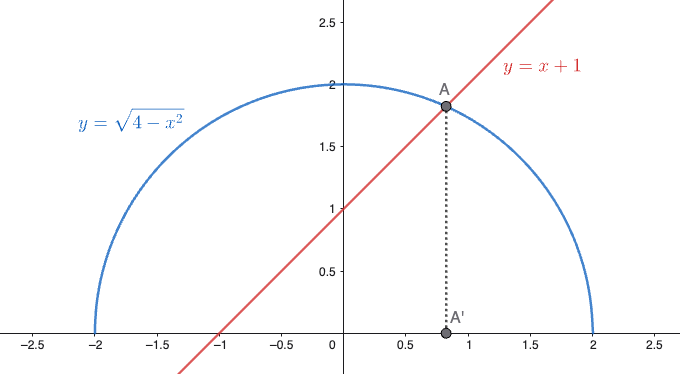
Solve the inequality \(\sqrt{4-x^2} > x + 1\).
The function \(y = \sqrt{4-x^2}\) is the upper semicircle centered at \(O(0,0)\) with radius \(r=2\). The function \(y = x + 1\) is a line with slope 1 and \(y\)-intercept 1.
Plotting both graphs (see figure below), the inequality holds on the intervals where the semicircle lies above the line. The endpoints of the solution interval are found from the intersection of the two graphs.
In this case the intersection point has \(x\)-coordinate equals to
so the inequality is satisfied into the following interval
This graphical technique, along with several worked exercises of increasing difficulty, is covered in full in a dedicated article on solving radical inequalities with semicircles (Graphical Method).
Circle Exercises
The following exercises represent the main problem types involving circles in the coordinate plane.
Exercise on Center and Radius
Find the center and radius of the circle:
\[x^2 + y^2 – 8x + 6y + 16 = 0\]
SOLUTION
Completing the square gives:
\[(x^2 – 8x + 16) + (y^2 + 6y + 9) = -16 + 16 + 9\]
\[(x-4)^2 + (y+3)^2 = 9\]
This gives:
Center \(C(4,-3)\), radius \(r=3\).
Exercise on Tangent Lines
Find the equations of the lines tangent to the circle \(x^2 + y^2 = 25\) from the external point \(P(7,1)\).
SOLUTION
Set up the system with the generic line through \(P\) and set the discriminant equal to zero, or apply the condition \(d = r\). The calculation leads to the two tangent lines:
\[3x + 4y – 25 = 0 \qquad 4x – 3y – 25 = 0\]
Exercise on Circles Through Known Points
Find the equation of the circle through \(A(0,0)\), \(B(4,0)\), \(C(0,6)\).
SOLUTION
Substituting into the general equation \(x^2 + y^2 + Dx + Ey + F = 0\):
\[\begin{cases} F = 0 \\ 16+4D + F = 0 \\ 36+6E+F = 0 \end{cases}\]
which gives \(D = -4\), \(E = -6\), \(F = 0\).
Substituting these values gives the equation:
\[x^2 + y^2-4x-6y = 0\]
with center \(C(2,3)\) and radius \(r = \sqrt{4+9} = \sqrt{13}\).
A full set of solved circle problems covering every case above — center and radius, tangent lines, chords, the radical axis, and more — offers further practice.
Circle Formula Reference
| What do you want to calculate? | Formula |
|---|---|
| Locus equation (center-radius) | \((x-h)^2 + (y-k)^2 = r^2\) |
| General equation | \(x^2 + y^2 + Dx + Ey + F = 0\) |
| Center coordinates (from general form) | \(C\left(-\frac{D}{2},\,-\frac{E}{2}\right)\) |
| Radius (from general form) | \(r =\sqrt{\frac{D^2+E^2}{4} – F}\) |
| Existence condition | \(D^2 + E^2 – 4F > 0\) |
| Tangency condition (line) | \(d = r\) or \(\Delta=0\) |
| Tangent line equation at \((x_P,y_P)\) | \(y-y_P=-\frac{1}{m}(x-x_P)\) |
Frequently Asked Questions About Circles
How can it be determined whether an equation represents a circle?
A quadratic equation represents a circle if the coefficients of \(x^2\) and \(y^2\) are equal to each other and no \(xy\) mixed term appears. After checking these conditions, the value of \(r^2\) obtained by completing the square must also come out positive.
How are the center and radius found from the general equation?
Completing the square is applied separately to the \(x\)-terms and the \(y\)-terms starting from the general form. Alternatively, the formulas \(h = -D/2\), \(k = -E/2\), and \(r^2 = (D^2+E^2)/4 – F\) can be used directly.
When is a line tangent to a circle?
A line is tangent to a circle when the distance from the center to the line equals the radius: \(d = r\). Alternatively, substituting the line’s equation into the circle’s equation produces a quadratic equation whose discriminant is zero.
How is the circle through three points found?
Use the general form \(x^2 + y^2 + Dx + Ey + F = 0\) and substitute the coordinates of the three points one at a time, obtaining a linear system of three equations in the unknowns \(D\), \(E\), and \(F\). Solving the system gives the equation sought.
How is the tangent line to a circle from an external point found?
Write the generic line through the external point and impose the condition \(d = r\), where \(d\) is the distance from the center to the line. The resulting equation gives the slope, from which the equations of the two tangent lines follow. Alternatively, impose the analytic tangency condition \(\Delta=0\).
Cite this resource
"If this explanation saved you some confusion, passing it along costs you nothing and might save someone else the same struggle."
Citation
HTML link to copy